What Program Income Means for AmeriCorps Grants
Program income shows up as a training fee, a host-site payment, a sale of materials. Classifying it is only step one — your FY2026 AmeriCorps award terms, not the federal default, tell you what to do next.
Drafted with AI assistance, checked against primary sources, reviewed and approved by Gary Kosman on August 10, 2026.
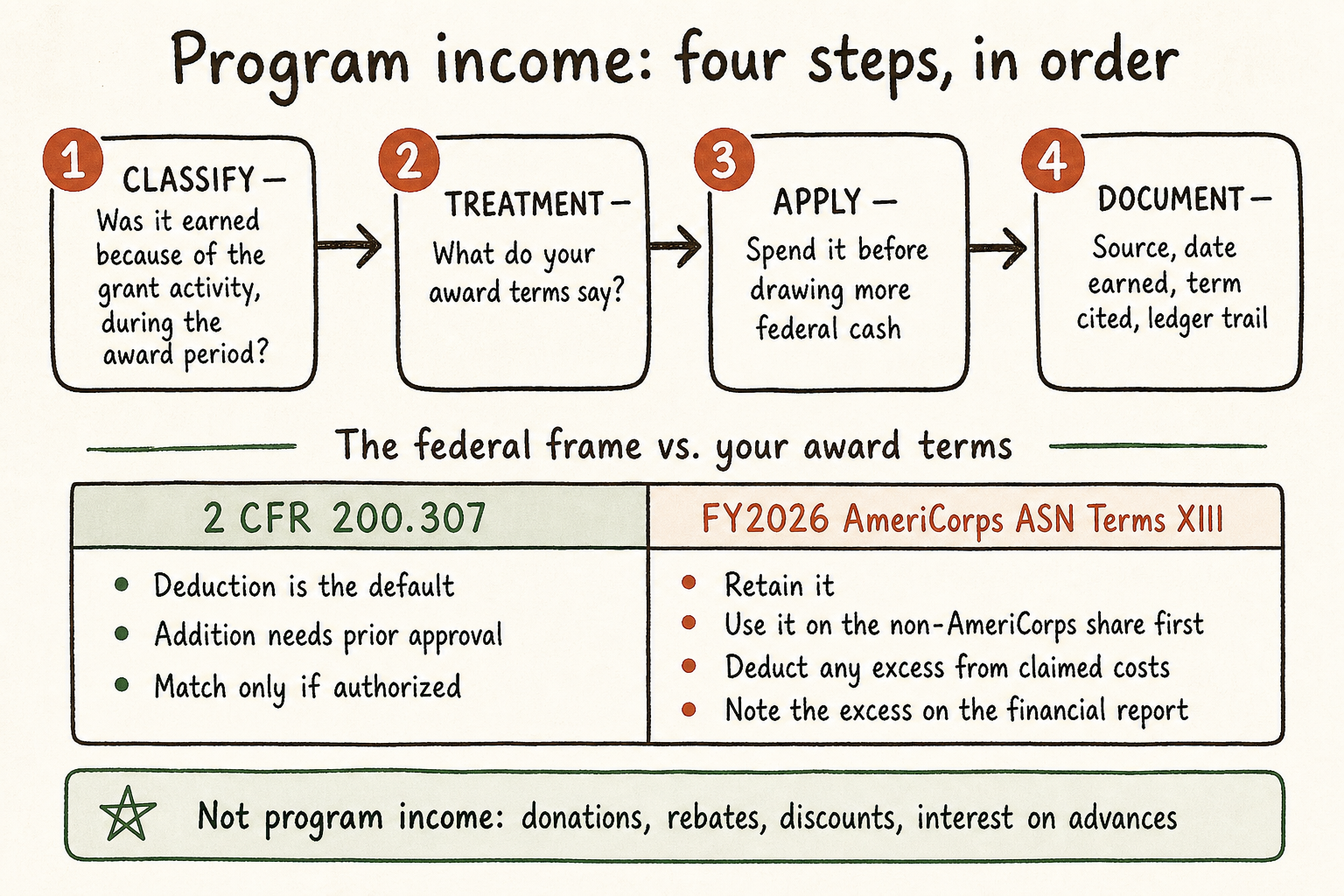
Classification is one question. What you do with the money is another.
Money lands in your account. A school district pays a placement fee. Someone registers for a training your grant-funded staff delivered. A partner reimburses you for materials.
The question in the room is usually "can we keep this?" That's the wrong first question, and it's why these files go sideways.
Work it in this order: classify it, find the authorized treatment, apply it the way that treatment requires, then document the trail. Classifying a receipt as program income tells you nothing on its own about how you may use it. The treatment comes from your award terms.
For AmeriCorps recipients, that distinction matters more than usual, because the AmeriCorps award terms say something more specific than the federal default does.
What program income is
Program income is gross income your organization earns that's directly generated by a supported activity, or earned as a result of the federal award, during the period of performance. That definition lives in 2 CFR § 200.1, and the treatment framework lives in 2 CFR § 200.307.
Three phrases carry the weight: directly generated, earned as a result of the federal award, during the period of performance.
The definition also lists what's out. Rebates, credits, discounts, and interest earned on advances of federal funds aren't program income. Interest on advances is handled in 2 CFR § 200.305, and applicable credits — refunds, rebates, discounts — in 2 CFR § 200.406.
Donations ordinarily aren't program income either. A foundation gift isn't a fee. If you want to count a gift toward your share, that's a separate analysis under the cost-sharing standards in 2 CFR § 200.306.
The test that settles most of it: would this money have been earned in this form, at this time, without the federally supported activity? If no, treat it as a program income question.
What the federal framework says, and what your AmeriCorps terms say
2 CFR § 200.307 describes three treatments and sets the default when nothing else speaks.
| Treatment | What it does | When it applies |
|---|---|---|
| Deduction | Program income is deducted from total allowable costs to determine net allowable costs | The federal default, unless the agency's regulations or the award terms say otherwise |
| Addition | Program income is added to the award, so the funds available for the project grow | Only with prior approval of the federal awarding agency |
| Cost sharing or matching | Program income is applied toward the non-federal share | Only where the agency's regulations or the award terms authorize it |
That's the frame. It isn't your instruction.
Your instruction, if you hold an AmeriCorps State and National award, is Section XIII of the FY2026 AmeriCorps State and National Terms and Conditions. It's short, and it's specific:
- XIII.A. Income, including fees for service earned as a direct result of the award-funded program activities during the award period, must be retained by the recipient and used to finance the award's non-AmeriCorps share.
- XIII.B. Program income earned in excess of the amount needed to finance the recipient share follows 2 CFR part 200 and is deducted from total claimed costs. Recipients that earn excess income must specify the amount of the excess in the comment box on the financial report.
Read that against the table above and you'll see why the federal default alone gives the wrong answer for an AmeriCorps program. AmeriCorps doesn't leave you at plain deduction from dollar one. Your terms direct the income at the non-AmeriCorps share first, and only the excess gets deducted from claimed costs.
Cite § 200.307 for the framework. Cite your award terms for what you have to do.
Two cautions. This is the FY2026 language; the Terms are reissued every award year and were already revised once in FY2026, so if you're operating on a prior-year award, follow the Terms attached to that award. And these are the State and National Terms — commission grants read differently, which is the next section.
Fees you may not accept at all
Before treatment, there's a prohibition worth knowing. Under XIII.C of the FY2026 ASN Terms, a recipient may not enter into a contract for, or accept, fees for service performed by members when the service benefits a for-profit entity, when it falls within the prohibited activities in the award provisions, or when it violates 42 U.S.C. § 12637, the nonduplication and nondisplacement statute.
That's a classification question you answer before you ever get to treatment. If the fee shouldn't have been accepted, no accounting method fixes it.
Host-site and service-site fees
This is the receipt that generates the most email.
Say you place members at ten sites and each site pays $5,000 per member — $50,000 in total. Is that program income, or is it cash match?
Look at what the payment buys.
If the site is paying for a service your program delivers — a defined deliverable, priced, invoiced, and provided because the grant-funded activity exists — that's a fee for service. Under XIII.A of the FY2026 ASN Terms, that $50,000 is retained and used to finance the non-AmeriCorps share of the award.
If the site is making a contribution toward the cost of the program with no service purchased in return, it's a cash contribution, and it's evaluated as match under 2 CFR § 200.306.
Here's the practical relief: on an ASN award, both roads often end at the same column of your budget. Program income is directed at the non-AmeriCorps share, and cash match sits in the non-AmeriCorps share. What changes is the paperwork — how you describe it, where it's reported, and what happens if you earn more than your share requires. Excess program income has a rule; excess cash match doesn't work the same way.
What you may never do is count the same $5,000 twice — once as program income financing your share, again as a separate cash match contribution. Same dollar, one job.
Read the site agreement, not the budget line. The agreement tells you what was purchased.
The timing rule people skip
Classification and treatment aren't the end. There's a sequencing obligation.
Under 2 CFR § 200.305(b)(5), you must disburse funds available from program income, rebates, refunds, contract settlements, audit recoveries, and interest earned on those funds before requesting additional cash payments. Program income sitting in your account while you draw down federal cash is a finding waiting to happen, even when your classification was perfect.
Spend it, then draw.
If you hold a fixed amount award
Fixed amount awards work differently, and FY2026 changed something here.
A fixed amount award pays a specific amount without regard to actual costs incurred (2 CFR § 200.1), and per XVII of the FY2026 ASN Terms, that includes Education Award Program, Professional Corps, and full-cost fixed amount awards. The revised FY2026 Terms removed the requirement for fixed amount recipients to report excess program income to AmeriCorps, citing the authority in 2 CFR § 200.201.
If your program is on a fixed amount award, don't carry over a cost-reimbursement habit here. Check your own award document, and check the change log at the front of your Terms.
Commission grants read differently
If your award is a Commission Support Grant or a Commission Investment Fund grant, don't borrow the ASN language.
Under Section VIII of the FY2026 Commission Support Grant Terms and Conditions, program income is retained and used to finance the grant's non-AmeriCorps share; income earned in excess of the recipient share is deducted from total claimed costs or, with approval from AmeriCorps through a budget amendment, used to enhance the program — the additive process. Unexpended program income is reported on line "O" of the Federal Financial Report.
That's the one place in this family of awards where addition is written into the terms, and it still requires AmeriCorps approval through a budget amendment. It is not a menu choice.
Under Section VIII of the FY2026 Commission Investment Fund Terms and Conditions, the rule is shorter: income is retained by the grantee, deducted from total claimed costs, and noted on the Federal Financial Report. No non-AmeriCorps-share step.
Three award types, three different sentences. That's why "what does AmeriCorps do with program income" doesn't have one answer.
Recipients, subrecipients, and commissions
The Terms bind recipients and flow down to subrecipients and assigned programs. If you're a subrecipient of a state or territory commission, your commission may add reporting instructions or timing requirements on top of the Terms, and those instructions govern your file. If you're a commission monitoring assigned programs, say in writing which treatment applies and where excess gets reported, before the first fee comes in rather than at closeout.
Royalties and license fees
One correction worth flagging, because the older guidance floating around gets it backwards. Under 2 CFR § 200.307, unless the terms and conditions of the federal award provide otherwise, a recipient or subrecipient has no obligation to the federal agency for program income earned from license fees and royalties on copyrighted material, patents, patent applications, trademarks, and inventions.
So royalties on a curriculum you copyrighted aren't automatically money you owe back. Check your award terms, because they can change that.
Four examples
A training registration fee. Grant-funded staff deliver a workshop during the award period; outside participants pay to attend. Fee for service, directly generated by the supported activity. On an ASN award, XIII.A: retain it, apply it to the non-AmeriCorps share. If it exceeds your required share, deduct the excess from claimed costs and note the amount in the comment box on the financial report.
A host site paying $5,000 per member for a defined service. Same path. Program income under XIII.A, financing your non-AmeriCorps share. Not also claimed as a separate cash match contribution.
A donor's gift after the workshop. Not program income under 2 CFR § 200.1. If you want it as match, test it against 2 CFR § 200.306 instead.
A fee offered by a for-profit company for member service. Stop at classification. XIII.C of the FY2026 ASN Terms says you may not accept it.
What the file has to show
Records under 2 CFR § 200.334 are generally kept three years from submission of the final financial report, with exceptions that extend it. For each receipt, a file that holds up shows four things:
| Question | What the file shows |
|---|---|
| Is it program income? | A short note tying the revenue to the supported activity and the award period, or explaining why it isn't |
| What treatment is authorized? | The specific award term — cite the section and the award year, not "the regulations" |
| How was it applied? | Evidence it financed the non-AmeriCorps share, or was deducted from claimed costs, and that it was spent before the next drawdown |
| How was it reported? | The financial report entry, including the excess amount in the comment box where that applies |
Verify every determination against the current eCFR text for 2 CFR part 200 and against the Terms and Conditions attached to your own award. The Terms change between award years, and sometimes within one.
Write the question down while it's small. That's the whole trick.
A quick reminder
AmeriCorps grants can vary from one to the next. If you’re unsure how a rule applies to your program, check with your commission or designated point of contact at the AmeriCorps agency for any additional guidance and clarifications. They know your award terms best.
Questions people ask
- Does program income count as match on an AmeriCorps grant?
Not as a separate match contribution, but on an AmeriCorps State and National award it does work on that side of the budget. Section XIII.A of the FY2026 ASN Terms and Conditions requires you to retain program income and use it to finance the award’s non-AmeriCorps share. What you may not do is count the same dollars twice — once as program income financing your share, again as a cash contribution tested under 2 CFR § 200.306.
- Are host-site or placement fees program income or cash match?
Look at what the site bought. If the payment purchases a defined service your grant-funded program delivers, it’s a fee for service and program income under Section XIII.A of the FY2026 ASN Terms. If the site is contributing toward program costs with nothing purchased in return, it’s a cash contribution evaluated as match under 2 CFR § 200.306. The site agreement decides it, not the budget line.
- What happens if we earn more program income than our non-AmeriCorps share requires?
Section XIII.B of the FY2026 ASN Terms says program income earned in excess of the amount needed to finance the recipient share follows 2 CFR part 200 and is deducted from total claimed costs, and that recipients earning excess income must specify the excess amount in the comment box on the financial report. Fixed amount recipients: the revised FY2026 Terms removed that reporting requirement, citing 2 CFR § 200.201.
- Can we ever add program income on top of our AmeriCorps award instead of deducting it?
Under 2 CFR § 200.307, the addition method requires prior approval from the federal awarding agency. The FY2026 State and National Terms don’t provide it. The FY2026 Commission Support Grant Terms, Section VIII.B, do allow excess program income to enhance the program through the additive process — but only with approval from AmeriCorps through a budget amendment. Never assume it; hold the written approval.
- Our grant comes through a state commission. Whose instructions do we follow?
Start with the Terms and Conditions attached to your own award for the award year you’re operating under, then follow any written instruction your commission or pass-through entity adds on top — commissions can add reporting and timing requirements, and those govern your file. If your commission’s instruction appears to conflict with your award terms, ask them in writing and keep the answer in the file. Don’t reconcile it yourself.
- What if my grant comes through a state or territory service commission?
- Check your commission’s current requirements too. They may be stricter than the federal floor, and stricter is what you follow. What a commission can’t do is override controlling federal law, regulation, or your AmeriCorps award terms, and it can grant only the waivers it’s authorized to grant. Read this post alongside your commission’s guidance, your award terms, and your written policies — and when something looks like a real conflict, ask your commission or program officer rather than guessing.
About the author
Gary Kosman is the founder and CEO of America Learns. He has worked with AmeriCorps programs and state service commissions for more than two decades, helping organizations strengthen the systems they use to manage members, grants, reporting, compliance, and impact. Reach him at gary@americalearns.net or 310-689-0542 x101.
Last reviewed August 10, 2026. Regulations change. Verify every citation against the current eCFR text and your own grant terms and conditions before you rely on it.
Looking for another topic?
Browse all compliance topics — from timesheets and member files to financial and progress reporting.
Browse topicsKeep reading on financial reporting and related topics
Financial Reporting/August 6, 2026
Fraud Risk Climbs at the End of a Grant
When a grant is ending, people are often tired + moving fast as they race to get the next program year off the ground. That's exactly when weak approvals, missing records, and rushed final reports can turn into findings.
Financial Reporting/August 6, 2026
The Four Tests Every AmeriCorps Cost Must Pass
Most questioned costs don't start with fraud. They start with hurry, assumptions, and a missing piece of paper. A practical review starts with four questions: is the cost necessary, reasonable, allocable, and documented well enough to prove it. Then you confirm the rest of the allowability rules and your award terms.
Financial Reporting/August 6, 2026
Match Documentation That Holds Up in an Audit
Match problems usually start months before review. The fix is a repeatable routine: confirm the award allows the contribution to count, document value with support that stands on its own, and reconcile reported match before it becomes a questioned cost.
OIG Findings/September 4, 2026
How Commissions Can Catch Timesheet and Term Errors Early
When education awards are tied to weak time records or unsupported service-term changes, the cost lands late and hard. A commission can catch most of it before exit with a tighter review sequence.
Performance Measurement/September 2, 2026
Your Data-Collection System Is Part of Your Audit Trail
Surveys, logs, and tests can become Federal award records. Federal rules do not require you to keep every draft or form configuration — they require retention of the records and supporting documentation that substantiate what you reported. ([2 CFR § 200.334](https://www.ecfr.gov/current/title-2/section-200.334))