What to Reconcile Before AmeriCorps Grant Closeout
Closeout is where old mistakes stop hiding. Before the final package leaves your desk, make sure your cash, reports, and supporting records tell the same story.
Drafted with AI assistance, checked against primary sources, reviewed and approved by Gary Kosman on August 10, 2026.
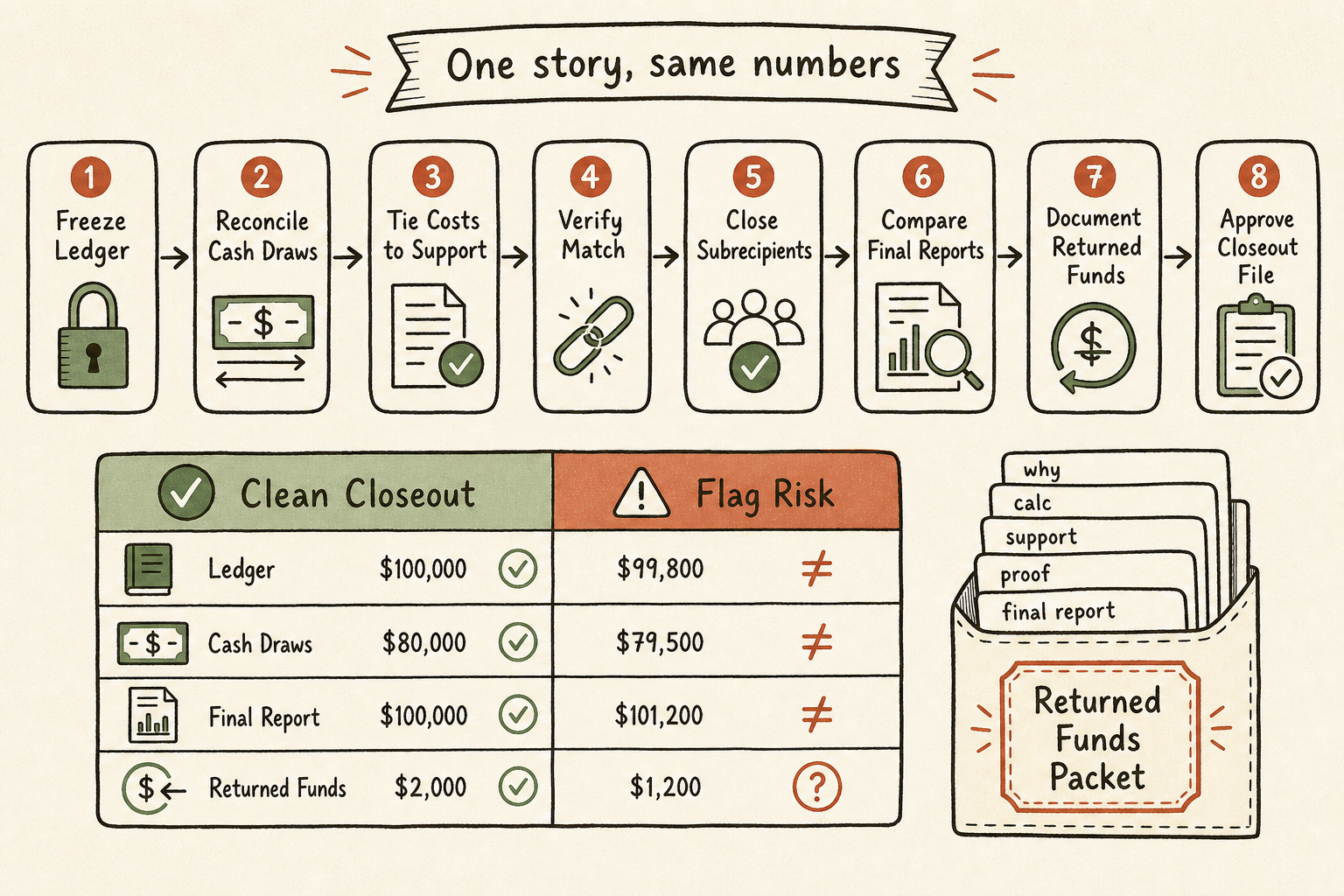
Closeout isn't a form. It's proof.
You know the feeling.
The grant is ending. Everyone wants it off the books. Program staff are moving on. Finance is trying to clean up months of loose ends fast.
That's when the dread shows up.
A missing reconciliation can feel personal. An unreconciled draw can feel like you failed at the one thing nobody else in the building understands. That feeling makes people hide records, postpone questions, and hope the final report goes through untouched.
Hope isn't a closeout control.
Under 2 CFR § 200.344, a recipient must submit all reports required by the award — financial, performance, and anything else — no later than 120 calendar days after the period of performance ends. A subrecipient has 90 calendar days after the end of its subaward's period of performance, or an earlier date if the pass-through entity and subrecipient agreed to one. Extensions are possible when justified. The same section gives you the same clocks for liquidating financial obligations. On the agency's side, § 200.344(h) says the Federal agency must make every effort to complete all closeout actions no later than one year after the end of the period of performance — not one year after your reports arrive. So a late report doesn't buy anyone extra room; it just compresses everyone else's.
That's the federal frame.
Your AmeriCorps award may add more. Requirements can differ by program, grant year, and funding path. A direct recipient should check its own award terms and current AmeriCorps guidance. A subrecipient should also check the pass-through entity's instructions. Start with AmeriCorps grantee and sponsor resources, then your actual award file.
Common practice adds the internal reconciliations that make the final package defensible.
Verify all of this against the current eCFR text and your own award terms and conditions before you rely on any checklist, including this one.
What you want ready before final closeout
The goal isn't more paper.
The goal is one story.
Before you submit closeout materials, assemble and review these records in order.
| Step | What to have ready | What it should reconcile to |
|---|---|---|
| 1 | Final general ledger for the grant | Approved budget, internal cost categories, and final financial report data |
| 2 | Drawdown and cash activity record | General ledger cash accounts and any amount due back |
| 3 | Final expenditure support | Ledger totals, budget categories, and reported federal share |
| 4 | Final match support, if required | Match reported to AmeriCorps and source documentation |
| 5 | Subrecipient closeout support, if applicable | Subaward reports, invoices, monitoring follow-up, and your consolidated totals |
| 6 | Final program and performance reports | Financial records where the same facts affect both reports |
| 7 | Returned-funds documentation, if applicable | Cash reconciliation, correspondence, payment record, and final report treatment |
| 8 | Record of review and approval | Evidence that finance and program reviewed before submission |
That order matters.
If you start with the portal form, you'll spend the afternoon chasing numbers. If you start with the ledger, the report becomes the last step.
Step 1: Freeze the final ledger
Save the final general ledger detail for the full period of performance.
Not a summary alone.
You need transaction-level detail. Include adjusting entries posted after the period of performance if they affect reported grant costs. Mark which entries are regular activity and which are cleanup adjustments.
Then do three checks.
First, confirm the grant period used for your review. Costs necessary to close out a Federal award may be allowable under 2 CFR § 200.403, provided they meet the applicable cost principles and award terms and conditions. For costs incurred after the period of performance, review the current eCFR text for that section carefully along with your award terms before including them in closeout.
Second, confirm the chart-of-accounts mapping. Each ledger category should map to the same budget line structure you use in reporting. If your internal accounts are more detailed than the report format, build a crosswalk.
Third, confirm the ending expense total. That total is the anchor for everything else.
If the ledger is still moving, closeout isn't ready.
Step 2: Reconcile cash before you think about returned funds
This is where many closeout problems start.
Returned funds aren't a problem because returning money is bad. They become a problem when nobody can explain, from source records, why the return happened and how the amount was calculated.
Build a cash reconciliation that shows:
- total federal funds drawn
- total allowable federal expenditures recorded
- any cash balance that remained and how it was resolved
- any amount due back
- the date and method of return, if funds were returned
Keep the support behind each line.
That means drawdown records, bank or payment confirmation if money was returned, and the internal worksheet showing the calculation.
You want a reviewer to answer four questions fast:
- Why was money returned?
- How was the amount calculated?
- When was it returned?
- How does that return tie to the final reported expenditures?
If those answers live only in someone's memory, they don't exist for closeout.
Step 3: Tie every final expenditure total to support
This is the least glamorous part.
It's also the part that saves rework.
For each cost category reported at closeout, maintain a reconciliation from:
- final reported amount
- to ledger total
- to transaction detail
- to supporting documentation
Supporting documentation varies by cost type.
For payroll, retain payroll records and records supporting the allocation of salary charges. Under 2 CFR § 200.430, charges for salaries and wages must be supported by records that accurately reflect the work performed, are supported by the entity's internal controls, and encompass both federally assisted and all other activities compensated by the recipient or subrecipient.
For fringe, retain the basis for the rate or the actual-cost calculation.
For travel, retain the expense support and approval trail.
For supplies, contractual, and other direct costs, retain invoices, approvals, and documentation showing the cost benefited the award.
For indirect costs, retain the applicable negotiated indirect cost rate agreement or award-approved rate. An entity that doesn't have a current negotiated indirect cost rate may elect the 15 percent de minimis rate on modified total direct costs if eligible under 2 CFR § 200.414 and not restricted by applicable award terms.
This is also the moment to pull out anything unusual.
Late adjustments. Reclasses. Credits. Refunds. Voids. Cost transfers.
Don't bury them.
List them on a one-page memo in the file. State what changed, why it changed, who approved it, and where it appears in the ledger. That isn't a regulatory format requirement. It's a strong internal control.
Step 4: Treat match as its own closeout file
If your award required match, don't let match ride in the passenger seat.
Match gets questioned when it's reported like a total but documented like a rumor.
Create a separate match reconciliation that shows each source, amount, valuation method for in-kind support if applicable, period incurred, and source document location. Then tie the total to the final amount reported.
If any match was reduced, replaced, or reclassified during the grant, explain that history in writing.
Match rules aren't one-size-fits-all across AmeriCorps awards. They can depend on program regulations, award terms, approved budget treatment, and whether the funds came directly from AmeriCorps or through a pass-through entity. Check your own documents.
Step 5: Close subrecipients early enough to meet your own deadline
If you pass funds through to subrecipients, get the information you need to support your own final reporting before your closeout clock runs out.
Obtain final financial information from each subrecipient.
Review it.
Resolve open questions.
Document any monitoring follow-up that affects final costs.
Then roll the supported amounts into your own totals.
Under 2 CFR § 200.332, pass-through entities have specified responsibilities for making and monitoring subawards, including risk-based monitoring and follow-up as appropriate. Collecting subrecipient closeout information helps support your own final reporting, but it doesn't replace those responsibilities.
If a subrecipient still has unresolved issues, document the status and how you treated those costs in your final numbers.
Step 6: Make the program report and the finance report agree where they touch
Not every narrative difference is a finance problem.
Some are.
Where your award's final performance and financial reports contain related measures, compare the underlying records for consistency. Depending on the program and award terms, those measures may include member enrollment or service information, approved slots, living-allowance-related activity, or other program data with financial implications.
You're looking for contradictions.
A mismatch doesn't automatically mean noncompliance. It does mean you should understand the reason before you file the final package.
Final closeout works when every system starts from the same numbers.
Step 7: Build a returned-funds packet
If any amount is being returned, create a packet with five items in this order:
- A one-page explanation of why funds are being returned.
- The calculation worksheet showing how the amount was determined.
- The source support for the underlying overdraw, credit, adjustment, or other reason for the return.
- Proof of remittance or payment.
- The final report pages or saved screens showing how the final expenditure total reflects the return.
This packet isn't named in 2 CFR § 200.344.
It's a practical file standard.
When staff turnover happens later, this packet is often the difference between a quick answer and a week of reconstruction.
Step 8: Document when the grant became closeout-ready
Timeliness is a control.
Make one internal milestone: the date the file became closeout-ready.
That means reconciliations were completed, final reports were drafted, approvals were obtained, and known cash issues were resolved or clearly documented.
Keep evidence of that milestone.
An email approval chain works.
A signed checklist works.
A dated closeout memo works.
This isn't a federal formatting rule.
It's evidence that your organization finished its internal closeout work in time to meet the actual reporting deadline.
A practical file index
When someone asks a closeout question a year later, you shouldn't need a treasure hunt.
Set up the file in this order:
- Final closeout checklist
- Award document and amendments
- Final general ledger and budget crosswalk
- Cash reconciliation
- Final financial report copy
- Match reconciliation and support, if applicable
- Returned-funds packet, if applicable
- Subrecipient closeout summary, if applicable
- Final performance report copy
- Review approvals and correspondence
This isn't a federal form requirement.
It's common practice.
And it lowers the temperature when questions come in later.
One more thing closeout includes
This checklist is about reconciliation.
It isn't the whole universe of closeout.
Depending on your award, closeout may also involve final financial adjustments, property matters, subaward issues, and other award-specific conditions under 2 CFR § 200.344. Record retention is its own requirement under 2 CFR § 200.334.
Check the current eCFR text. Then check your award terms again.
You don't need perfect conditions.
You need a file that tells the truth the same way every time it's opened.
That's closeout.
Not the end of the grant.
The final proof that your records can stand in the room without you.
A quick reminder
AmeriCorps grants can vary from one to the next. If you’re unsure how a rule applies to your program, check with your commission or designated point of contact at the AmeriCorps agency for any additional guidance and clarifications. They know your award terms best.
Questions people ask
- What's a core reconciliation to complete before AmeriCorps grant closeout?
A core closeout reconciliation ties federal cash drawn to allowable federal expenditures recorded in the general ledger and shows any cash balance or amount due back. It should also show how any returned funds were calculated and where they appear in the final reported expenditures. Depending on your award, you may also need separate reconciliations for match, subawards, property, or other award-specific items. The closeout framework is in 2 CFR § 200.344, but the exact reports and support required come from your award terms and conditions.
- What documentation should we keep if we return AmeriCorps funds during closeout or identify funds due after closeout?
Keep a complete internal packet: a written explanation of why funds were returned or became due, the calculation worksheet, source records supporting the adjustment, proof of remittance or payment, and a copy or saved screen showing how the final reported expenditures reflect the return when applicable. Follow the Federal agency's or pass-through entity's written instructions for remittance and any required post-closeout adjustment. The packet is good internal documentation. It isn't a substitute for those instructions.
- Does 2 CFR 200.344 tell recipients exactly how to organize closeout files?
No. 2 CFR § 200.344 establishes the general closeout framework and timing. It requires recipients to submit all reports required by the award within 120 calendar days after the period of performance ends, and subrecipients to submit theirs to the pass-through entity within 90 calendar days (or an earlier agreed date), unless extended. It doesn't prescribe a single recipient file order or worksheet format.
- Why should finance staff compare the final performance report to the final financial report?
Because some facts appear in both worlds. Where your award's final performance and financial reports contain related measures, compare the underlying records for consistency before submission. Depending on the program and award terms, that may include member enrollment or service information, approved slots, living-allowance-related activity, or other program data with financial implications. A mismatch doesn't automatically prove a problem, but it tells you where to ask questions before closeout.
- How can we show that our grant was ready for timely closeout?
Create a dated internal record showing when the grant became closeout-ready. That record should show that reconciliations were completed, final reports were drafted, approvals were obtained, and known cash issues were resolved or documented. A signed checklist, dated memo, or approval email chain can all work if they're retained in the closeout file. This is a practical control, not a format required by 2 CFR § 200.344.
- What if my grant comes through a state or territory service commission?
- Check your commission’s current requirements too. They may be stricter than the federal floor, and stricter is what you follow. What a commission can’t do is override controlling federal law, regulation, or your AmeriCorps award terms, and it can grant only the waivers it’s authorized to grant. Read this post alongside your commission’s guidance, your award terms, and your written policies — and when something looks like a real conflict, ask your commission or program officer rather than guessing.
About the author
Gary Kosman is the founder and CEO of America Learns. He has worked with AmeriCorps programs and state service commissions for more than two decades, helping organizations strengthen the systems they use to manage members, grants, reporting, compliance, and impact. Reach him at gary@americalearns.net or 310-689-0542 x101.
Last reviewed August 10, 2026. Regulations change. Verify every citation against the current eCFR text and your own grant terms and conditions before you rely on it.
Looking for another topic?
Browse all compliance topics — from timesheets and member files to financial and progress reporting.
Browse topicsKeep reading on oig findings and related topics
OIG Findings/September 4, 2026
How Commissions Can Catch Timesheet and Term Errors Early
When education awards are tied to weak time records or unsupported service-term changes, the cost lands late and hard. A commission can catch most of it before exit with a tighter review sequence.
OIG Findings/August 6, 2026
Internal Controls That Save a Two-Person Program
When your office is tiny, internal controls can sound like a luxury meant for bigger shops. They aren't. They're the repeatable habits that catch mistakes early, document review, and protect your AmeriCorps grant later.
OIG Findings/July 31, 2026
The AmeriCorps OIG Findings That Keep Coming Back
Published AmeriCorps OIG reports often point to the same kinds of compliance breakdowns. Here's where the patterns tend to show up, why good organizations still get caught there, and the control that helps.
Performance Measurement/September 2, 2026
Your Data-Collection System Is Part of Your Audit Trail
Surveys, logs, and tests can become Federal award records. Federal rules do not require you to keep every draft or form configuration — they require retention of the records and supporting documentation that substantiate what you reported. ([2 CFR § 200.334](https://www.ecfr.gov/current/title-2/section-200.334))
2 CFR 200 Basics/August 18, 2026
When Staff Duties and Timesheets Don’t Match
Salary costs get vulnerable when payroll support, payroll charges, and the role described in your award materials stop lining up. The fix starts with a clean match between supported work, the amount charged, and the staffing picture your award says you funded.