Fraud Risk Climbs at the End of a Grant
When a grant is ending, people are often tired + moving fast as they race to get the next program year off the ground. That's exactly when weak approvals, missing records, and rushed final reports can turn into findings.
Drafted with AI assistance, checked against primary sources, reviewed and approved by Gary Kosman on August 9, 2026.
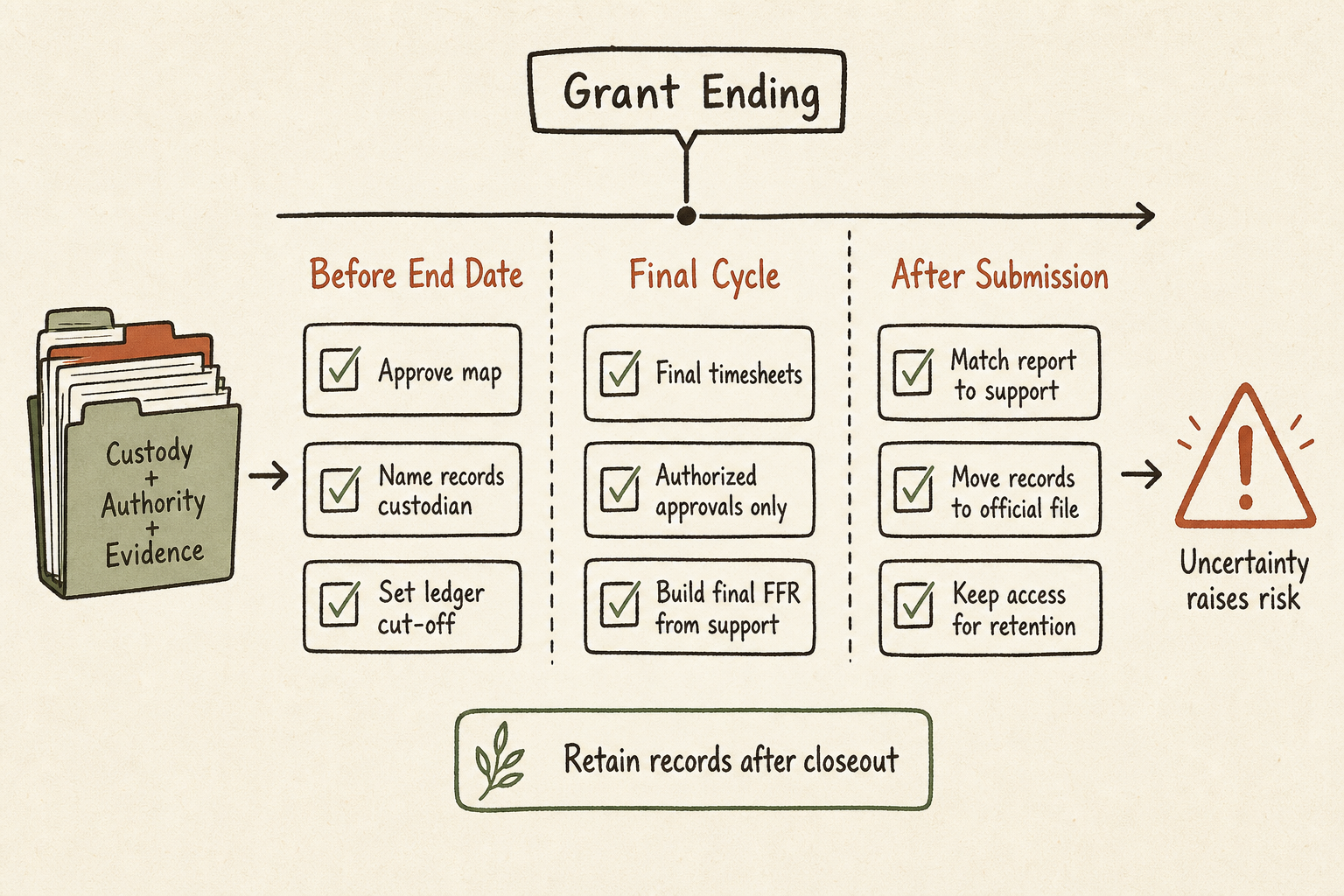
You can feel the strain before you can footnote it.
People are worried. Roles change. Access changes. The person who knows where the records live may be halfway out the door.
That isn't only an operations problem.
It's a risk condition.
Periods of organizational uncertainty can create control risk when authority, access, and record custody are changing.
That matters during closeout.
Not because every closeout turns into misconduct.
Because changing staff, shifting authority, and scattered records create openings for errors, unsupported charges, and approvals nobody can explain later.
And yes, closeout can bring a lot of second-guessing into the room.
Files are messy. Timesheets are late. The approval happened in email, or in a hallway, or with a supervisor who has already left. That pressure makes people hide. It makes people delay. It makes smart people hope nobody asks one more question.
You don't need to hide.
You need a process that holds up when everyone is tired.
Build it around authority, evidence, and custody.
When a grant is ending, tighten controls before you speed up.
What changes when the grant is ending
Most controls are built for a normal operating cycle.
Closeout isn't normal.
Financial reporting still has to be accurate under 2 CFR § 200.328. Closeout still has to be completed under 2 CFR § 200.344. Records still have to be retained under 2 CFR § 200.334.
But the people, systems, and timelines around those duties may be changing at the same time.
So your first job in the final weeks is to answer four questions in writing:
- Who is still authorized to approve?
- Where do the official records live now?
- What support exists for payroll, match, and other reported costs?
- Who will hold the file after staff departures?
If those answers are fuzzy, your risk is already up.
The closeout controls that matter most
These are recommended controls.
They are not all spelled out line by line in federal regulation.
They are the practical steps that help you meet the federal baseline and your award terms when the grant is winding down.
1) Freeze the approval map
Start with authority.
Make a dated list of who may approve timesheets, expenditures, journal entries, draw activity, and closeout submissions. Include backups. Include the date each person's authority ends, if known.
Then compare the list to reality.
Has anyone left? Given notice? Lost system access? Moved off the grant?
Update the approval chain before routing final timesheets and any final financial report required by your award.
That's important because the exact final report, certification, submission route, and due date may vary. Common practice is a final Federal Financial Report, often the SF-425, but you should confirm your own AmeriCorps award terms, commission instructions if applicable, and any pass-through requirements.
A short internal memo usually does the job.
Date it. Save it. Put it in the closeout file.
2) Lock down the last timesheet cycle
Final timesheets need more attention, not less.
For the last cycle, identify:
- the final service or work period covered
- the deadline for submission
- the deadline for review
- who steps in if the regular supervisor is unavailable
- where the approved record will be stored
Then confirm that approvals follow your organization's documented delegation and timekeeping procedures.
That's the key point.
Not whether everyone "knows" who can sign.
Whether the substitute authority is documented and retained with the record.
This is where terms can vary. Employee payroll documentation and AmeriCorps member service documentation aren't always governed by the same internal process. Your award terms and program guidance may add expectations, so check those before you make a cleanup decision on the fly.
If a record is late or incomplete, don't rebuild it from memory alone. Follow your written correction process. Keep the explanation with the record.
You're not performing perfection.
You're building a file another person can follow.
3) Set a final ledger cut-off
Your final financial reporting process needs one declared cut-off point.
Name the date through which costs will be reviewed for inclusion. State who may post entries after that date, and for what purpose.
Write down:
- the reporting period covered
- the deadline for late source documentation
- who reviews late entries
- who approves adjusting entries
- when the ledger is treated as final for reporting
This is a control practice.
It helps prevent last-minute entries from drifting into the final numbers without clear review.
If your finance office already has a month-end or year-end close procedure, adapt it for grant closeout rather than inventing a new system.
4) Build the final report from support, not memory
This is also a control practice.
Federal financial reporting is required by 2 CFR § 200.328. Closeout is governed by 2 CFR § 200.344. Your award terms tell you what final report is due, where it goes, and when.
Under 2 CFR § 200.344, final reports required by the terms and conditions of the Federal award are due on the timeline set by that section, unless the Federal awarding agency or pass-through entity authorizes an extension. The exact deadline can differ depending on whether you're the recipient or a subrecipient, so check the current regulation text and your award documents before you calendar the due date.
So when you prepare the final financial report required by the award, tie the reported amounts to the final ledger and the source support you will retain.
If you use an internal reconciliation, keep the final reconciliation with the closeout file.
You may know the number is right.
But if the support sits in five inboxes, two desktops, and one former employee's folder, the number won't carry much weight later.
5) Name the records custodian before people leave
This step can be missed during rapid transitions.
Choose one role, by name, to serve as post-closeout custodian of records. Then make a location list showing where the official records will reside after closeout.
Include at least these categories:
| Record category | Official location | Custodian | Notes |
|---|---|---|---|
| Approved timesheets or service records | |||
| Payroll support and allocation records | |||
| General ledger and adjusting entry support | |||
| Final financial report support | |||
| Match support, if applicable | |||
| Delegations and approval memos | |||
| Closeout correspondence |
You're creating a trail for your future self.
And for the person who inherits the file after you've moved on.
What the rules require, and what practice adds
The federal baseline matters.
Under 2 CFR § 200.334, financial records, supporting documents, statistical records, and other non-Federal entity records generally must be retained for three years from the date of submission of the final financial report, unless an exception in that section or another applicable requirement changes the period.
That is the rule.
The operational piece is what practice adds.
Before drives are cleaned up, paper files are boxed, or access is shut off, make sure retained records stay identifiable, accessible, and under the organization's control.
A staffing change doesn't erase the organization's retention duty.
And 2 CFR § 200.344 matters too. It establishes the closeout process and the reporting obligations that continue through closeout. Aligning reports, supporting records, and responsibility for follow-up is a recommended closeout control.
Your AmeriCorps terms and conditions may add more. So might a state commission or other pass-through entity. That's especially true for final report format, deadlines, certification language, and supporting documentation.
Verify all of it against your current award and the current eCFR text for 2 CFR part 200.
A practical checklist for the final weeks
Use this in order.
Two to four weeks before the end
- Create the dated approval map for timesheets, expenditures, journal entries, and final reports.
- Confirm who has access now and who will lose access before closeout is complete.
- Name the records custodian for the retained file.
- Create the record location list for official grant records.
- Set the ledger cut-off and the deadline for late documentation.
- Confirm what final financial report the award requires and when it is due.
During the final timesheet and reporting cycle
- Notify staff and supervisors of the final submission and approval dates.
- Route records only through currently documented authority.
- Review late items and corrections one by one, and keep explanations with the file.
- Prepare the final financial report from the ledger and underlying support.
- Save the reconciliation and approval evidence in the closeout file.
Immediately after submission
- Confirm the submitted report matches the retained support.
- Move records to the official retained location.
- Save approval emails or memoranda that explain substitutions in authority.
- Check that the records custodian can still access the file.
- Document who will answer follow-up questions after staff departures.
What to say when records are messy
Say the true thing early.
If records are incomplete, scattered, or dependent on a departing employee, naming that risk now is stronger than pretending the file is clean.
A messy file isn't a moral failure.
It's a control problem.
Control problems can be documented, escalated, and corrected.
If you have to reconstruct an approval chain or gather support from multiple locations, keep a short memo in the file that says:
- what was missing
- what was obtained
- what could not be confirmed
- who reviewed the reconstructed file
- where the final record now lives
That memo doesn't erase the weakness.
It does show that the organization faced the issue directly.
If you're the only one holding the file together
You may be the person everyone turns to at the end.
You know which supervisor left. You know which number still needs support. You know where the approvals are buried.
That knowledge matters.
It is also a risk if it lives only in your head.
Before closeout is done, move what you know into the file.
Name the approvers.
Name the custodian.
Name the record location.
Name the cut-off.
Then keep the support where the organization can still produce it later.
That's what steadiness looks like at the end of a grant.
A quick reminder
AmeriCorps grants can vary from one to the next. If you’re unsure how a rule applies to your program, check with your commission or designated point of contact at the AmeriCorps agency for any additional guidance and clarifications. They know your award terms best.
Questions people ask
- Why does risk increase when a grant is ending?
Because closeout often compresses review at the same moment authority, staffing, access, and record custody are changing. That combination can create more opportunity for unsupported costs, weak approvals, or records that can't be produced later. The federal rules still apply during that period, including financial reporting under 2 CFR § 200.328, closeout under 2 CFR § 200.344, and record retention under 2 CFR § 200.334.
- What should I check first during a grant wind-down?
Check authority first. Make a dated list of who may approve timesheets, expenditures, journal entries, and final reports, including backup approvers and any planned end dates for that authority. This approval map is a practical first step because every later closeout task depends on knowing who can still act for the organization.
- What does record retention require after the grant ends?
Under 2 CFR § 200.334, financial records, supporting documents, statistical records, and other non-Federal entity records generally must be retained for three years from the date of submission of the final financial report, unless an exception in that section or another applicable requirement sets a different period. You should verify the current text in the eCFR for 2 CFR part 200 and then check your award terms for any added requirements.
- Can a final timesheet be approved by someone filling in for a departed supervisor?
It may be acceptable if the substitute approver is authorized under your organization's documented delegation and timekeeping procedures and the approval also complies with any applicable award requirements. Confirm the rule that applies to the specific record you are reviewing, because employee payroll documentation and AmeriCorps member service documentation may be handled differently. Retain the delegation, substitute-approval memo, or other explanation with the record.
- What if our closeout records are messy or spread across multiple places?
Treat that as a control issue and document it early. Identify what is missing, gather what you can, note what could not be confirmed, document who reviewed the reconstructed file, and move the final support into one official retained location with a named custodian. That approach is stronger than relying on memory or leaving records scattered across inboxes, desktops, and former staff folders.
- What if my grant comes through a state or territory service commission?
- Check your commission’s current requirements too. They may be stricter than the federal floor, and stricter is what you follow. What a commission can’t do is override controlling federal law, regulation, or your AmeriCorps award terms, and it can grant only the waivers it’s authorized to grant. Read this post alongside your commission’s guidance, your award terms, and your written policies — and when something looks like a real conflict, ask your commission or program officer rather than guessing.
About the author
Gary Kosman is the founder and CEO of America Learns. He has worked with AmeriCorps programs and state service commissions for more than two decades, helping organizations strengthen the systems they use to manage members, grants, reporting, compliance, and impact. Reach him at gary@americalearns.net or 310-689-0542 x101.
Last reviewed August 9, 2026. Regulations change. Verify every citation against the current eCFR text and your own grant terms and conditions before you rely on it.
Looking for another topic?
Browse all compliance topics — from timesheets and member files to financial and progress reporting.
Browse topicsKeep reading on financial reporting and related topics
Financial Reporting/August 6, 2026
The Four Tests Every AmeriCorps Cost Must Pass
Most questioned costs don't start with fraud. They start with hurry, assumptions, and a missing piece of paper. A practical review starts with four questions: is the cost necessary, reasonable, allocable, and documented well enough to prove it. Then you confirm the rest of the allowability rules and your award terms.
Financial Reporting/August 6, 2026
Match Documentation That Holds Up in an Audit
Match problems usually start months before review. The fix is a repeatable routine: confirm the award allows the contribution to count, document value with support that stands on its own, and reconcile reported match before it becomes a questioned cost.
Financial Reporting/August 5, 2026
What Program Income Means for AmeriCorps Grants
Program income shows up as a training fee, a host-site payment, a sale of materials. Classifying it is only step one — your FY2026 AmeriCorps award terms, not the federal default, tell you what to do next.
OIG Findings/September 4, 2026
How Commissions Can Catch Timesheet and Term Errors Early
When education awards are tied to weak time records or unsupported service-term changes, the cost lands late and hard. A commission can catch most of it before exit with a tighter review sequence.
Performance Measurement/September 2, 2026
Your Data-Collection System Is Part of Your Audit Trail
Surveys, logs, and tests can become Federal award records. Federal rules do not require you to keep every draft or form configuration — they require retention of the records and supporting documentation that substantiate what you reported. ([2 CFR § 200.334](https://www.ecfr.gov/current/title-2/section-200.334))