The Four Tests Every AmeriCorps Cost Must Pass
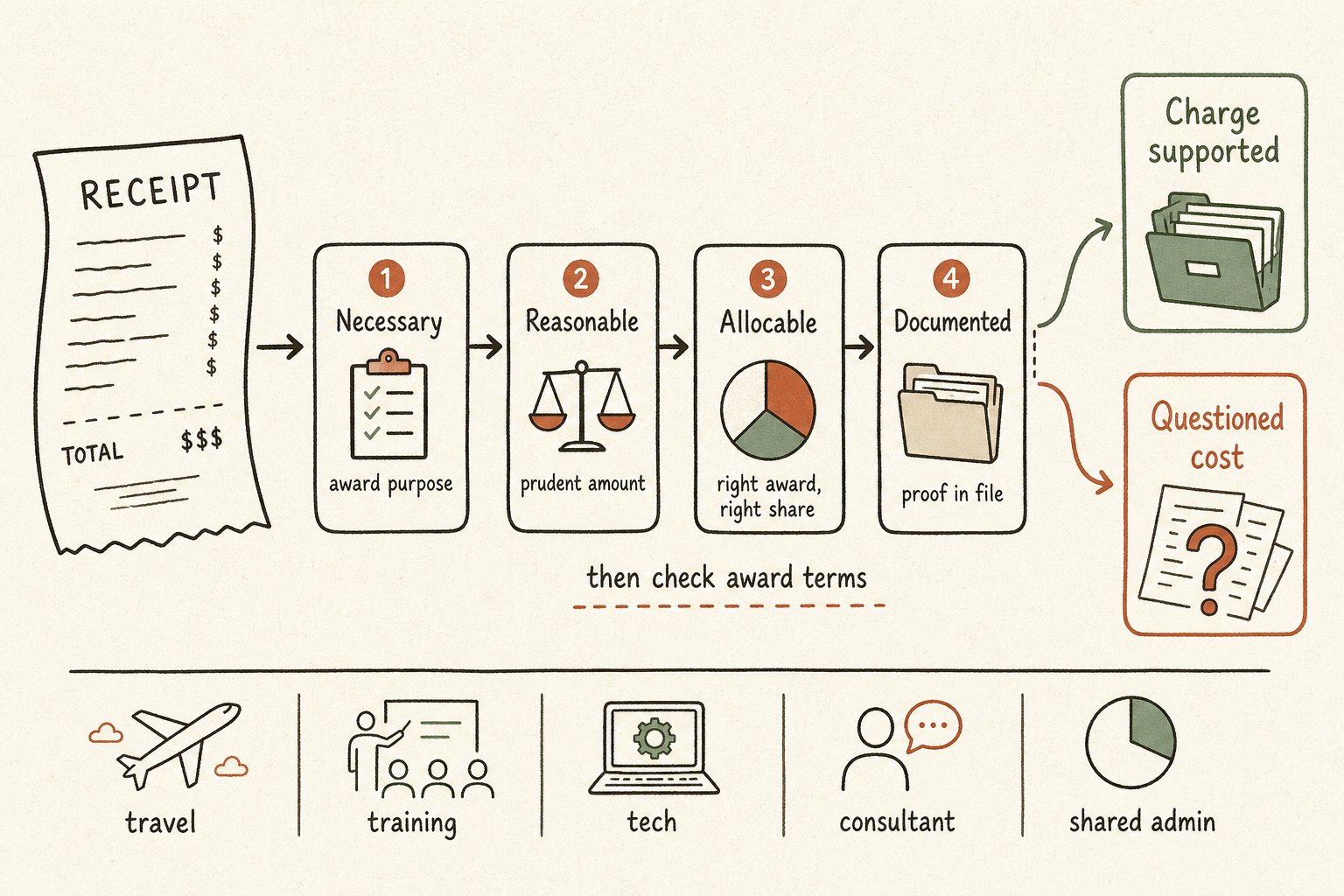
Most questioned costs don't start with fraud. They start with hurry, assumptions, and a missing piece of paper. A practical review starts with four questions: is the cost necessary, reasonable, allocable, and documented well enough to prove it. Then you confirm the rest of the allowability rules and your award terms.
Drafted with AI assistance, checked against primary sources, reviewed and approved by Gary Kosman on August 9, 2026.
Start with the feeling in the room
You know that moment.
A charge looked fine when you approved it. Then someone asks for support six months later, and suddenly the file feels thin. Your stomach drops before you even open the folder.
That's not incompetence.
That's what happens when one person is carrying program operations, finance follow-up, member issues, and reporting at the same time.
It also matters because allowability isn't based on whether a cost feels mission-aligned. Under 2 CFR § 200.403, costs charged to a federal award have to meet specific conditions, including being necessary and reasonable for performance of the award, allocable to the award, consistent with limitations and exclusions, and adequately documented.
That sentence does a lot of work.
If you use it well, it becomes a control.
Not a slogan. A control.
Use four questions as your operating checklist
The regulation is broader than four words.
Your daily review still needs a shape.
A practical checklist is to ask these four questions:
- Is it necessary for this award?
- Is it reasonable in nature and amount?
- Is it allocable to this award?
- Is it documented well enough to prove the answer to the first three?
Then do one more thing.
Confirm the charge also complies with the rest of the allowability rule in 2 CFR § 200.403, any specific cost rules that apply, your AmeriCorps award terms and conditions, and your organization's documented procedures.
That's the distinction that keeps people out of trouble.
This article gives you an operating checklist.
It doesn't replace the full legal standard.
And because the text changes over time, verify your final answer against the current eCFR text for 2 CFR part 200. AmeriCorps-specific restrictions can also vary by program and award.
Necessary comes first
People often skip this one because it feels obvious.
It isn't.
As part of the allowability rule in 2 CFR § 200.403, a cost must be necessary for performance of the federal award.
In practice, ask a cleaner question.
What award-related need did this cost address, at that time?
Not "Was it helpful?"
Not "Did staff want it?"
Not "Can we tell a good story about it now?"
For AmeriCorps programs, this comes up around:
- staff travel
- training events
- outreach materials
- technology purchases
- shared office expenses
- temporary staffing support
- food connected to meetings or events
None of those categories is automatically allowed or disallowed by this article.
Some have their own rules.
Some are affected by award terms.
Some depend heavily on facts.
The file gets stronger when you write down the specific grant purpose when the decision is made.
Documentation that supports necessity
For the necessity question, the file should answer: what problem was this cost solving for this award, at this time?
That usually means:
| Cost type | Documentation that helps support necessity |
|---|---|
| Travel | agenda, invitation or meeting notice, traveler role, dates, approval, and purpose tied to the award |
| Supplies or equipment | purchase request, business purpose statement, who will use it, where it will be used |
| Consultant or temporary help | scope of work, period of performance, and why the work was needed for the award |
| Outreach or recruitment costs | campaign purpose, target audience, and connection to grant activities |
| Shared administrative cost | explanation of how the service or item supported the award |
One sentence is often enough.
But it has to be the right sentence.
"For program use" won't carry much weight.
"Laptop for the staff member responsible for member supervision and grant reporting under this award" gives a reviewer something real to follow.
Then ask whether it was reasonable
Reasonableness is where hindsight gets loud.
You made the best call you could in the moment. Then later, in a quieter room, the same charge can look expensive, rushed, or thinly explained.
Doubt likes that gap.
It tells people to stop looking.
Don't do that.
Reasonable doesn't always mean the lowest price. Under 2 CFR § 200.404, the nature and amount have to reflect what a prudent person would do under the circumstances, considering factors like market prices, ordinary business practice, and responsibility to the public and the federal government.
For the charges programs debate most, reasonableness often turns on:
- the number of units purchased
- the price paid
- the staff level involved
- the timing
A training registration may be necessary and still look unreasonable if the file can't show why that event matched the role.
A rush order may be necessary and still need an explanation for the urgency.
A consultant invoice may reflect real work and still raise questions if the scope is vague and the hours don't connect to deliverables.
Documentation that supports reasonableness
You don't need a novel.
You need evidence that someone exercised judgment.
That can include:
- price quotes, competition records, and cost or price analysis when required by the applicable procurement method, award terms, or your documented procedures
- procurement records showing how the vendor was selected
- an approval note explaining urgency or unusual timing
- agenda, work product, or deliverables showing the level of effort matched the charge
- an invoice detailed enough to evaluate what was provided
For procurement, recipients must use documented procedures that conform to the federal procurement standards in 2 CFR §§ 200.317 through 200.327. Your state, commission, or organization may have more specific steps. Your award may too.
Allocable is where clean-looking files often fail
Allocable sounds technical.
What it asks is direct.
Should this award bear this cost, in this amount?
Under 2 CFR § 200.405, a cost is allocable to a federal award when it is assignable to that award in accordance with the relative benefits received.
That's why a charge can be real, useful, and well supported, but still assigned to the wrong funding source.
The pressure points are familiar:
- one staff member works across several grants
- office costs support multiple activities
- a training benefits more than one program
- a technology tool is used by both grant and non-grant staff
- a supervisor's time crosses cost objectives
Allocability is about proportion and method.
Why this grant?
Why this percentage?
Why this month?
If the answer is "because that's how we've always done it," the control has failed.
Documentation that supports allocability
The file should show both the basis for charging the award and the method used to calculate the amount.
That may include:
| Situation | Documentation that helps support allocability |
|---|---|
| Shared staff time | payroll and personnel-activity records that meet 2 CFR § 200.430(g) and support distribution among cost objectives; award terms or internal policy may require more specific timekeeping records |
| Shared supplies or services | allocation worksheet, usage count, headcount, square footage, or another documented basis that fits the cost |
| Conference or training cost shared across grants | attendee list, role list, split calculation, and explanation of benefit to each funding source |
| Monthly administrative charge | consistent methodology, calculation backup, and evidence of review |
This is where precision matters.
If you use an allocation method, write down why that method is reasonable for that cost category.
Not every basis works for every cost.
Headcount may fit one shared cost and distort another.
Square footage may make sense for rent and no sense at all for training materials.
Documented isn't an afterthought
People talk about documentation as though it's separate from allowability.
It isn't.
Under 2 CFR § 200.403(g), costs charged to a federal award must be adequately documented.
That means documentation isn't a nice extra after the decision. It's part of the decision.
If the paperwork can't show necessity, reasonableness, allocability, and compliance with the award terms and other applicable rules, the cost is exposed.
The needed records vary by transaction.
They also vary by procurement method, cost type, award conditions, and your documented procedures.
And the records have to be retained under the federal retention rule in 2 CFR § 200.334, unless a longer period applies.
A cost you can explain is not the same as a cost you can prove.
Apply the checklist to the charges people debate most
Travel
Ask in order:
- Why was the trip needed for the award?
- Was the cost level prudent?
- Did this award receive the benefit?
- Do the file and reimbursement support show that?
A strong file often includes the purpose, agenda or invitation, traveler identity and role, approvals, and receipts or other support required by the applicable award terms, travel policy, and reimbursement procedures. See 2 CFR § 200.475 for the general federal travel rule.
Training and meetings
The argument is rarely about whether training matters.
It's whether this training, for these people, at this price, belonged on this award.
Support the answer with an agenda, participant roles, cost backup, approval, and a note explaining the connection to the award.
If food, venue, or meeting costs are involved, don't assume the answer from memory. Check the current award terms and any specific cost restrictions that apply.
Technology and equipment-like purchases
The pressure point here is often convenience.
A device or related service may absolutely help staff do the work. Your file still needs to show who needed it, for what award function, how the cost was evaluated, and whether the charge was fully or partly allocable to the award.
If the purchase meets the federal definition of equipment, the equipment rules in 2 CFR § 200.313 also matter.
Don't rely on memory.
Write it down when you buy it.
Consultants and temporary staffing
These costs attract attention because they can be both necessary and vulnerable.
Use a scope of work, dates, rates, deliverables, approval, procurement support as applicable, and an invoice that maps to the work performed.
If the person supported multiple funding sources, the file should also show the basis for the split.
Shared administrative costs
This is where many organizations get tired and start hand-waving.
Please don't.
Shared costs need the calmest math in the building.
Keep the methodology with the monthly support. Keep the calculations. Keep evidence of review. If you change the method, document why and when.
The sequence matters
Most avoidable problems start because teams begin with the receipt.
Start earlier.
Use this order:
- Define the award purpose for the cost.
- Check whether a specific cost rule, award condition, or internal procedure applies.
- Evaluate the price and amount.
- Decide whether the award receives all or only part of the benefit.
- Record the allocation method if the cost is shared.
- Approve the transaction using your documented procedures.
- Retain the records that prove each step.
Order creates ease.
A tidy file isn't cosmetic.
It's merciful.
It lets future-you answer questions without panic.
What this framework gives you
The framework in 2 CFR § 200.403 is brief, but it gives you a powerful frame.
A cost isn't allowable because it sounds mission-related.
It becomes supportable when the file shows an award-related need, a prudent amount, the right funding source, adequate records, and compliance with the rest of the applicable rules.
That frame belongs in your pre-approval process.
It belongs on your internal checklist.
It belongs in your subrecipient monitoring questions too, if you're a pass-through entity. Under 2 CFR § 200.332, pass-through entities must monitor subrecipient activities as necessary to ensure subawards are used for authorized purposes and in compliance with applicable requirements.
If you're fixing old files, start gently
If reading this made you think of three charges you need to revisit, you're not alone.
Don't hide from the folder.
Open it.
Make a list:
- what's there
- what's missing
- what can still be reconstructed from contemporaneous records
- what policy or process failed upstream
Then fix the system, not only the transaction.
Weak files often reflect overloaded systems, not bad intent.
But they still need prompt review and a documented resolution.
The four-part checklist won't do everything.
It will help you make better decisions before the money goes out.
That's compliance at its best.
Not fear.
Clarity.
A quick reminder
AmeriCorps grants can vary from one to the next. If you’re unsure how a rule applies to your program, check with your commission or designated point of contact at the AmeriCorps agency for any additional guidance and clarifications. They know your award terms best.
Questions people ask
- What's the quickest way to review a questionable cost?
Use a short operating checklist. Ask whether the cost was necessary for the award, reasonable in amount, allocable to the award, and adequately documented. Then confirm the rest of the allowability rule in 2 CFR § 200.403, any specific cost rule that applies, and your current award terms and procedures. If the file can't answer one of those questions without guesswork, the cost needs more support or a closer review.
- Can a cost be necessary and still be unallowable?
Yes. A cost can serve a real program need and still be unallowable if the amount wasn't reasonable under 2 CFR § 200.404, the award didn't receive the benefit under 2 CFR § 200.405, the award terms restrict it, or the records are inadequate under 2 CFR § 200.403. Other allowability conditions also apply, including conformity with limitations and exclusions and consistent treatment under your accounting practices.
- What counts as adequate documentation for an AmeriCorps grant cost?
Adequate documentation is the set of records that lets a reviewer understand why the cost was needed for the award, why the amount was prudent, why this award paid all or part of it, and whether the charge complied with applicable requirements. Depending on the transaction, that may include approvals, invoices, agendas, allocation worksheets, procurement records, payroll support, scopes of work, and travel support. The federal rule is 2 CFR § 200.403, but the exact records vary by cost type, procurement method, award terms, and your documented procedures.
- Do grant terms and conditions matter if the cost looks fine under 2 CFR part 200?
Yes. 2 CFR § 200.403 requires costs to conform to any limitations or exclusions in federal laws, award terms, and other governing requirements. So a cost can look supportable under the general Uniform Guidance standards and still be restricted by an AmeriCorps award condition, program rule, or your organization's documented procedures. Check all three.
- What should I do if I find an old transaction with weak support?
Start by inventorying what the file already contains, what can still be reconstructed from contemporaneous records, and what control failed when the transaction was approved. Then document your resolution and fix the process going forward. Weak files often reflect overloaded systems, not bad intent, but they still need prompt review because unsupported costs can become questioned costs.
- What if my grant comes through a state or territory service commission?
- Check your commission’s current requirements too. They may be stricter than the federal floor, and stricter is what you follow. What a commission can’t do is override controlling federal law, regulation, or your AmeriCorps award terms, and it can grant only the waivers it’s authorized to grant. Read this post alongside your commission’s guidance, your award terms, and your written policies — and when something looks like a real conflict, ask your commission or program officer rather than guessing.
About the author
Gary Kosman is the founder and CEO of America Learns. He has worked with AmeriCorps programs and state service commissions for more than two decades, helping organizations strengthen the systems they use to manage members, grants, reporting, compliance, and impact. Reach him at gary@americalearns.net or 310-689-0542 x101.
Last reviewed August 9, 2026. Regulations change. Verify every citation against the current eCFR text and your own grant terms and conditions before you rely on it.
Looking for another topic?
Browse all compliance topics — from timesheets and member files to financial and progress reporting.
Browse topicsKeep reading on financial reporting and related topics
Financial Reporting/August 6, 2026
Fraud Risk Climbs at the End of a Grant
When a grant is ending, people are often tired + moving fast as they race to get the next program year off the ground. That's exactly when weak approvals, missing records, and rushed final reports can turn into findings.
Financial Reporting/August 6, 2026
Match Documentation That Holds Up in an Audit
Match problems usually start months before review. The fix is a repeatable routine: confirm the award allows the contribution to count, document value with support that stands on its own, and reconcile reported match before it becomes a questioned cost.
Financial Reporting/August 5, 2026
What Program Income Means for AmeriCorps Grants
Program income shows up as a training fee, a host-site payment, a sale of materials. Classifying it is only step one — your FY2026 AmeriCorps award terms, not the federal default, tell you what to do next.
OIG Findings/September 4, 2026
How Commissions Can Catch Timesheet and Term Errors Early
When education awards are tied to weak time records or unsupported service-term changes, the cost lands late and hard. A commission can catch most of it before exit with a tighter review sequence.
Performance Measurement/September 2, 2026
Your Data-Collection System Is Part of Your Audit Trail
Surveys, logs, and tests can become Federal award records. Federal rules do not require you to keep every draft or form configuration — they require retention of the records and supporting documentation that substantiate what you reported. ([2 CFR § 200.334](https://www.ecfr.gov/current/title-2/section-200.334))