How Commissions Can Catch Timesheet and Term Errors Early
When education awards are tied to weak time records or unsupported service-term changes, the cost lands late and hard. A commission can catch most of it before exit with a tighter review sequence.
Drafted with AI assistance, checked against primary sources, reviewed and approved by Gary Kosman on September 4, 2026.
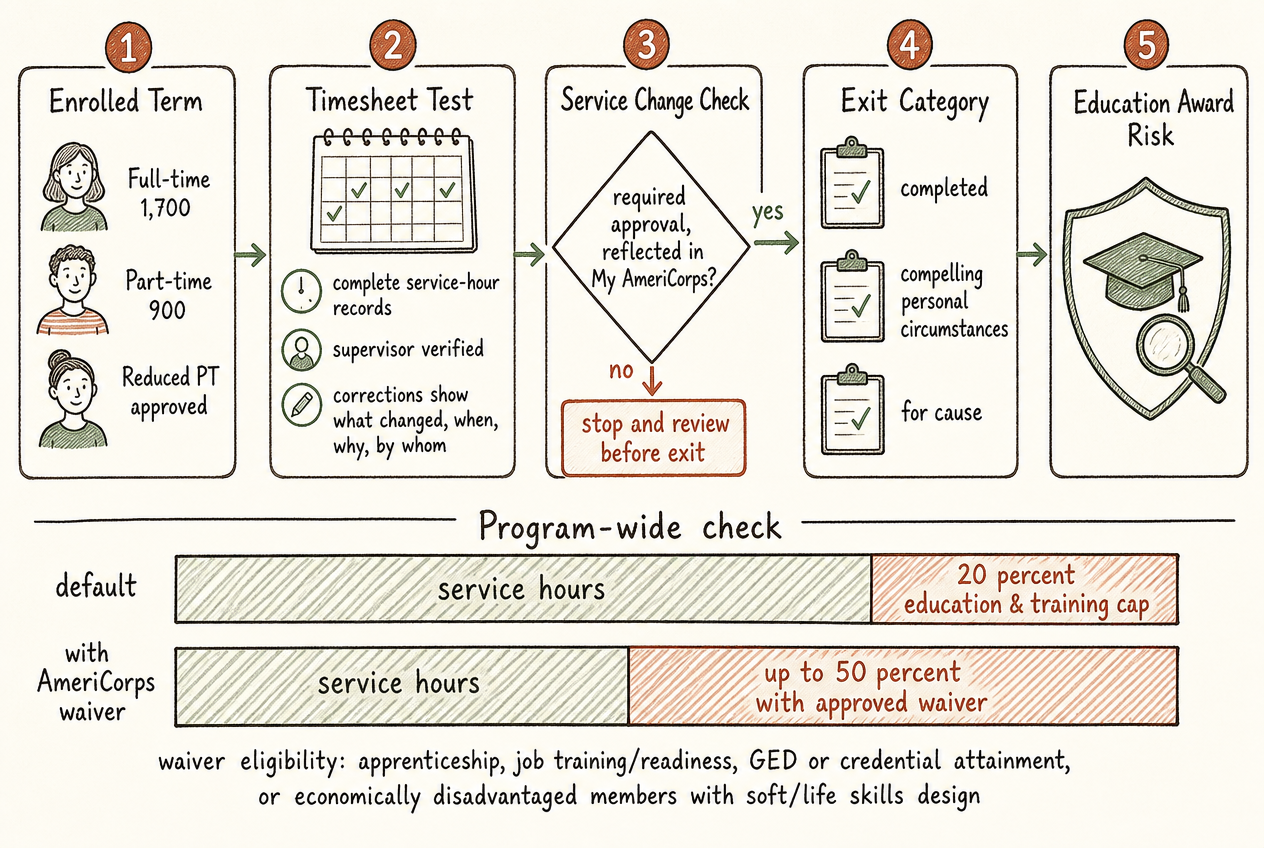
You usually find these problems too late.
A member exits. An education award is queued. Then someone looks closer and sees missing or incomplete service-hour records, hours that don't fit the member's enrolled term, or a mid-year change in status that was handled like an office convenience instead of a regulated decision.
That isn't a small paperwork issue. An AmeriCorps member's time and attendance record is the document that establishes eligibility for in-service and post-service benefits, including the education award (2026 AmeriCorps State and National Terms and Conditions, § V.I). When the record is thin, the benefit decision resting on it is thin too.
For a state commission, the practical lesson is clear: don't wait for member exit to test whether the file can support the service decision.
Start with the two decisions that matter most
Every member file is moving toward the same end-of-term determination about the participant. (45 CFR § 2522.220(c)(1))
The end-of-term evaluation should determine whether the participant successfully completed the required term of service, was released for compelling personal circumstances, or was released for cause. (45 CFR § 2522.220(c)(1))
The end-of-term evaluation should also include a performance and conduct review that assesses whether the participant satisfactorily completed assignments, tasks, or projects, or made a satisfactory effort if released early, and whether the participant met other criteria that were clearly communicated orally and in writing at the beginning of the term. (45 CFR § 2522.220(c)(2))
A participant released for compelling personal circumstances who has otherwise performed satisfactorily and has completed at least 15 percent of the required term of service is eligible for a pro-rated education award. (45 CFR § 2522.230(a)(1)) (45 CFR § 2522.230(a)(2))
A participant released for cause may not receive any portion of the AmeriCorps education award or any other payment from the National Service Trust. (45 CFR § 2522.230(b)(3))
If a participant is released for reasons other than misconduct before completing 15 percent of a term of service, that term is not considered one of the terms of service for which an individual may receive the related benefits. (45 CFR § 2522.230(e))
That means your monitoring needs to test two things before exit:
- Do the member's service records support the hours the subrecipient is counting?
- Does the file support the service-status decision the program is making?
If either answer is no, the member file needs attention before the exit transaction moves forward.
What to look for in member timesheets first
Start with the authority that governs member time records, which is the award's terms and conditions rather than the employee-payroll rules (2026 ASN Terms and Conditions, § V.I).
The recipient is required to ensure that time and attendance recordkeeping is conducted by the AmeriCorps member's supervisor, and that record is used to document member eligibility for in-service and post-service benefits. (2026 ASN Terms and Conditions, § V.I)
The same provision draws a line worth sitting with. A recipient must have a timekeeping system compliant with 2 CFR § 200.430, but because AmeriCorps members are National Service Participants and not employees, there is no expectation that a recipient track time beyond the member's AmeriCorps service. (2026 ASN Terms and Conditions, § V.I) (45 CFR § 2510.20)
Read those together and the employee-specific machinery in the salary-and-wage rule — total compensated activity, allocation across cost objectives, after-the-fact adjustment of budget-based charges — isn't the right test for a member timesheet (2026 ASN Terms and Conditions, § V.I). Applying it as though it were will send you looking for documents the member's file was never supposed to hold.
There's also a supervision detail commissions catch more often than programs do. A member serving as a Team Leader may not sign member timesheets. (2026 ASN Terms and Conditions, § V.G)
For the risk side of the review, the AmeriCorps OIG has been unusually direct. Timekeeping fraud, as OIG describes it, includes intentionally charging time to an AmeriCorps grant that is knowingly false or incorrect, showing reckless disregard for timekeeping rules, and staff modifying members' time records without any basis or authorization (AmeriCorps OIG Anti-Fraud Advisory, Vol. 2). OIG also reports that 30 percent of all OIG investigation cases opened since 2019 have been related to allegations of false or problematic timekeeping (AmeriCorps OIG Anti-Fraud Advisory, Vol. 2).
That gives you a first-pass screen built on member-specific authority:
| Check | What you're testing | Why it matters |
|---|---|---|
| Supervisor verification | Whether the member's supervisor is the person conducting time and attendance recordkeeping (§ V.I) | Required by the ASN Terms (§ V.I), and weak verification is a recurring OIG theme |
| Ineligible signer | Whether a Team Leader signed member timesheets (§ V.G) | Signing member timesheets is an unallowable Team Leader activity (§ V.G) |
| Timeliness | Whether timesheets were completed close to the service, not months later | Late and reconstructed records are a common fraud indicator (OIG advisory) |
| Unexplained revisions | Whether the record carries an auditable correction history showing what changed, when, why, and by whom | Modifying member time records without basis or authorization is OIG's own definition of timekeeping fraud (OIG advisory) |
| Member certification and supervisor verification | Whether the member certified the reported hours and the supervisor verified them for each period (§ V.I) | Without member certification and supervisor verification, the benefit determination rests on an unverified record (§ V.I) |
| Coding of activity | Whether hours are coded to direct service, training, or capacity building | Without clean coding, the education and training limit can't be tested later (45 CFR § 2520.50(a)) |
Two habits make this screen work harder. Pull a small sample from members closest to exit rather than only a random sample from the full year, because that's where unsupported hours do the most damage. And compare the timesheet to the member's enrolled term type before you read anything else in the file.
One caution about how you frame findings. The 2024 YouthBuild audit exposed a significant disagreement: OIG found the member-timekeeping controls ineffective and questioned substantial costs, while AmeriCorps declined some of OIG's proposed financial remedies (AmeriCorps OIG audit reports). Commissions should therefore write findings against the governing award terms, the regulations, and applicable commission policy.
A separate check for grant-funded employees
Program staff paid from the grant are a different review entirely, and it belongs in a different section of your monitoring tool.
Charges to Federal awards for salaries and wages must be based on records that accurately reflect the work performed, supported by a system of internal control providing reasonable assurance that the charges are accurate, allowable, and properly allocated. (2 CFR § 200.430)
Those records must reasonably reflect the total activity for which the employee is compensated, not exceeding 100 percent of compensated activities, and where an employee works across multiple awards or activity types, the records must support the distribution of salary or wages among those specific activities or cost objectives. (2 CFR § 200.430)
Budget estimates alone do not qualify as support for charges to Federal awards. (2 CFR § 200.430)
For nonexempt employees, charges for salaries and wages must also be supported by records indicating the total number of hours worked each day. (2 CFR § 200.430)
Keep those tests where they belong. A staff allocation problem is a cost question. A member time record problem is a benefit-eligibility question. Mixing them produces findings that don't hold up when the subrecipient pushes back.
One overlap does exist. If a recipient engages an AmeriCorps member in other Federal grant activities as an employee, the member and supervisor must certify, under penalty of perjury, that the member is not double counting their time, duplicating, displacing, or supplanting the other Federal grant activities. (2026 ASN Terms and Conditions, § V.I)
Audit the service term against the enrollment, not the story
Full-time service is 1,700 hours of service during a period of not more than one year. (45 CFR § 2522.220(a)(1)) Part-time service is 900 hours of service during a period of not more than two years. (45 CFR § 2522.220(a)(2))
A reduced part-time term may be used when AmeriCorps reduces the number of hours required for certain approved part-time participants, and in that case the education award is reduced in direct proportion to the reduction in required hours of service. (45 CFR § 2522.220(a)(3))
That matters because programs sometimes drift into informal changes. A member starts as one kind of slot. Attendance problems pile up. The program decides, midstream, to treat the member as if they were serving a lower-hour term, or wants to preserve some education-award outcome and back into a different status after the fact.
Asking for "written approval" isn't a specific enough test. Ask for the workflow.
Changes in terms of service for enrolled members may not result in an increased number of MSYs for the program. (2026 ASN Terms and Conditions, § VI.C)
State commissions and National Direct organizations may authorize or approve occasional changes of currently enrolled full-time members to less than full-time, and recipients and subrecipients may not transfer currently enrolled full-time members to a less than full-time status simply to provide the member a less than full-time education award. (2026 ASN Terms and Conditions, § VI.C.1)
Going the other direction is harder. AmeriCorps discourages moving less-than-full-time members to full-time unless it happens very early in the term, the current budget has to accommodate it, and the member's minimum 1,700 hours must still be completed within 12 months of the member's original start date. (2026 ASN Terms and Conditions, § VI.C.2)
Changes to the types of member positions are made by the recipient directly in the My AmeriCorps Portal (2026 ASN Terms and Conditions, § VI.B), so the portal record is where the change either exists or doesn't. And the portal enforces its own approval routing: status change requests can be approved at the Program and Prime user levels, but a change to term of service (slot type) 90 days after the member's start date can only be approved at the grantee level. (My AmeriCorps: approving a status change request) (2026 ASN Terms and Conditions, § VI.B)
So a workable commission worksheet for each sampled member has five lines, not three:
- enrolled term type and required hours at enrollment
- whether a change of term was requested, and when relative to the member's start date
- whether the change was processed through the official status-change workflow and is reflected in My AmeriCorps
- who approved it, at the required level — in My AmeriCorps, status change requests can be approved at the Program and Prime user levels, but changes to term of service (slot type) 90 days after the member's start date can only be approved at the grantee level (My AmeriCorps: approving a status change request)
- whether the program's MSYs still support the change
Until an approved change appears in My AmeriCorps, treat the enrolled term as controlling and resolve the discrepancy before exit.
Watch for unsupported early-release decisions
Programs are allowed to release participants for compelling personal circumstances or for cause. (45 CFR § 2522.230)
The criteria are more specific than most monitoring tools capture. An AmeriCorps program may release a participant upon a determination by the program that the participant is unable to complete the term of service because of compelling personal circumstances, if the participant has otherwise performed satisfactorily and has completed at least fifteen percent of the agreed term of service. (45 CFR § 2522.230(a)(1))
The program must document the basis for any determination that compelling personal circumstances prevent a participant from completing a term of service. (45 CFR § 2522.230(a)(3))
Compelling personal circumstances include circumstances beyond the participant's control, such as serious illness, disability, death or serious illness in the family when completion becomes unreasonably difficult or impossible, or conditions attributable to the program or other unforeseeable events beyond the participant's control that make completion unreasonably difficult or impossible. (45 CFR § 2522.230(a)(4)(i))
Compelling personal circumstances also include certain public-policy situations identified by AmeriCorps, including military service obligations, transition from welfare to work, or acceptance of an employment opportunity by a participant serving in a program with approved objectives promoting employment among participants. (45 CFR § 2522.230(a)(4)(ii))
Compelling personal circumstances do not include leaving to enroll in school, leaving to obtain employment except in the limited situations identified in the rule, or leaving because of dissatisfaction with the program. (45 CFR § 2522.230(a)(5))
As an alternative to release, an AmeriCorps State and National program may suspend a participant's term of service for up to two years, or longer if AmeriCorps approves it based on extenuating circumstances, after determining that compelling personal circumstances exist. (45 CFR § 2522.230(a)(6))
This is where files often get thin. The program knows a member couldn't continue. Everyone feels for the person. Someone writes a short note. Then the file jumps to exit.
But the file has to carry the decision, and it has to carry four elements, not one:
- a qualifying circumstance that prevented completion
- documentation of the program's determination of that circumstance
- hours showing the member completed at least fifteen percent of the agreed term
- evidence the member otherwise performed satisfactorily for the period served (45 CFR § 2522.230(a)(1))
The last one is the one most tools leave out, and it's the one that turns a sympathetic note into a supported determination.
Don't forget the training-hours ceiling
No more than 20 percent of the aggregate of all AmeriCorps member service hours in a program, as reflected in member enrollments in the National Service Trust, may be spent in education and training activities, unless AmeriCorps grants a waiver under paragraph (c) of this section. (45 CFR § 2520.50(a))
That waiver is real, and it isn't small. AmeriCorps may waive that limit to allow up to 50 percent of the aggregate of all AmeriCorps member service hours in a program to be spent in education and training activities if the program is a Registered Apprenticeship program, is a job training or job readiness program, includes activities to support member attainment of a GED or high school diploma or occupational, technical, or safety credentials, or primarily enrolls economically disadvantaged AmeriCorps members and employs a program design that also includes soft skills or life skills development. (45 CFR § 2520.50(c))
Capacity-building activities and direct service activities do not count towards the 20 percent cap on education and training activities. (45 CFR § 2520.50(b))
Fundraising carries its own separate limit. An AmeriCorps member may spend no more than ten percent of his or her originally agreed-upon term of service, as reflected in the member enrollment in the National Service Trust, performing fundraising activities, as described in § 2520.40. (45 CFR § 2520.45) The education-and-training limit works differently: it is measured across the aggregate of all AmeriCorps member service hours in the program, not member by member. (45 CFR § 2520.50(a))
Here's the part that trips up monitoring tools. The limit on education and training activities is measured across the aggregate of all AmeriCorps member service hours in the program, not across a sampled group of members. (45 CFR § 2520.50(a))
So we'd treat a sample of member timesheets as a risk signal rather than a verdict. It can point you toward a problem, but we'd ask for the program-wide total before drawing any conclusion about the limit.
So the sample is your trigger, not your conclusion. When timesheets in your sample use broad labels like "training," "orientation," or "professional development" week after week, ask the subrecipient for the program-wide education and training total against the program-wide aggregate of member service hours, and ask whether an approved waiver is on file and what ceiling it set.
If the coding on the timesheets is too vague to produce that program-wide total at all, the records are telling you something important on their own.
Build your monitoring around the last clean checkpoint before exit
The best control point isn't the audit.
It's the member exit action, because that's the last routine checkpoint before the benefit determination is submitted.
Each AmeriCorps grantee is responsible for conducting a mid-term and end-of-term evaluation, though a mid-term evaluation is not required for a participant released early from a term of service or in other circumstances approved by AmeriCorps. (45 CFR § 2522.220(c))
A participant will only be eligible to serve a subsequent term of service if that individual has received a satisfactory performance review for any previous term of service in an approved AmeriCorps position. (45 CFR § 2522.220(b))
A participant who wishes to contest a program's ruling of unsatisfactory performance may file a grievance, and if the grievance or subsequent binding arbitration finds the participant did satisfactorily complete a term, that individual will be eligible to receive an education award and/or be eligible to serve a second term. (45 CFR § 2522.220(e))
So we'd treat an exit decision as a decision with a tail, not just paperwork. (45 CFR § 2522.220(b)) (45 CFR § 2522.220(e))
A commission's subrecipient review process should trigger a pre-exit check for members who appear headed toward one of these situations:
- barely meeting required hours,
- switching service expectations midstream,
- leaving early for personal reasons,
- carrying missing, late, or reconstructed timesheets,
- or receiving an unsatisfactory performance determination.
One strong practice is to require subrecipients to send a short pre-exit packet for sampled higher-risk members. Not because a regulation requires that exact method, but because it forces the right review at the right time.
That packet can include the member's enrolled term, cumulative hours to date, the latest supervisor-verified timesheets, the draft exit category, the basis for any compelling-personal-circumstances determination including the satisfactory-performance element, and the performance review materials.
That isn't extra bureaucracy for its own sake. It's a way to catch second-guessing before the record hardens into an unsupported award.
What this means for commissions now
You don't need to inspect every line of every timesheet to reduce risk. You do need a review sequence that mirrors the authority.
First, confirm the term the member was enrolled in, and confirm any change to it exists in My AmeriCorps with the right approval. (2026 ASN Terms and Conditions, § VI)
Second, test whether member time records were supervisor-verified, timely, complete, and free of unexplained revisions. (2026 ASN Terms and Conditions, § V.I) (AmeriCorps OIG Anti-Fraud Advisory, Vol. 2)
Third, test whether the file supports the exit category the program plans to use, including the satisfactory-performance element for a compelling-personal-circumstances release. (45 CFR § 2522.230(a)(1)) (45 CFR § 2522.220)
Fourth, use your sample to flag training-coding risk, then request the program-wide aggregate before you conclude anything about the 20 percent cap or an approved waiver's higher ceiling. (45 CFR § 2520.50)
Fifth, run your grant-funded staff timekeeping test separately, against the salary-and-wage documentation rules. (2 CFR § 200.430)
Sixth, hold questionable files before exit actions move forward.
That's the work.
It's detailed. It can feel lonely when you're the one catching the problem no one else wanted to name. But this is where good commission oversight protects members, protects subrecipients from avoidable findings, and protects the integrity of the education award.
Before you finalize any monitoring tool or interpretation, verify it against the current eCFR text and your current grant terms and conditions, especially where your agency's required documentation practices go beyond the baseline rules described here.
A quick reminder
AmeriCorps grants can vary from one to the next. If you’re unsure how a rule applies to your program, check with your commission or designated point of contact at the AmeriCorps agency for any additional guidance and clarifications. They know your award terms best.
Questions people ask
- Can a program move a member into a reduced part-time term when the member falls behind on hours?
Not based on the material here. AmeriCorps may reduce the number of hours required to be served in order to receive an educational award for certain part-time participants serving in approved programs, and the education award is reduced in direct proportion to the reduction in required hours of service. (45 CFR § 2522.220(a)(3)) That points to an approved reduced part-time arrangement rather than a mid-year fix for a member who has fallen behind.
- What does a commission need to see to support a release for compelling personal circumstances?
Four things. An AmeriCorps program may release a participant upon a determination by the program that the participant is unable to complete the term of service because of compelling personal circumstances, if the participant has otherwise performed satisfactorily and has completed at least fifteen percent of the agreed term of service. (45 CFR § 2522.230(a)(1)) The program must document the basis for any determination that compelling personal circumstances prevent a participant from completing a term of service. (45 CFR § 2522.230(a)(3)) So the file needs the qualifying circumstance, the documented determination, the hour count crossing that threshold, and evidence of otherwise satisfactory performance for the period served.
- Do the 2 CFR § 200.430 payroll rules apply to AmeriCorps member timesheets?
Not the way they apply to employees. Section 200.430 governs salaries and wages of employees charged to a Federal award. (2 CFR § 200.430) The 2026 AmeriCorps State and National Terms require a timekeeping system compliant with that section, but they also state that because AmeriCorps members are National Service Participants and not employees per 45 CFR 2510.20, there is not an expectation that the recipient track time beyond a member's AmeriCorps service. (2026 ASN Terms and Conditions, § V.I) For members, the operative requirement is that time and attendance recordkeeping is conducted by the member's supervisor and that the record documents eligibility for in-service and post-service benefits. (2026 ASN Terms and Conditions, § V.I)
- Does a member released early always get a pro-rated education award?
No. A participant who is released for compelling personal circumstances and who completes at least 15 percent of the required term of service is eligible for a pro-rated education award. (45 CFR § 2522.230(a)(2)) A participant released for cause may not receive any portion of the AmeriCorps education award or any other payment from the National Service Trust. (45 CFR § 2522.230(b)(3)) If a participant is released for reasons other than misconduct prior to completing 15 percent of a term of service, the term will not be considered one of the terms of service for which an individual may receive the related benefits. (45 CFR § 2522.230(e))
- Should commissions review training hours as part of a timesheet audit?
Yes, but as a trigger rather than a conclusion. No more than 20 percent of the aggregate of all AmeriCorps member service hours in a program, as reflected in the member enrollments in the National Service Trust, may be spent in education and training activities, unless AmeriCorps grants a waiver under paragraph (c) of that section. (45 CFR § 2520.50(a)) Because the limit is measured across the program's aggregate hours, a sample of timesheets can show risk but cannot establish compliance. (45 CFR § 2520.50(a)) Ask for the program-wide total, and check whether an approved waiver raised the ceiling to as much as 50 percent of the aggregate of all AmeriCorps member service hours in the program. (45 CFR § 2520.50(c))
- What if my grant comes through a state or territory service commission?
- Check your commission’s current requirements too. They may be stricter than the federal floor, and stricter is what you follow. What a commission can’t do is override controlling federal law, regulation, or your AmeriCorps award terms, and it can grant only the waivers it’s authorized to grant. Read this post alongside your commission’s guidance, your award terms, and your written policies — and when something looks like a real conflict, ask your commission or program officer rather than guessing.
About the author
Gary Kosman is the founder and CEO of America Learns. He has worked with AmeriCorps programs and state service commissions for more than two decades, helping organizations strengthen the systems they use to manage members, grants, reporting, compliance, and impact. Reach him at gary@americalearns.net or 310-689-0542 x101.
Last reviewed September 4, 2026. Regulations change. Verify every citation against the current eCFR text and your own grant terms and conditions before you rely on it.
Looking for another topic?
Browse all compliance topics — from timesheets and member files to financial and progress reporting.
Browse topicsKeep reading on oig findings and related topics
OIG Findings/August 6, 2026
Internal Controls That Save a Two-Person Program
When your office is tiny, internal controls can sound like a luxury meant for bigger shops. They aren't. They're the repeatable habits that catch mistakes early, document review, and protect your AmeriCorps grant later.
OIG Findings/August 5, 2026
What to Reconcile Before AmeriCorps Grant Closeout
Closeout is where old mistakes stop hiding. Before the final package leaves your desk, make sure your cash, reports, and supporting records tell the same story.
OIG Findings/July 31, 2026
The AmeriCorps OIG Findings That Keep Coming Back
Published AmeriCorps OIG reports often point to the same kinds of compliance breakdowns. Here's where the patterns tend to show up, why good organizations still get caught there, and the control that helps.
Performance Measurement/September 2, 2026
Your Data-Collection System Is Part of Your Audit Trail
Surveys, logs, and tests can become Federal award records. Federal rules do not require you to keep every draft or form configuration — they require retention of the records and supporting documentation that substantiate what you reported. ([2 CFR § 200.334](https://www.ecfr.gov/current/title-2/section-200.334))
2 CFR 200 Basics/August 18, 2026
When Staff Duties and Timesheets Don’t Match
Salary costs get vulnerable when payroll support, payroll charges, and the role described in your award materials stop lining up. The fix starts with a clean match between supported work, the amount charged, and the staffing picture your award says you funded.