Match Documentation That Holds Up in an Audit
Match problems usually start months before review. The fix is a repeatable routine: confirm the award allows the contribution to count, document value with support that stands on its own, and reconcile reported match before it becomes a questioned cost.
Drafted with AI assistance, checked against primary sources, reviewed and approved by Gary Kosman on August 9, 2026.
Match is where good intentions get tested
You can feel the tension when the word comes up.
Someone donated space. A partner covered staff time. A board member says, "Count that." And now it's headed toward your ledger, your grant file, and maybe an audit sample.
Pause.
For AmeriCorps, the first question isn't whether the contribution helped. It's whether your award allows it to be counted, and whether your file can prove that.
That matters because the federal rule is doing two jobs at once.
2 CFR § 200.306 sets the conditions for contributions counted toward required cost sharing or match.
2 CFR § 200.403 still applies to costs used as match, because match doesn't sit outside the allowability rules.
And the amount of match you owe, if any, doesn't come from one place.
For AmeriCorps, the requirement and amount can come from statute, program regulations, the notice of funding opportunity, and your award terms and conditions. Practice varies by program and award. Check your own documents.
That isn't nitpicking.
It's stewardship.
If you're the person who has to answer for match, you already know the emotional part.
Records arrive late. Program staff hear about donations first. Finance sees them later. Partners send backup when they can. By the time a reviewer asks, you're trying to rebuild the story from email threads and memory.
That isn't carelessness.
It's what happens when one stretched team is translating community support into federal evidence.
And the worry shows up fast.
When support is thin, people hide. They hope the sample lands somewhere else. That's human. It also makes cleanup harder. You don't need a reckoning here. You need a routine.
What federal rules require
Start with the rule, not the spreadsheet.
A contribution counted as match has to meet the conditions in 2 CFR § 200.306. Among other things, it must be verifiable from your records, not counted toward another federal award unless federal statute allows that, necessary and reasonable for the project, and allowable under 2 CFR Part 200, Subpart E.
Then layer on your AmeriCorps award requirements.
Those may tell you whether match is required at all, how much is required, what sources are restricted, and what reporting format applies. If your commission or program office gave additional written instructions, those matter too.
Common practice is not the same as a requirement.
A monthly reconciliation, a donor form, or a centralized approval step may be excellent internal controls. They still aren't the regulation. Say the difference out loud inside your organization. It keeps people from defending a habit as if it were law.
Four questions to ask before you count anything
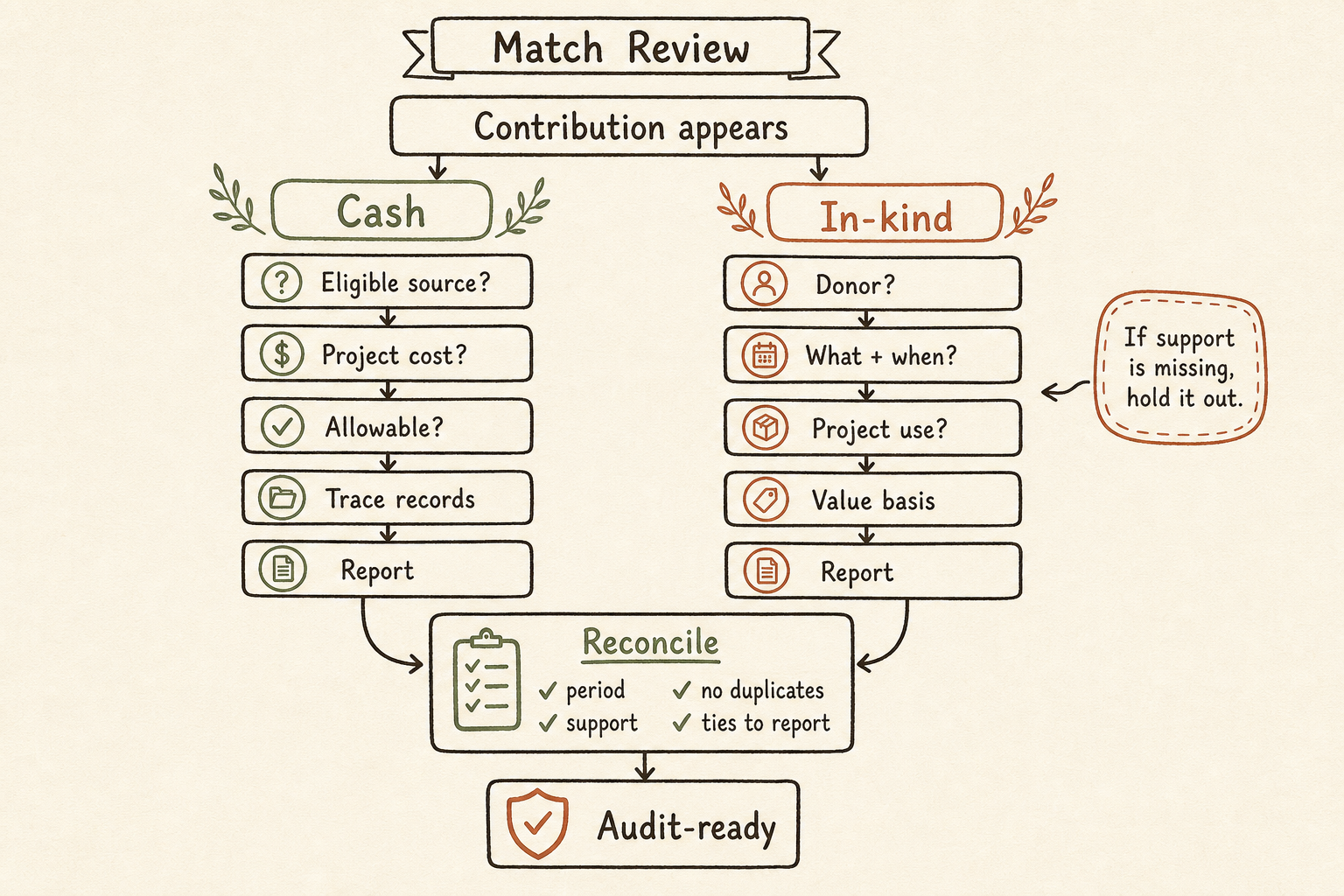
Use these in order.
- Does this award allow this contribution to count as match?
- Is it allocable to the approved project and provided during the period the award permits?
- Is the amount supported and valued under the applicable rules?
- Can we trace it from source records to the amount reported?
If any answer is no, hold it out until you resolve it.
That isn't being rigid.
It's how you keep a messy file from becoming a questioned cost.
Cash match and in-kind match need different controls
People say "match" like it's one job.
It isn't.
| Type of match | What it usually means | Main documentation risk |
|---|---|---|
| Cash match | Cash contributions by your organization or a third party used for allowable project costs, subject to award terms and source restrictions under 2 CFR § 200.306 | Tracing the amount to eligible source records and the reported total |
| In-kind match | Non-cash third-party contributions such as goods, services, supplies, or space, if allowable under the award and 2 CFR § 200.306 | Valuation and proof of program use |
Cash match usually fails on source or traceability.
In-kind match usually fails on valuation or thin description.
So build two checklists.
Not one.
A clean routine for cash match
Cash match should be boring.
Boring is your friend.
Step 1: Identify the funding source
Document where the money came from.
Don't stop at a fund code if the organization has multiple grants and revenue streams. Keep a note, schedule, or other support that shows why the source is eligible to be counted.
Be especially careful with other federal funds.
Under 2 CFR § 200.306, costs or contributions generally can't be counted toward more than one federal award unless federal statute specifically authorizes it. If another federal funding source is involved, review both awards before you count it.
Step 2: Tie it to the approved project
Confirm the cost is allocable to the AmeriCorps project and falls within the period your award permits.
If the cost is shared across programs, keep the allocation support with the match file or in a location the file clearly points to. Don't make future-you hunt for it.
Step 3: Check allowability
This is where people get tripped up.
A non-federal dollar doesn't become acceptable match because it wasn't charged to the federal share.
A cost counted as match still has to satisfy the applicable conditions in 2 CFR § 200.306, including the allowability standards in 2 CFR Part 200, Subpart E and the factors affecting allowability at 2 CFR § 200.403.
Step 4: Trace it to the books and the report
The amount you count should agree to the accounting records you rely on for reporting.
If your organization uses a separate reconciliation schedule for match, that's fine. It's a recommended internal control, not a federal format requirement. What matters is that the records clearly support the amount and source.
The underlying recordkeeping standards in 2 CFR § 200.306 and 2 CFR § 200.334 are the real anchor.
Step 5: Keep a report-ready packet
For each line or grouped category, keep:
- ledger detail or the accounting report you used
- source support such as invoices, payroll records, or proof of payment
- allocation support, if any
- a short note tying the cost to the project
- the amount ultimately counted as match
An auditor shouldn't need your memory to understand the file.
A clean routine for in-kind match
In-kind match needs more description.
Not more paperwork for its own sake.
Your file has to answer five questions:
- Who gave it?
- What was given?
- When was it provided or used?
- How did it support the project?
- How was the value determined?
If one of those is missing, the file is weak.
Step 1: Get the donor record early
Ask for written support close in time to the contribution.
It should identify the donor, describe the contribution, and state the date or period involved. That record can take different forms. What matters is that it is reliable and complete.
Step 2: Describe the program use
A donated thing isn't match because it exists.
It counts, if at all, because it supported the approved project.
Write the connection down. Two plain sentences often do the job better than a vague form title.
Step 3: Apply the right valuation rule
This part needs more than "we thought it was reasonable."
For third-party in-kind contributions, 2 CFR § 200.306 gives specific valuation rules. Volunteer services are valued at rates consistent with those ordinarily paid for similar work. Donated supplies are valued at fair market value at the time of donation. Donated space is valued at fair rental value. Donated property has separate rules and may require closer review under your award terms.
If your file doesn't show both the basis used and the support for that basis, you're depending on trust instead of evidence.
Step 4: Make finance able to trace it
If in-kind support lives only in program email, it's fragile.
Whether you record in-kind in the general ledger or track it through a separate schedule, use a method that lets finance tie source documents to the amount reported. A formal reconciliation schedule is a strong internal control when in-kind isn't booked in the ledger.
Step 5: Check for duplicate counting
One owner should review the full match schedule before reporting.
That's how you catch the donated staff time that was reported by a partner and also reflected somewhere else in your records.
Reconciliation is the control that keeps the story straight
Reconciliation doesn't prove everything.
It won't fix an ineligible source. It won't create valuation support after the fact.
What it does is show that the amount reported agrees with the underlying records you've decided are eligible.
Use one master match schedule for the reporting period. For each item, show:
- cash or in-kind
- date or period
- contributor or funding source
- short description
- amount supported
- amount approved to count, if different
- location of backup
- whether it has already been reported
Then review it in this order:
- Remove items outside the permitted period.
- Remove items without adequate support in hand.
- Remove items with unclear project connection.
- Remove items with weak valuation support.
- Check the remaining amounts against the ledger or reconciliation records.
- Check that the final total agrees to the report draft.
Match is strongest when the file explains itself without you in the room.
What reviewers will test
Reviewers don't begin with your intention.
They begin with the governing requirements for the award and the records supporting what you reported.
That may include your award terms, applicable AmeriCorps program requirements, 2 CFR § 200.306, 2 CFR § 200.403, and the relevant audit guidance for the engagement.
The AmeriCorps OIG anti-fraud advisories index is also worth watching. The advisory on match is a useful signal about the kinds of documentation weaknesses that attract attention.
So before the review, ask the outsider question.
Can someone who doesn't know your program tell what the contribution was, why it was eligible, how it was valued, and how it reached the report?
If not, the file isn't ready yet.
Three habits that lower risk fast
1. Don't count promises
As a conservative internal control, don't report an item until you have sufficient reliable support for eligibility, amount, source, and project connection.
2. Separate collection from approval
Program staff can collect documents. One trained reviewer should decide whether the item is counted.
That pause protects the relationship and the file.
3. Reconcile before submission
Build match review into the reporting calendar before the due date, with enough time to pull an item out.
That small gap is where a lot of findings get prevented.
What to verify in your own files this week
Pick five current-period items.
- two cash match items
- two in-kind items
- one item that made somebody say, "I think this should count"
For each one, ask:
- Does our award allow this to count?
- Does it meet the conditions in 2 CFR § 200.306?
- If it's a cost, does it fit the allowability framework in 2 CFR § 200.403?
- Does the file show the value and project connection clearly enough for someone else to follow?
- Can we trace it to what was reported?
If the answer is no, that isn't failure.
It's information.
And before you finalize any practice, verify it against the current eCFR text for 2 CFR Part 200, any applicable AmeriCorps regulations in 45 CFR, and your own award terms and conditions. Regulations change. Terms differ. What one portfolio accepts may not work in another.
A quick reminder
AmeriCorps grants can vary from one to the next. If you’re unsure how a rule applies to your program, check with your commission or designated point of contact at the AmeriCorps agency for any additional guidance and clarifications. They know your award terms best.
Questions people ask
- Does a contribution count as match because it helped the program?
No. Program benefit matters, but it isn't enough by itself. For a contribution to count toward required cost sharing or match, it has to meet the conditions in 2 CFR § 200.306. If the item is a cost, it also has to fit the allowability framework in 2 CFR § 200.403. On top of that, your AmeriCorps award must allow it to be counted.
- What's the practical difference between cash match and in-kind match?
Cash match usually means cash contributions used for allowable project costs, so the main control is proving the source is eligible and tracing the amount through accounting records to the report. In-kind match is a non-cash contribution, so the main control is proving what was provided, when, how it supported the project, and how it was valued under 2 CFR § 200.306. The exact documentation can vary by award.
- Can we report match if we know the contribution happened but the paperwork isn't complete yet?
You might be able to complete documentation after the event and still support the item, depending on the facts and your award requirements. But as a conservative internal control, don't report it until you have reliable support for eligibility, amount, source, and project connection. If the file can't stand on its own when reviewed, the item is vulnerable.
- What should be in an in-kind match file?
An in-kind file should show who made the contribution, what was donated, when it was provided or used, how it supported the approved project, and how the value was determined. For third-party in-kind contributions, use the valuation rules in 2 CFR § 200.306. Then verify that your award terms don't add program-specific requirements.
- Why do reviewers focus so much on reconciliation for match?
Because reconciliation helps show that the amount reported agrees with the records supporting it. It connects source documents, valuation support, accounting records or schedules, and the final report. It doesn't replace the underlying tests for eligibility, source restrictions, valuation, or project benefit. It proves the story hangs together.
- What if my grant comes through a state or territory service commission?
- Check your commission’s current requirements too. They may be stricter than the federal floor, and stricter is what you follow. What a commission can’t do is override controlling federal law, regulation, or your AmeriCorps award terms, and it can grant only the waivers it’s authorized to grant. Read this post alongside your commission’s guidance, your award terms, and your written policies — and when something looks like a real conflict, ask your commission or program officer rather than guessing.
About the author
Gary Kosman is the founder and CEO of America Learns. He has worked with AmeriCorps programs and state service commissions for more than two decades, helping organizations strengthen the systems they use to manage members, grants, reporting, compliance, and impact. Reach him at gary@americalearns.net or 310-689-0542 x101.
Last reviewed August 9, 2026. Regulations change. Verify every citation against the current eCFR text and your own grant terms and conditions before you rely on it.
Looking for another topic?
Browse all compliance topics — from timesheets and member files to financial and progress reporting.
Browse topicsKeep reading on financial reporting and related topics
Financial Reporting/August 6, 2026
Fraud Risk Climbs at the End of a Grant
When a grant is ending, people are often tired + moving fast as they race to get the next program year off the ground. That's exactly when weak approvals, missing records, and rushed final reports can turn into findings.
Financial Reporting/August 6, 2026
The Four Tests Every AmeriCorps Cost Must Pass
Most questioned costs don't start with fraud. They start with hurry, assumptions, and a missing piece of paper. A practical review starts with four questions: is the cost necessary, reasonable, allocable, and documented well enough to prove it. Then you confirm the rest of the allowability rules and your award terms.
Financial Reporting/August 5, 2026
What Program Income Means for AmeriCorps Grants
Program income shows up as a training fee, a host-site payment, a sale of materials. Classifying it is only step one — your FY2026 AmeriCorps award terms, not the federal default, tell you what to do next.
OIG Findings/September 4, 2026
How Commissions Can Catch Timesheet and Term Errors Early
When education awards are tied to weak time records or unsupported service-term changes, the cost lands late and hard. A commission can catch most of it before exit with a tighter review sequence.
Performance Measurement/September 2, 2026
Your Data-Collection System Is Part of Your Audit Trail
Surveys, logs, and tests can become Federal award records. Federal rules do not require you to keep every draft or form configuration — they require retention of the records and supporting documentation that substantiate what you reported. ([2 CFR § 200.334](https://www.ecfr.gov/current/title-2/section-200.334))