The Federal Financial Report, Reconciled Before You Submit It
The SF-425 is short, but it exposes any gap between your reported expenditures, your books, and your cash draws. Here's how to close that gap first.
Drafted with AI assistance, checked against primary sources, reviewed and approved by Gary Kosman on August 9, 2026.
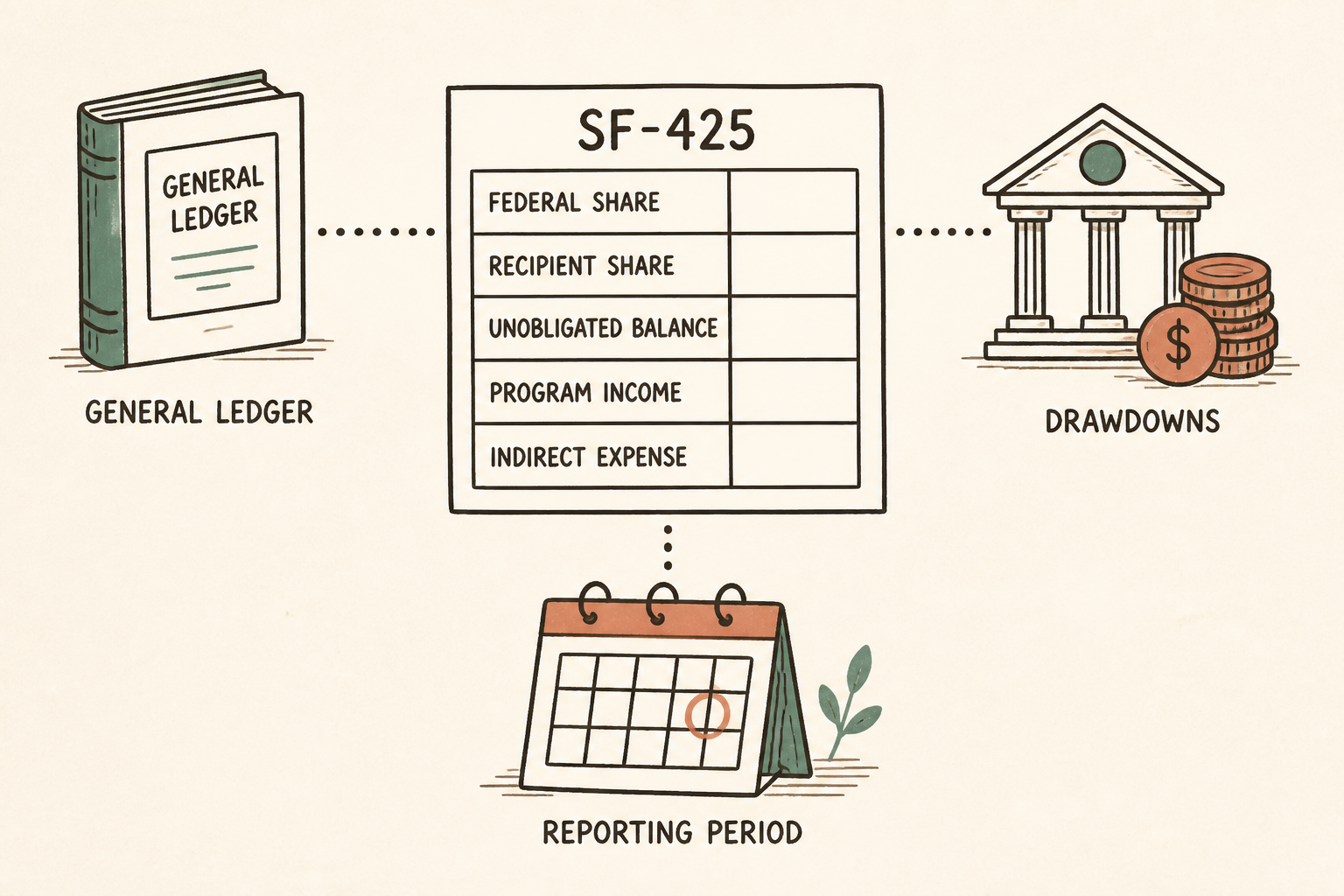
The report that puts every gap in one place
You can feel steady all quarter. Then the SF-425 lands on your desk and the room gets tight.
That feeling is real.
The Federal Financial Report pulls your reported expenditures, your accounting records, and your federal cash activity into one report. Differences may be legitimate. They still need to be understood and supportable before you submit.
And that discomfort can make smart people hide the gap.
Please don't.
An unreconciled report is a systems problem, not a character flaw.
What the FFR is
The SF-425 is the standard federal form recipients use to report the financial status of a federal award.
The federal awarding agency sets the reporting frequency and submission process in the award and related instructions. Under 2 CFR § 200.328, financial reports generally may not be required more often than quarterly, subject to the regulation's exceptions. Final financial reporting is part of closeout under 2 CFR § 200.344.
For AmeriCorps awards, practice can vary by program and by current terms and conditions. Check your own award instructions. Then verify against the current eCFR text.
The line items that cause the most trouble
| Line item | What it means | Where it breaks |
|---|---|---|
| Federal share of expenditures | Federal expenditures incurred and reportable for the period, not the approved budget | Pulling from the budget instead of the ledger |
| Recipient share | Cost share or match provided and supported | Using an estimate that doesn't tie to match records |
| Unobligated balance | The remaining federal amount not yet obligated by the recipient | Reporting a plug number because obligations aren't tracked clearly |
| Program income | Gross income that meets the definition in 2 CFR § 200.1 and must be treated under 2 CFR § 200.307 and the award terms | Leaving it unidentified, or applying the wrong treatment |
| Indirect expense | Indirect costs charged to the award; the form also asks for the applicable rate and base | Applying the rate to the wrong base, using a rate not authorized for the award, or omitting required rate and base information |
This is where intention and documentation part ways.
Cash or accrual: name the basis before you report
The SF-425 identifies whether reporting is on a cash or accrual basis.
The rule isn't that every award can choose either one forever. The rule is that your report must follow the awarding agency's instructions and reconcile to your records. Your financial management system must support accurate, current, and complete disclosure of financial results under 2 CFR § 200.302.
If the reporting basis changes, or if a prior cumulative amount needs correction, document why. Then follow your agency's instructions for amended reports or explanations.
Reconcile the FFR to two other records
Before you submit, line the report up against two things.
- Your general ledger. The expenditure amounts on the FFR should tie to your accounting records.
- Your federal cash history. Compare cumulative federal cash receipts or draws to cumulative federal expenditures.
A material unexplained difference between cash received and cash spent can point to a cash-management problem, a posting problem, or a reporting problem. You want to know which one before someone else asks.
Cash management under 2 CFR § 200.305
For advance payments, 2 CFR § 200.305(b)(1) requires you to minimize the time between transfer of federal funds and disbursement, and to limit advances to the minimum amounts needed for actual, immediate cash requirements.
That's the rule.
Common practice is to reconcile draw dates and amounts to disbursement timing each reporting cycle, because it shows you whether federal cash sat too long. Your terms and conditions may add more specific instructions.
The financial management system underneath the form
The FFR isn't a spreadsheet problem.
It's a financial-management-system test.
Under 2 CFR § 200.302, your system must, among other things, identify awards, provide accurate and complete financial reporting, track the source and application of funds, maintain effective control and accountability, compare expenditures with budget amounts, and maintain written procedures for payments and allowability.
If your system can't produce supportable federal share, recipient share, and program income figures without hand assembly every quarter, that isn't you failing.
That's a control weakness asking for attention.
What “final” means
A final FFR reports final financial results for closeout.
It should be complete and supportable. It's also not magic. Closeout and post-closeout actions can still involve corrections, disallowances, audit resolution, or other adjustments under 2 CFR § 200.344.
The retention clock
This part needs precision.
Under 2 CFR § 200.334, financial records, supporting documents, statistical records, and other non-Federal entity records generally must be retained for three years from the date you submit the final financial report.
Exceptions can change the retention period. Read the section itself before you rely on shorthand.
Program income: don't guess
This is where people freeze.
Not because they're careless. Because program income can be fact-specific, and the treatment isn't identical across every award.
Under 2 CFR § 200.1, program income is gross income earned by the recipient or subrecipient that's directly generated by a supported activity or earned as a result of the federal award during the period of performance, subject to the regulation's exclusions. Under 2 CFR § 200.307, the required treatment depends on the regulation, the award terms, and sometimes agency direction.
So don't net it against expenses because that feels tidy. Don't leave it off because the amount feels small. Identify it. Document it. Then apply the treatment your award requires.
If you aren't sure whether a fee or other receipt is program income, that's a good question. Ask it early.
Indirect costs: the rate matters, and the base matters
A recurring risk is using the right idea with the wrong math.
Under 2 CFR § 200.414, indirect-cost recovery depends on the applicable rate method or negotiated rate and the award terms; costs charged to the award must also be allowable under the applicable cost principles. The SF-425 also asks for the rate, the base, and the indirect expense.
If your agreement uses modified total direct cost, check the current definition in 2 CFR § 200.1. Under the revised definition applicable to awards subject to the October 1, 2024 Uniform Guidance revisions, modified total direct cost generally excludes specified items and excludes the portion of each subaward and contract above $50,000. Awards governed by the earlier definition may use the $25,000 threshold. Confirm the applicable Uniform Guidance version, award terms, and rate agreement for your award.
A pre-submission reconciliation checklist
- Pull the ledger detail for the reporting period and the cumulative award-to-date balance.
- Confirm the reporting basis required for the report and make sure the figures reconcile on that basis.
- Tie federal expenditures on the FFR to the ledger, not the budget.
- Compare cumulative federal cash draws or receipts to cumulative federal expenditures and resolve any unexplained difference.
- Tie recipient share to underlying match support, not to a standalone worksheet total.
- Identify any program income and confirm the treatment required by 2 CFR § 200.307 and your award terms.
- Recalculate indirect cost using the applicable rate agreement or authorized method and the correct base.
- If a prior amount changed, prepare the support and follow agency instructions for corrections or amendments.
- Have a second reviewer trace the major figures back to source records before submission.
The FFR isn't extra paperwork. It's your internal controls, revealed.
Keep interim reports consistent with each other
Cumulative figures should reconcile from one report to the next.
If a cumulative amount decreases because you corrected an error, keep the support for that correction and follow the awarding agency's instructions for amended reporting or explanation. Don't rely on memory six months later.
Future you deserves a paper trail.
One practical file to keep every time
As a practical step, keep one reconciliation packet for each submitted FFR.
Include the submitted report, ledger support, federal cash support, recipient-share support, program-income support if any, and indirect-cost calculation support.
The regulation doesn't prescribe that exact packet.
But when questions come, the hardest part is often not the answer.
It's finding the paper.
Always verify the current 2 CFR part 200 eCFR text, any applicable 45 CFR AmeriCorps regulations, the current official SF-425 form and instructions from your awarding agency, and your own award terms and conditions before you submit.
A quick reminder
AmeriCorps grants can vary from one to the next. If you’re unsure how a rule applies to your program, check with your commission or designated point of contact at the AmeriCorps agency for any additional guidance and clarifications. They know your award terms best.
Questions people ask
- What's the SF-425 Federal Financial Report?
The SF-425 is the standard federal form recipients use to report the financial status of a federal award. The awarding agency sets the reporting frequency and submission instructions in the award and related guidance. Under 2 CFR § 200.328, financial reports generally may not be required more often than quarterly, subject to stated exceptions.
- What does 2 CFR 200.305 require about cash management?
For advance payments, 2 CFR § 200.305(b)(1) requires recipients to minimize the time between transfer of federal funds and disbursement and to limit advances to the minimum amounts needed for actual, immediate cash requirements. The same section also addresses reimbursement and working-capital-advance payment methods.
- What record retention period starts when I submit a final FFR?
Under 2 CFR § 200.334, the general retention period is three years from the date you submit the final financial report. The regulation also contains exceptions that can change the start date or extend the period, so check the current eCFR text and your award terms before relying on shorthand.
- What's a common error when reporting match on the FFR?
A common error is reporting recipient share from a separate estimate instead of from supportable records. The amount reported as recipient share should tie back to your underlying match documentation and to the accounting records or other support your award requires.
- What if my grant comes through a state or territory service commission?
- Check your commission’s current requirements too. They may be stricter than the federal floor, and stricter is what you follow. What a commission can’t do is override controlling federal law, regulation, or your AmeriCorps award terms, and it can grant only the waivers it’s authorized to grant. Read this post alongside your commission’s guidance, your award terms, and your written policies — and when something looks like a real conflict, ask your commission or program officer rather than guessing.
About the author
Gary Kosman is the founder and CEO of America Learns. He has worked with AmeriCorps programs and state service commissions for more than two decades, helping organizations strengthen the systems they use to manage members, grants, reporting, compliance, and impact. Reach him at gary@americalearns.net or 310-689-0542 x101.
Last reviewed August 9, 2026. Regulations change. Verify every citation against the current eCFR text and your own grant terms and conditions before you rely on it.
Looking for another topic?
Browse all compliance topics — from timesheets and member files to financial and progress reporting.
Browse topicsKeep reading on financial reporting and related topics
Financial Reporting/August 6, 2026
Fraud Risk Climbs at the End of a Grant
When a grant is ending, people are often tired + moving fast as they race to get the next program year off the ground. That's exactly when weak approvals, missing records, and rushed final reports can turn into findings.
Financial Reporting/August 6, 2026
The Four Tests Every AmeriCorps Cost Must Pass
Most questioned costs don't start with fraud. They start with hurry, assumptions, and a missing piece of paper. A practical review starts with four questions: is the cost necessary, reasonable, allocable, and documented well enough to prove it. Then you confirm the rest of the allowability rules and your award terms.
Financial Reporting/August 6, 2026
Match Documentation That Holds Up in an Audit
Match problems usually start months before review. The fix is a repeatable routine: confirm the award allows the contribution to count, document value with support that stands on its own, and reconcile reported match before it becomes a questioned cost.
OIG Findings/September 4, 2026
How Commissions Can Catch Timesheet and Term Errors Early
When education awards are tied to weak time records or unsupported service-term changes, the cost lands late and hard. A commission can catch most of it before exit with a tighter review sequence.
Performance Measurement/September 2, 2026
Your Data-Collection System Is Part of Your Audit Trail
Surveys, logs, and tests can become Federal award records. Federal rules do not require you to keep every draft or form configuration — they require retention of the records and supporting documentation that substantiate what you reported. ([2 CFR § 200.334](https://www.ecfr.gov/current/title-2/section-200.334))