What AmeriCorps Members Cannot Do on Service Time
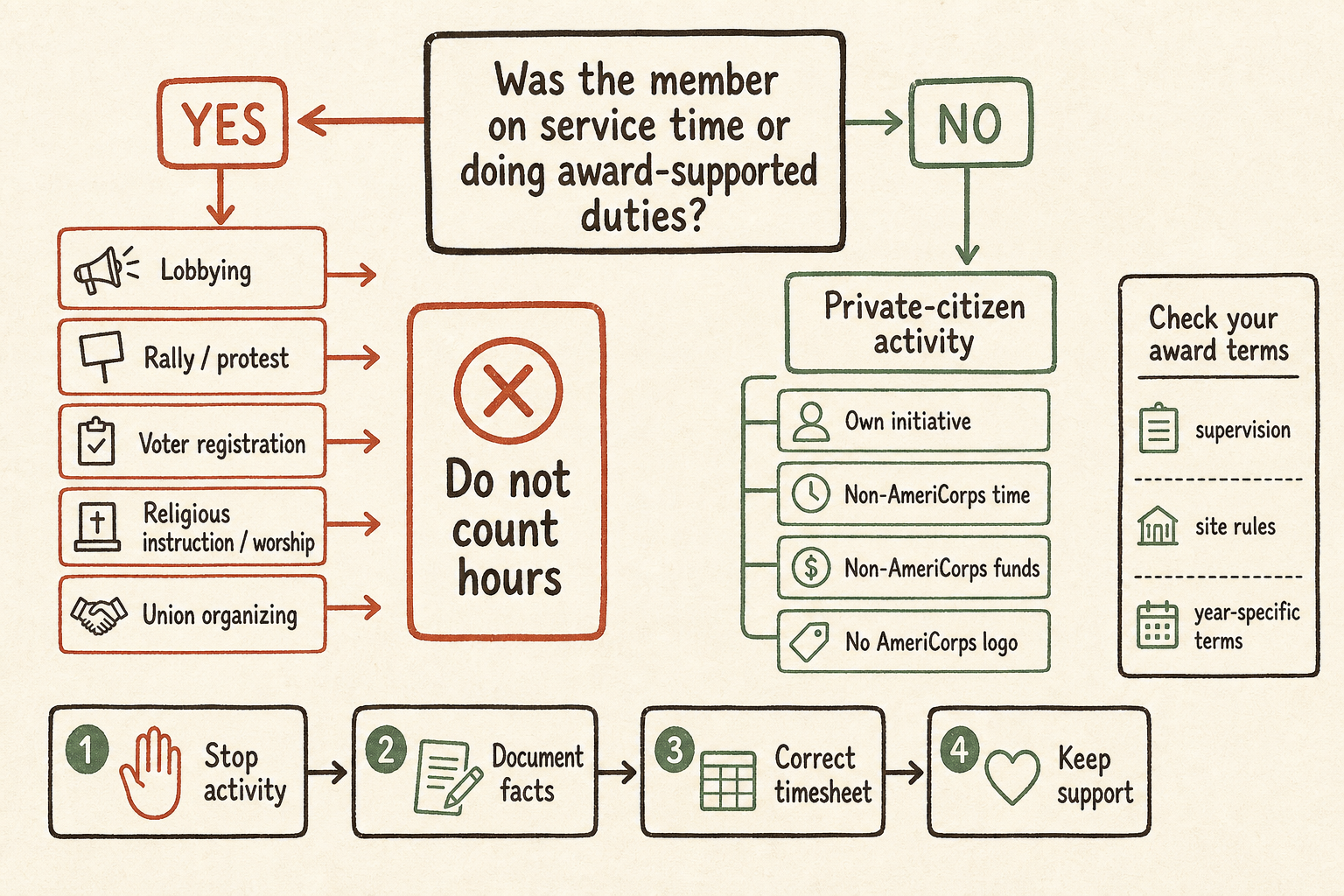
The first question is about time and duties. If a member or staff person engages in a prohibited activity while charging time to the AmeriCorps program, accumulating service or training hours, or otherwise performing activities supported by the AmeriCorps program or AmeriCorps, your program should review the record promptly under its written procedures, award terms, and any applicable AmeriCorps or pass-through instructions. Private-citizen participation in the listed activities has its own conditions too, including a logo instruction in the regulation.
Drafted with AI assistance, checked against primary sources, reviewed and approved by Gary Kosman on August 12, 2026.
The pressure in this rule shows up fast.
A partner wants members at a voter drive.
A host site says the project ends with a devotional.
Someone asks whether a rally is fine if the member is off duty.
Start in one place: 45 CFR § 2520.65, What activities are prohibited in AmeriCorps subtitle C programs?.
For AmeriCorps subtitle C programs, including AmeriCorps State and National, the first question is about time and duties. Under 45 CFR § 2520.65(a), What activities are prohibited in AmeriCorps subtitle C programs?, the listed activities are prohibited while staff and members are charging time to the AmeriCorps program, accumulating service or training hours, or otherwise performing activities supported by the AmeriCorps program or AmeriCorps.
Read the first words of paragraph (a) closely. It says staff and members.
Most questions land on members. The rule reaches staff too. And if staff time tied to a prohibited activity was charged to the award or claimed as match, that can raise the same kind of allowability review.
Start with the hours. Then check the duty. Then check the exact activity named in the regulation.
What the regulation forbids
Read the current eCFR text for the full list in 45 CFR § 2520.65, What activities are prohibited in AmeriCorps subtitle C programs?. In plain language, examples include:
- Attempting to influence legislation
- Organizing or engaging in protests, petitions, boycotts, or strikes
- Assisting, promoting, or deterring union organizing
- Impairing existing contracts for services or collective bargaining agreements
- Engaging in partisan political activities, or other activity designed to influence the outcome of an election to public office
- Participating in, or endorsing, events or activities likely to include advocacy for or against political parties, platforms, political candidates, proposed legislation, or elected officials
- Engaging in religious instruction, conducting worship services, or proselytizing
- Conducting voter registration drives, or using AmeriCorps funds to conduct voter registration drives
- Providing abortion services or referrals for receipt of such services
The list goes further.
It also covers providing a direct benefit to certain organizations named in the regulation, including a for-profit business, a labor union, a partisan political organization, a nonprofit organization that fails to comply with the restrictions in section 501(c)(3) of the Internal Revenue Code, and certain religious organizations unless AmeriCorps assistance is not used to support the religious activities identified in the rule. Read 45 CFR § 2520.65 before approving an assignment. Shortcuts like "no politics" or "no religion" won't protect the file.
It also addresses providing instruction as part of a program that includes mandatory religious instruction or worship, and certain construction, operation, or maintenance work tied to facilities used for religious instruction or worship. The exact wording matters.
What else may control your award
This is where many programs stop too early.
45 CFR § 2520.65 is one controlling prohibition.
It isn't the whole award.
Your grant may also be governed by statutes, other regulations, executive orders, the FY 2026 General Terms and Conditions, program-specific terms, and incorporated award documents. Practice can also vary at the commission or pass-through level.
For an FY 2026 AmeriCorps State and National award, use the FY 2026 General Terms and Conditions and the 2026 AmeriCorps State and National Program-Specific Terms and Conditions attached to your award, including any amendments and current revision dates. If you're on another award year or another AmeriCorps program, use the terms attached to that award.
Time is the main trigger
This is the part many people need twice.
A prohibited activity becomes an AmeriCorps compliance problem when it happens while the member or staff person is charging time to the AmeriCorps program, accumulating service or training hours, or otherwise performing activities supported by the AmeriCorps program or AmeriCorps under 45 CFR § 2520.65(a), What activities are prohibited in AmeriCorps subtitle C programs?.
One distinction is worth keeping straight. A member's prohibited-activity hours shouldn't be credited as AmeriCorps service. Staff hours aren't AmeriCorps service in the first place — for a staff person, the question is whether that time is an allowable charge to the award, including when it's claimed as match.
Ask these questions in order:
- Was the person charging time to the AmeriCorps program or accumulating service or training hours then?
- Were they performing assigned AmeriCorps duties?
- Was the activity otherwise supported by the AmeriCorps program or AmeriCorps?
Clothing does not, by itself, turn private conduct into countable service.
But the regulation doesn't stop there.
Under 45 CFR § 2520.65(b), What activities are prohibited in AmeriCorps subtitle C programs?, individuals may exercise their rights as private citizens and may participate in the activities listed above on their initiative, on non-AmeriCorps time, and using non-AmeriCorps funds. That paragraph also says individuals should not wear the AmeriCorps logo while doing so.
So yes, time is the main trigger.
And yes, the logo instruction is still in the rule.
Faith-based settings need careful boundaries
A member may serve with a faith-based organization.
The assignment still cannot include the religious activities prohibited by 45 CFR § 2520.65, What activities are prohibited in AmeriCorps subtitle C programs? on countable AmeriCorps time or while otherwise performing activities supported by the AmeriCorps program or AmeriCorps.
That means you should look at the task, not the building name.
Tutoring after school may be fine.
Leading prayer, teaching doctrine, conducting worship, or proselytizing on countable AmeriCorps time is not.
If the site mixes allowable services with religious activities, the file needs clear role boundaries, and your program should check the current regulation and the terms attached to its own award before approving the placement.
What this means in everyday situations
Can a member attend a rally?
While charging time to the AmeriCorps program, accumulating service or training hours, or otherwise performing activities supported by the AmeriCorps program or AmeriCorps, no if the event falls within the prohibited categories in 45 CFR § 2520.65, What activities are prohibited in AmeriCorps subtitle C programs?.
As a private citizen, maybe, under 45 CFR § 2520.65(b), What activities are prohibited in AmeriCorps subtitle C programs?: on the individual's initiative, on non-AmeriCorps time, and using non-AmeriCorps funds. Other applicable law, award terms, and organizational rules may still apply. The regulation also says the individual should not wear the AmeriCorps logo while doing so.
Can a member help with voter registration?
Not while charging time to the AmeriCorps program, accumulating service or training hours, or otherwise performing activities supported by the AmeriCorps program or AmeriCorps.
45 CFR § 2520.65, What activities are prohibited in AmeriCorps subtitle C programs? bars conducting voter registration drives or using AmeriCorps funds to conduct voter registration drives. Whether the drive is partisan or nonpartisan does not make those hours countable as AmeriCorps service.
Can a member lobby or push for a bill?
Not on countable AmeriCorps time or during other award-supported duties.
45 CFR § 2520.65, What activities are prohibited in AmeriCorps subtitle C programs? bars attempting to influence legislation in those circumstances.
Can a member provide religious instruction?
Not on countable AmeriCorps time or during other award-supported duties.
45 CFR § 2520.65, What activities are prohibited in AmeriCorps subtitle C programs? bars engaging in religious instruction, conducting worship services, or proselytizing in those circumstances.
Can a member support union organizing?
Not on countable AmeriCorps time or during other award-supported duties.
45 CFR § 2520.65, What activities are prohibited in AmeriCorps subtitle C programs? bars assisting, promoting, or deterring union organizing in those circumstances.
Does any of this apply to program staff?
Yes. Paragraph (a) of 45 CFR § 2520.65, What activities are prohibited in AmeriCorps subtitle C programs? names staff and members together.
For staff, the immediate recordkeeping issue is often cost allocation and match allowability, but the activity can also create broader award-compliance and supervision concerns. If staff time tied to a prohibited activity was charged to the award or claimed as match, the program should assess whether that charge or match claim is allowable under the award and applicable cost and match requirements.
What to do with the timesheet
Don't rename the hour.
If prohibited activity may have been credited as service or training time, review the record promptly under your written procedures, applicable award terms, and any applicable AmeriCorps or pass-through instructions. Make any correction those authorities require.
The correction process itself usually comes from your written procedures, your award terms, and any pass-through requirements, not from one sentence in the CFR.
A careful sequence looks like this:
- Identify the date, time block, and activity.
- Determine whether the member was charging time to the AmeriCorps program, accumulating service or training hours, or otherwise performing activities supported by the AmeriCorps program or AmeriCorps.
- Review whether the time was improperly credited toward countable AmeriCorps hours.
- Correct the timesheet or hour record under your written procedure and applicable award requirements.
- Keep supporting documentation showing what changed, when, and why.
- Update cumulative totals if needed.
- Retrain the member and the supervisor if the problem came from instruction or site practice.
If the record has already been certified, don't leave the old entry standing without explanation.
Under 2 CFR § 200.334, Record retention requirements, recipients and subrecipients generally must retain Federal award records, including supporting documentation, for three years from submission of the final financial report, with different timing rules stated in the regulation itself for some categories of records. Under 2 CFR § 200.337, Access to records, the Federal agency or pass-through entity, Inspectors General, the Comptroller General, or any of their authorized representatives have access to pertinent Federal-award records for official purposes; the right also includes timely and reasonable access to personnel for related interviews and discussion.
When you think something more serious happened
This is the moment that can bring on second-guessing.
You don't need to know everything before you protect the record.
Preserve the documentation you already have.
Then check the current instructions that apply to your award.
Follow the reporting and escalation instructions in your current award terms, pass-through guidance, and any verified current direction from the AmeriCorps Office of Inspector General hotline page or the AmeriCorps Office of Inspector General publications page, if those sources apply to the issue.
Until you've confirmed those current instructions, the conservative move is this: preserve the records, alert the right internal leadership under your procedures, and follow the reporting and escalation instructions attached to your award and pass-through relationship.
What supervisors should do the same day
You don't need a dramatic memo.
You need a usable file.
One caution before you start: if AmeriCorps OIG or another authority directs you to pause fact-finding, follow that direction before interviewing people, reviewing additional records, or making final findings. You can still stop the activity and preserve the records you already have, without altering them.
| Step | What to do | Why it matters |
|---|---|---|
| 1 | Stop the activity or remove the member from it. | It prevents more unallowable time from being counted. |
| 2 | Confirm whether the member was charging time to the AmeriCorps program, accumulating service or training hours, or otherwise performing activities supported by the AmeriCorps program or AmeriCorps. | The compliance analysis starts there. |
| 3 | Document the facts: date, start and stop time, location, what occurred, and who assigned it. | Later reviews rely on records. |
| 4 | Correct the timesheet or hour record under your procedure and applicable award requirements. | Improperly credited time shouldn't stay in the record. |
| 5 | Check whether other members were involved. | The same assignment may have affected more than one file. |
| 6 | Address the supervision problem. | If staff or a site directed it, the fix is bigger than one timesheet. |
| 7 | Preserve the supporting documents with the corrected record. | The correction needs a trail. |
| 8 | Follow any verified reporting instructions in your award terms, commission guidance, or other applicable current guidance. | Escalation steps can vary by award year and source. |
If the member was told to do the activity by staff or a host site, consider saying that plainly in the file. That fact can matter to supervision and corrective-action review.
What comes from the CFR, and what comes from award terms
This distinction matters.
The prohibition itself comes from the regulation.
Other obligations may come from the award.
A program operating on an earlier award follows that year's terms, including any amendments attached to that award. A program on a current award follows the terms attached to that award, not last year's version sitting in a training folder.
Practice varies by commission and grant. So before you write a policy memo or make a site-level call, compare your approach to the documents that govern your own award.
The mistakes that cause the most trouble
The first is treating prohibited activities as a branding issue.
They're not.
Logo use matters because 45 CFR § 2520.65(b), What activities are prohibited in AmeriCorps subtitle C programs? addresses it for private-citizen participation in the listed activities. But logo use is not what makes prohibited AmeriCorps time countable.
The second is making intent do too much work.
45 CFR § 2520.65 does not state a separate intent element before a program reviews time that may have been improperly credited. The record still needs enough facts to show what happened, when, and whether the time was counted.
The third is making the timesheet prettier than the facts.
Renaming prohibited time as training, outreach, or something else doesn't solve the problem.
The fourth is relying on broad labels.
"Advocacy" can mean many different things. The file needs the specific task.
The fifth is treating the CFR as the whole story.
Sometimes the terms, incorporated documents, or pass-through instructions add duties the regulation doesn't spell out in the same place.
A practical training line
Use language your sites will remember.
Do not assign members, while charging time to the AmeriCorps program, accumulating service or training hours, or otherwise performing activities supported by the AmeriCorps program or AmeriCorps, to activities that fall within the prohibited categories in 45 CFR § 2520.65, What activities are prohibited in AmeriCorps subtitle C programs?.
Then pair it with the private-citizen rule.
For participation as a private citizen in the activities listed above, 45 CFR § 2520.65(b), What activities are prohibited in AmeriCorps subtitle C programs? permits participation on the individual's initiative, on non-AmeriCorps time, and using non-AmeriCorps funds, and says the individual should not wear the AmeriCorps logo while doing so.
That is the distinction people can use.
One last accuracy note
Rules move.
Terms change by award year.
Before you rely on a citation in a training, corrective action, or monitoring memo, verify it against the current eCFR text, especially 45 CFR § 2520.65, What activities are prohibited in AmeriCorps subtitle C programs? and 2 CFR part 200. Then read the terms attached to your own award year.
When you're tired, this rule can feel larger than it is.
Start with the hours.
Then check the duty.
Then check the exact activity named in the regulation.
A quick reminder
AmeriCorps grants can vary from one to the next. If you’re unsure how a rule applies to your program, check with your commission or designated point of contact at the AmeriCorps agency for any additional guidance and clarifications. They know your award terms best.
Questions people ask
- If a member wears AmeriCorps gear to a rally on personal time, is that prohibited?
Clothing alone does not make private activity countable AmeriCorps service. But the private-citizen rule in 45 CFR § 2520.65(b), What activities are prohibited in AmeriCorps subtitle C programs? is narrower than many people remember. For participation as a private citizen in activities listed above, the regulation permits it on the individual's initiative, on non-AmeriCorps time, and using non-AmeriCorps funds, and it says the individual should not wear the AmeriCorps logo while doing so. Other applicable law, award terms, and organizational rules may still apply.
- Can prohibited activity time be moved to training or another timesheet category?
Not as a fix. If time was spent on an activity barred during the circumstances described in 45 CFR § 2520.65(a), What activities are prohibited in AmeriCorps subtitle C programs?, review whether that time was improperly credited toward the member's service or training hours under your written procedures, award terms, and any applicable AmeriCorps or pass-through instructions. Make any correction those authorities require, keep documentation showing what changed and why, and retain that documentation under 2 CFR § 200.334, Record retention requirements.
- Can a member help with voter registration if the host site is nonpartisan?
Not while charging time to the AmeriCorps program, accumulating service or training hours, or otherwise performing activities supported by the AmeriCorps program or AmeriCorps. 45 CFR § 2520.65, What activities are prohibited in AmeriCorps subtitle C programs? bars conducting voter registration drives and using AmeriCorps funds to conduct voter registration drives. A nonpartisan setting does not make those hours countable as AmeriCorps service. Outside AmeriCorps time, private-citizen participation is addressed by 45 CFR § 2520.65(b), What activities are prohibited in AmeriCorps subtitle C programs?: on the individual's initiative, on non-AmeriCorps time, and using non-AmeriCorps funds, and the individual should not wear the AmeriCorps logo while doing so.
- What should a supervisor document when a prohibited activity happens?
Document the date, start and stop time, location, what the member did, whether the member was charging time to the AmeriCorps program, accumulating service or training hours, or otherwise performing activities supported by the AmeriCorps program or AmeriCorps, who assigned the activity if known, and what correction was made to the hour record under your procedure. Keep the supporting documents with the corrected record. The prohibition itself comes from 45 CFR § 2520.65, What activities are prohibited in AmeriCorps subtitle C programs?. Record retention and access rules come from 2 CFR § 200.334, Record retention requirements and 2 CFR § 200.337, Access to records. If your award terms add supervision or reporting steps, follow the terms attached to your own award year.
- Do commissions and monitors need proof that the member meant to break the rule?
45 CFR § 2520.65, What activities are prohibited in AmeriCorps subtitle C programs? does not state a separate intent element before a program reviews time that may have been improperly credited. The practical question is whether the prohibited activity occurred while the person was charging time to the AmeriCorps program, accumulating service or training hours, or otherwise performing activities supported by the AmeriCorps program or AmeriCorps, and whether those hours were counted. The review process for any formal finding may vary by AmeriCorps, a state commission, or another pass-through entity, so keep records that show what happened, when it happened, who assigned it, and how the timesheet was handled.
- Does the prohibited activities rule apply to program staff, or only members?
Both. Paragraph (a) of 45 CFR § 2520.65, What activities are prohibited in AmeriCorps subtitle C programs? says staff and members may not engage in the listed activities while charging time to the AmeriCorps program, accumulating service or training hours, or otherwise performing activities supported by the AmeriCorps program or AmeriCorps. For staff, the immediate compliance question is often whether time charged to the award or claimed as match remains allowable, but the issue can also reach supervision and broader award compliance.
- What should we do first if we suspect a prohibited activity happened?
First, preserve the records you already have and stop any ongoing activity that may be affected. Then follow the reporting and escalation instructions in your current award terms, pass-through guidance, and any verified current direction that applies to the issue, including the AmeriCorps Office of Inspector General hotline page or the AmeriCorps Office of Inspector General publications page when those sources fit the situation.
- Are direct benefits to outside organizations covered too?
Yes. 45 CFR § 2520.65, What activities are prohibited in AmeriCorps subtitle C programs? does more than list politics and religion. The section also prohibits providing a direct benefit to certain organizations named in the rule, including a for-profit business, a labor union, a partisan political organization, a nonprofit organization that does not comply with the restrictions in section 501(c)(3) of the Internal Revenue Code, and certain religious organizations unless AmeriCorps assistance is not used to support the religious activities identified there. When an assignment benefits an outside organization, read the current eCFR text closely before approving the work.
- Are census work, poll work, or organizing volunteers for a drive covered?
Maybe, depending on the exact task and the source of the restriction. Don't treat 45 CFR § 2520.65, What activities are prohibited in AmeriCorps subtitle C programs? as the only source. Some limits may come from the regulation's election-related prohibitions. Others may come from your current award terms, incorporated guidance, or pass-through instructions, such as the FY 2026 General Terms and Conditions or the terms attached to your own award year. The safe move is to check the exact assignment against the current eCFR text and the terms attached to your own award year before approving it.
- What if my grant comes through a state or territory service commission?
- Check your commission’s current requirements too. They may be stricter than the federal floor, and stricter is what you follow. What a commission can’t do is override controlling federal law, regulation, or your AmeriCorps award terms, and it can grant only the waivers it’s authorized to grant. Read this post alongside your commission’s guidance, your award terms, and your written policies — and when something looks like a real conflict, ask your commission or program officer rather than guessing.
About the author
Gary Kosman is the founder and CEO of America Learns. He has worked with AmeriCorps programs and state service commissions for more than two decades, helping organizations strengthen the systems they use to manage members, grants, reporting, compliance, and impact. Reach him at gary@americalearns.net or 310-689-0542 x101.
Last reviewed August 12, 2026. Regulations change. Verify every citation against the current eCFR text and your own grant terms and conditions before you rely on it.
Looking for another topic?
Browse all compliance topics — from timesheets and member files to financial and progress reporting.
Browse topicsKeep reading on member timesheets and related topics
Member Timesheets/August 5, 2026
What OIG Notices First in Timekeeping Records
You may not be worried about a fraudster. You are worried about exhausted staff, late timesheets, and records that get cleaned up after the fact. That's exactly why this matters.
Member Timesheets/July 23, 2026
How to Fix an AmeriCorps Timesheet Without Making It Worse
Once a signed timesheet exists, it's part of your grant record. Here's how to correct it without hiding the history, and what to do when the problem is bigger than one line item.
Member Timesheets/July 21, 2026
What Has to Be on an AmeriCorps Member Timesheet
For AmeriCorps State and National, a member timesheet is evidence about service hours, hour categories, and approvals under the rules that apply to your award. It isn't the same thing as payroll support for staff salaries.
OIG Findings/September 4, 2026
How Commissions Can Catch Timesheet and Term Errors Early
When education awards are tied to weak time records or unsupported service-term changes, the cost lands late and hard. A commission can catch most of it before exit with a tighter review sequence.
Performance Measurement/September 2, 2026
Your Data-Collection System Is Part of Your Audit Trail
Surveys, logs, and tests can become Federal award records. Federal rules do not require you to keep every draft or form configuration — they require retention of the records and supporting documentation that substantiate what you reported. ([2 CFR § 200.334](https://www.ecfr.gov/current/title-2/section-200.334))