Terms and Conditions Beat Assumptions Every Time
When the Uniform Guidance leaves room for interpretation, your AmeriCorps award documents often decide the operational answer. The control isn't knowing every rule by memory. It's keeping the executed award, its incorporated terms, and any modifications in front of every person who approves spending.
Drafted with AI assistance, checked against primary sources, reviewed and approved by Gary Kosman on August 9, 2026.
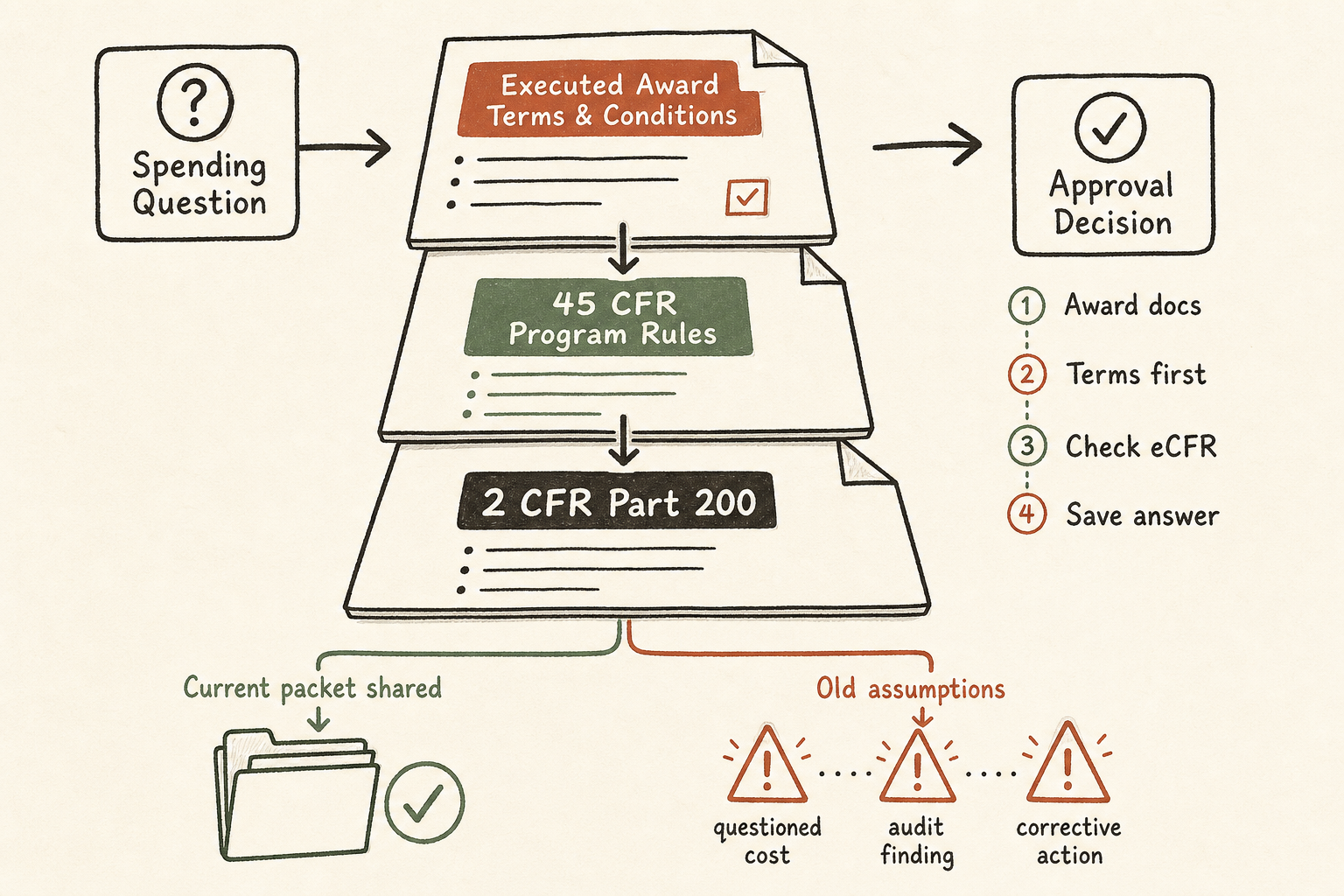
The document people skip is often the document that decides
Old assumptions are expensive.
Not because you're careless. Because AmeriCorps compliance comes in layers. Government-wide grant rules matter. AmeriCorps program rules matter. And the award you signed may add conditions that control how this grant must operate.
If you feel your shoulders go up when someone asks, “Did you check the terms and conditions?” that makes sense. Most of us were trained to start with 2 CFR Part 200. That's the backbone.
But backbone isn't the whole body.
For a federal award, compliance obligations can arise from applicable statutes and regulations, the executed award and its valid incorporated terms, and applicable agency requirements. Read those sources together. Award conditions can't override controlling law or regulation.
Uniform Guidance sets the floor
The Uniform Guidance establishes broad federal requirements for matters including cost principles, financial management, internal controls, procurement, and subrecipient oversight. AmeriCorps-specific obligations may also come from program regulations, the notice of funding opportunity, the executed award, and documents incorporated into that award.
For example, 2 CFR § 200.403 lays out the basic factors affecting allowability of costs. 2 CFR § 200.404 covers reasonableness. 2 CFR § 200.405 addresses allocability. 2 CFR § 200.302 establishes financial management standards. 2 CFR § 200.303 requires recipients to establish and maintain effective internal control over the federal award.
Those rules are real requirements.
They are not a complete operating manual for your specific AmeriCorps award.
Uniform Guidance often tells you the standard a cost or practice must meet. It doesn't always answer the narrower question your staff is asking at 4:42 p.m.
Can we charge this?
Can we do it this way?
Can the subrecipient handle it under our local policy?
Sometimes the answer is in Part 200. Sometimes it's in the relevant AmeriCorps program regulations in 45 CFR chapter XXV. And sometimes the answer turns on an award condition incorporated into your grant.
Award terms can add conditions your team is most likely to guess at
This is where smart people get into trouble.
A finance director knows a cost can be allowable under federal cost principles in the abstract. A program director knows the activity supports the grant purpose. A subrecipient manager knows a similar expense was accepted three years ago. Each person holds one true fact.
But those facts do not displace the terms and conditions incorporated into the current award.
Read them together with the governing authorities.
An award condition can add a restriction, set a prior-approval requirement, define a reporting expectation, or state an operating condition for that award. It doesn't override a statute or controlling regulation. It works alongside them.
Think of it this way:
| Source | What it usually does |
|---|---|
| 2 CFR Part 200 | Sets government-wide grant administration and cost rules |
| 45 CFR chapter XXV | Sets AmeriCorps program regulations |
| Your executed award and incorporated terms | Applies award-specific conditions, instructions, and approvals |
This isn't a hierarchy where award terms supersede statutes or regulations.
It's a reminder to read all applicable sources together.
What this means in real life
It means “we've always done it this way” isn't a control.
It means “Part 200 doesn't forbid it” isn't enough.
It means “the last grants officer said it was fine” may not carry into a new award or a modified award unless the current award documents support that position.
And it means your best compliance habit isn't memorizing every rule.
It's checking the current documents before money moves.
The controlling version matters
This is the part people underestimate.
Terms and conditions aren't a decorative attachment to the award file. They're active instructions for the award, as incorporated into the executed grant and any later amendment or modification.
So when staff rely on a PDF saved in a desktop folder called “AmeriCorps Grant Stuff,” you have risk.
When a subrecipient uses last year's orientation packet, you have risk.
When procurement, HR, finance, and program staff all have different reference materials, you have layered risk.
You don't need bad intent for this to go sideways. You need one old attachment and one confident person.
That's why the control has to be operational, not intellectual.
Guessing is expensive
Let's name the part nobody says out loud.
Audits can make good people feel exposed.
When someone realizes they approved a cost without checking the current award documents, the urge to hide shows up fast. It says: don't ask now, it'll make you look careless. It says: maybe nobody will notice. It says: fix the file quietly.
That's when records disappear into side email chains and private explanations.
Don't build a culture where people hide because they were trying to keep up.
Build one where the standard response is, “Let's pull the award and walk through it together.”
Not knowing isn't the problem.
Pretending to know is.
A practical review process that works under pressure
When a spending or operating question comes up, identify the applicable award documents and governing authorities, then use a consistent review process.
1. Start with the exact question
Write it in one sentence.
Not “travel issue.”
Write: “Can we charge this airfare to the grant without prior approval under the current award?” Or: “Can this subrecipient use federal funds for this activity under the current award documents?”
If the question stays vague, the answer will too.
2. Pull the controlling award documents
Use the fully executed award, all amendments or modifications, and the terms and conditions attached to or incorporated into that award.
Don't rely on a training deck.
Don't rely on last year's packet.
Don't rely on memory.
If your organization has multiple AmeriCorps awards, confirm you're looking at the right award and the right period of performance.
3. Identify direct award instructions, then test them against applicable governing authorities
Look for any section that answers the question directly or adds conditions.
You're looking for words that function like gates: required, prohibited, must, prior approval, except, may not, subject to, consistent with.
If the award terms appear to answer the question, read them together with the applicable regulations and any incorporated guidance before you close the issue. Then document the analysis.
4. Then read the underlying regulation and other governing authority
If the award documents don't fully answer it, check the relevant federal rule.
For cost questions, that often means 2 CFR § 200.403 through 2 CFR § 200.405, and sometimes a more specific cost section in 2 CFR Part 200, Subpart E.
For internal control and documentation questions, 2 CFR § 200.302 and 2 CFR § 200.303 are often relevant.
For program operation questions, identify the applicable AmeriCorps program and consult the relevant part of 45 CFR chapter XXV, along with the award and any valid incorporated instructions or program guidance. Depending on the issue, the governing statute may matter too, so don't assume the CFR and award are the only sources.
And because federal text changes, verify against the current eCFR text before you finalize your answer.
5. Distinguish the source of the rule
This matters more than people think.
When you write your answer, label which part comes from regulation, which part comes from the award terms, and which part comes from your organization's internal practice.
Those are not the same thing.
For example:
- Federal regulation may require allowability and internal controls.
- Award terms may add a grant-specific operating condition or approval step.
- Your organization may choose a stricter approval workflow as a local control.
If you blend those together, staff can't tell what is mandatory and what is your local process.
6. Save the answer where the next person will find it
A correct answer trapped in one inbox isn't a control.
As a local practice, save the decision with:
- the question asked,
- the date answered,
- the award period,
- the source documents reviewed,
- the person who answered,
- and any follow-up conditions.
Then put it in the shared place your approvers use.
The people approving spending need the same packet
This is where compliance gets mundane in the best possible way.
The current award file should be in front of the people who make decisions before reimbursement requests, before purchase approvals, before subrecipient guidance goes out, and before someone promises a practice is allowed.
That often includes:
- program director
- finance lead
- executive approver
- grants manager
- subrecipient monitor
- anyone reviewing budget modifications or unusual purchases
If one of those people is working from an old version, your system isn't aligned.
A control you can set up this week
You do not need a heroic compliance overhaul.
You need one standard packet and one standard habit.
As a recommended internal control, set up a current award file with these documents in this order:
- Fully executed award document.
- All award amendments or modifications.
- Terms and conditions attached to or incorporated into that award.
- Current internal approval matrix.
- Key federal references your team uses most often, including 2 CFR Part 200.
- A running decision log for interpretation questions.
Then do one more thing that matters a lot.
Retire old versions on purpose.
Archive them in a clearly labeled folder. Mark them as prior award or prior version. Remove them from the working folder used for current approvals. If your staff can accidentally grab the wrong version in ten seconds, they eventually will.
What to say when practice varies
Sometimes neither the regulation nor the award terms answer your question cleanly.
Or practice may differ by program, competition, award type, or current award conditions.
Say that plainly.
Write: “Practice varies. Check your executed award, incorporated terms and conditions, any amendments or modifications, and applicable AmeriCorps guidance before proceeding.”
That sentence protects your team from false certainty.
False certainty is expensive.
The point isn't fear
Failure to follow award terms can lead to questioned or disallowed costs, audit or monitoring findings, corrective action, and other remedies available under the award and applicable law. Depending on the facts, conduct involving false statements, fraud, or misuse of funds can also create civil or criminal exposure.
That's why the award belongs in your active control system, not buried in closeout files or kickoff emails.
But fear isn't a management system.
Clarity is.
The strongest programs don't run on a staff member's memory of what happened last year. They run on current documents, shared access, and a team culture where asking to see the terms and conditions is normal.
If money is about to move, the executed award and its current terms belong on the table.
That's not overkill.
That's stewardship.
A quick reminder
AmeriCorps grants can vary from one to the next. If you’re unsure how a rule applies to your program, check with your commission or designated point of contact at the AmeriCorps agency for any additional guidance and clarifications. They know your award terms best.
Questions people ask
- Do AmeriCorps terms and conditions matter if 2 CFR 200 already covers the cost rules?
Yes. 2 CFR Part 200 sets government-wide grant rules, including cost principles and administrative requirements. Your executed AmeriCorps award can also include valid award-specific requirements, approvals, or operating restrictions. Read the award and 2 CFR Part 200 together, and verify against the current eCFR text.
- What's the safest way to answer a spending question when staff are under time pressure?
Start by writing the exact question. Then pull the fully executed award, any amendments or modifications, and the terms and conditions attached to or incorporated into that award. Check those documents for direct instructions, but don't stop there if another governing source may matter. For cost issues, review the relevant sections of 2 CFR Part 200. For program-operations issues, check the applicable AmeriCorps regulations in 45 CFR chapter XXV, along with any valid incorporated program guidance and, when relevant, the governing statute. Then document both the answer and the source.
- Can we rely on last year's terms and conditions if this year's award looks similar?
No. Similar isn't the same as controlling. Use the terms and conditions incorporated into the executed award you're working under, together with any later amendments or modifications. Prior award documents are useful for history and training, but they shouldn't be the working authority for current approvals unless they are still part of the current award.
- Who in the organization should have the current terms and conditions?
Anyone who can influence whether federal funds are used, approved, reimbursed, or explained should be working from the same current award file. That often includes program leadership, finance, executive approvers, grants staff, and subrecipient monitors. As a local control, keep the executed award, incorporated terms, and any modifications in one shared location and retire outdated working copies.
- What if my grant comes through a state or territory service commission?
- Check your commission’s current requirements too. They may be stricter than the federal floor, and stricter is what you follow. What a commission can’t do is override controlling federal law, regulation, or your AmeriCorps award terms, and it can grant only the waivers it’s authorized to grant. Read this post alongside your commission’s guidance, your award terms, and your written policies — and when something looks like a real conflict, ask your commission or program officer rather than guessing.
About the author
Gary Kosman is the founder and CEO of America Learns. He has worked with AmeriCorps programs and state service commissions for more than two decades, helping organizations strengthen the systems they use to manage members, grants, reporting, compliance, and impact. Reach him at gary@americalearns.net or 310-689-0542 x101.
Last reviewed August 9, 2026. Regulations change. Verify every citation against the current eCFR text and your own grant terms and conditions before you rely on it.
Looking for another topic?
Browse all compliance topics — from timesheets and member files to financial and progress reporting.
Browse topicsKeep reading on 2 cfr 200 basics and related topics
2 CFR 200 Basics/August 18, 2026
When Staff Duties and Timesheets Don’t Match
Salary costs get vulnerable when payroll support, payroll charges, and the role described in your award materials stop lining up. The fix starts with a clean match between supported work, the amount charged, and the staffing picture your award says you funded.
2 CFR 200 Basics/August 17, 2026
Uniform Guidance for AmeriCorps: 2 CFR part 200 AmeriExplained
If you run an AmeriCorps grant, 2 CFR part 200 shapes much of your daily compliance work. This guide translates the rule into program language and shows how it fits with AmeriCorps regulations and award terms.
2 CFR 200 Basics/August 14, 2026
A Calm 60-Day Plan for Start-Up Compliance
If you're starting late and carrying the grant mostly alone, you don't need a perfect launch. You need the right compliance pieces in the right order so member files, timekeeping, financial controls, and data collection can hold up.
OIG Findings/September 4, 2026
How Commissions Can Catch Timesheet and Term Errors Early
When education awards are tied to weak time records or unsupported service-term changes, the cost lands late and hard. A commission can catch most of it before exit with a tighter review sequence.
Performance Measurement/September 2, 2026
Your Data-Collection System Is Part of Your Audit Trail
Surveys, logs, and tests can become Federal award records. Federal rules do not require you to keep every draft or form configuration — they require retention of the records and supporting documentation that substantiate what you reported. ([2 CFR § 200.334](https://www.ecfr.gov/current/title-2/section-200.334))