What Has to Be on an AmeriCorps Member Timesheet
For AmeriCorps State and National, a member timesheet is evidence about service hours, hour categories, and approvals under the rules that apply to your award. It isn't the same thing as payroll support for staff salaries.
Drafted with AI assistance, checked against primary sources, reviewed and approved by Gary Kosman on August 18, 2026.
The first mistake is the one that causes all the others.
AmeriCorps member timesheets aren't the same thing as employee time-and-effort records.
If both jobs landed on your desk, that can feel fussy. It isn't fussy. It changes what the record is proving, which rule you cite, and what a reviewer is looking for.
For staff salaries and wages charged to a federal award, the Uniform Guidance uses 2 CFR § 200.430(g).
This article focuses on AmeriCorps State and National members.
Other AmeriCorps programs may use different service documentation rules, forms, and award terms. For State and National, start with 45 CFR part 2520, 45 CFR part 2522, and your current AmeriCorps grant terms and conditions on the AmeriCorps grantees and sponsors page.
Keep that line clear.
Everything else gets easier.
What the timesheet is proving
For AmeriCorps State and National programs, a member service-hour record helps document hours the program treats as counting toward the member's term of service, subject to applicable rules and award terms.
It also helps show whether those hours were categorized well enough to monitor activity limits.
And some categories have caps.
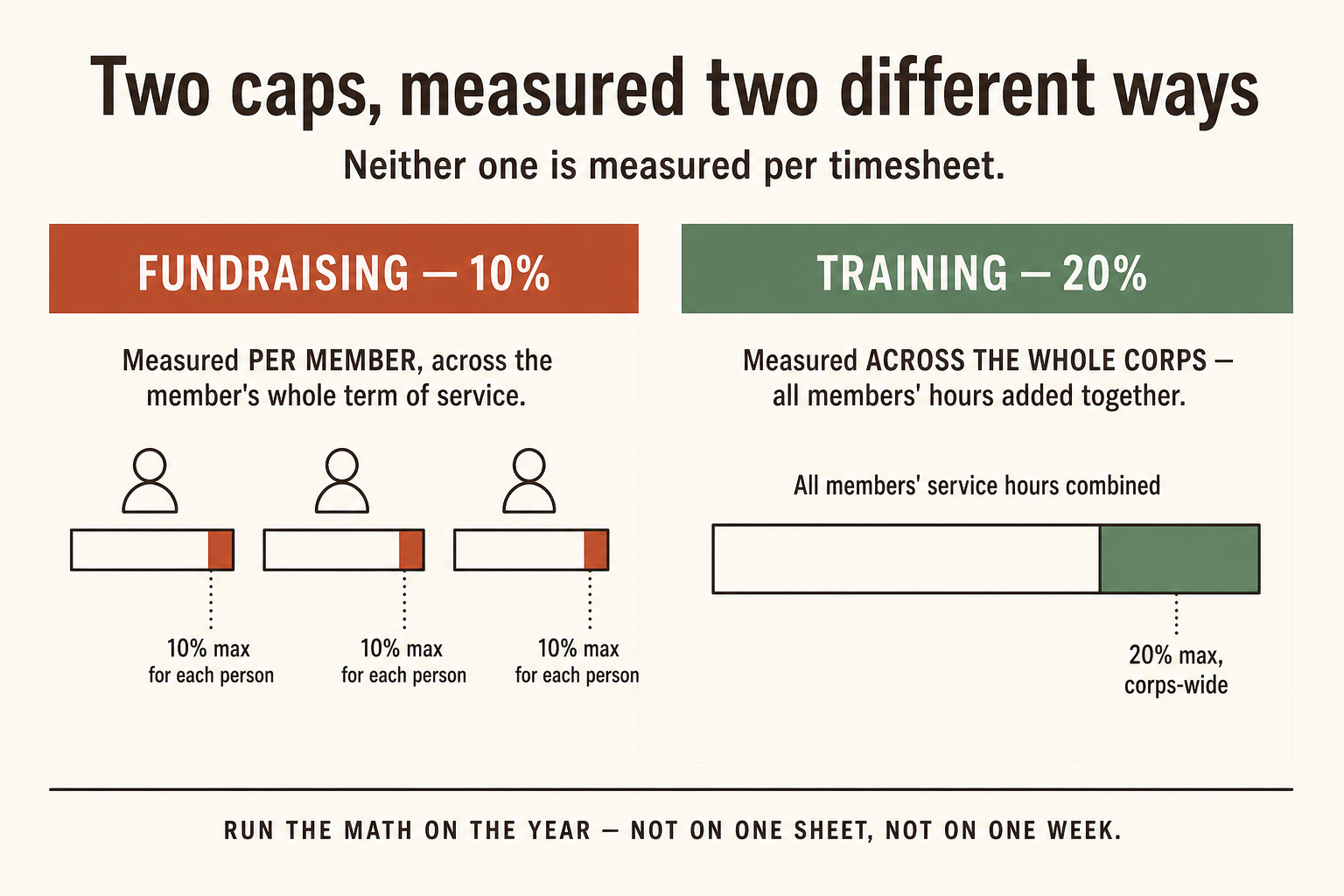
Here's the part people get backwards. The two caps are measured on two different denominators, and neither one is measured per timesheet or per week.
Fundraising is per member. Under 45 CFR § 2520.45, a member may spend no more than 10 percent of that member's originally agreed-upon term of service on fundraising. You total each individual's fundraising hours across the whole term and compare them to that member's originally agreed-upon term of service hours -- not to the hours the member ends up actually serving. A member who serves beyond the agreed-upon term doesn't get extra fundraising room, and a member who falls short doesn't shrink the denominator.
Training is corps-wide. Under 45 CFR § 2520.50, education and training activities may not exceed 20 percent of the aggregate of all program members' service hours. You add up every member's hours into one pool, add up all the training hours into another, and compare those two totals. It isn't a 20 percent ceiling on any one person's sheet, and one member above 20 percent isn't automatically a problem if the corps as a whole is under.
So: training is counted and totaled per person, but tested against the whole corps. Fundraising is counted and tested against that one member's originally agreed-upon term of service. A single week or a single sheet tells you almost nothing about either.The rules on what fundraising activities are allowed appear in 45 CFR § 2520.40.
That isn't a side issue.
It's why the form has to help you see what kind of hour this was.
Which categories belong on the form
There's no universal AmeriCorps member timesheet template in the regulations.
That's where a lot of people get tripped up.
Your form should track the categories your program is required to monitor under the applicable program rules and your current award terms.
For many AmeriCorps State and National programs, separate service, education-and-training, and fundraising fields are a practical control for monitoring the limits in 45 CFR § 2520.45 and 45 CFR § 2520.50, even though those sections don't prescribe a universal timesheet template.
If you also track site-specific categories, keep them subordinate to the compliance categories.
The point isn't to make the form look complete.
The point is to make the record usable when someone asks what happened here.
About the 10% and 20% caps
This is where shorthand causes damage.
Here's the part people get backwards. The two caps are measured on two different denominators, and neither one is measured per timesheet or per week.
Fundraising is per member. Under 45 CFR § 2520.45, a member may spend no more than 10 percent of that member's originally agreed-upon term of service on fundraising. You total each individual's fundraising hours across the whole term and compare them to that member's originally agreed-upon term of service hours -- not to the hours the member ends up actually serving. A member who serves beyond the agreed-upon term doesn't get extra fundraising room, and a member who falls short doesn't shrink the denominator.
Training is corps-wide. Under 45 CFR § 2520.50, education and training activities may not exceed 20 percent of the aggregate of all program members' service hours. You add up every member's hours into one pool, add up all the training hours into another, and compare those two totals. It isn't a 20 percent ceiling on any one person's sheet, and one member above 20 percent isn't automatically a problem if the corps as a whole is under.
So: training is counted and totaled per person, but tested against the whole corps. Fundraising is counted and tested against that one member's originally agreed-upon term of service. A single week or a single sheet tells you almost nothing about either.
The safe habit is to monitor both throughout the year -- each member's own fundraising percentage, and the corps-wide training percentage -- unless your program received a Training waiver. Running the numbers once at closeout is how programs find out too late.
But don't teach your staff that every AmeriCorps program uses the same percentages in the same way.
For State and National, 45 CFR § 2520.50 speaks in terms of the aggregate of all program members' service hours, not a universal individual-member cap. Some programs also watch it at the member level as an internal control. If yours does, say so as a local rule.
If your commission, subrecipient agreement, or current terms and conditions add stricter tracking rules, follow those.
What the regulation requires, and what good controls add
You can feel the tension here.
You want one clean citation and one clean answer.
What you often have is a mix of regulation, award terms, and internal controls.
Here's the clean version:
| Item | What it's | Source |
|---|---|---|
| Classification sufficient to monitor applicable activity limits | Necessary to demonstrate compliance; specific documentation details may appear in award terms | For State and National, see 45 CFR § 2520.45, 45 CFR § 2520.50, and current award terms |
| Tracking fundraising limits (10% of each member's originally agreed-upon term of service) | Requirement | 45 CFR § 2520.45 |
| Tracking education/training limits (20% of all members' service hours combined, corps-wide) | Requirement | 45 CFR § 2520.50 |
| Member certification and supervisor approval | Often required by award terms or policy; strong internal control in any case | Check current grant terms and your written procedures |
| Daily or weekly entry | Common practice and strong internal control | Check your written procedures and any pass-through requirements |
| Clear correction method with an audit trail | Strong internal control; may be required by your system or policy | Check your written procedures and record retention rules |
That distinction matters in an audit.
If it's a federal requirement, say that.
If it's an award condition, say that.
If it's your house rule because it prevents a mess, say that too.
What “contemporaneous” should mean in your program
Avoidance makes people backfill.
Fear makes people guess.
Neither one creates a reliable record.
Neither 45 CFR § 2520.45 nor 45 CFR § 2520.50 specifies a universal number of days for entering member service hours.
So be careful with grand statements.
What you can say, and defend, is this: records created close to the service period are easier to trust, easier to review, and easier to support if a monitor asks questions later.
That's why many programs require daily or weekly entry as an internal control.
Not because every program has the same formal deadline.
Because memory isn't an internal control.
The timesheet should tell the story before anyone has to reconstruct it.
Six problems that get records questioned
I'm saying questioned on purpose.
A bad timesheet doesn't automatically mean fraud. Most of the time it means a tired person, a weak routine, or a form that was never trained well.
These are the documentation problems that create trouble:
| Problem | Why it creates risk |
|---|---|
| Missing required approval or date | You may not be able to show the record was reviewed under your procedure |
| Hours don't add up | The record looks unreliable, and reviewers may test more of them |
| Hours aren't separated in a way that lets you monitor required limits | You may not be able to show compliance with fundraising or education/training caps |
| Entries appear to be completed in batches long after the fact | The record may look reconstructed rather than created from actual service activity |
| Descriptions are too vague, where your form requires descriptions | It's harder to tell whether the activity was allowable and categorized correctly |
| Corrections obscure the original entry or have no explanation | The record loses credibility because the audit trail is weak |
None of this means your program is doomed.
It means your controls need to be plain enough to hold on a Wednesday afternoon.
What not to put on a member timesheet
Don't import employee payroll logic into member service records.
For purposes of federal law, national-service participants are generally not employees solely because of their service; see 42 U.S.C. § 12571(e). Employment-status questions can still depend on the applicable program and legal context.
So don't assume that employee payroll concepts determine whether member time counts as service.
In particular, don't record non-service absences as earned service hours unless an applicable program rule or award term expressly allows it.
If your program tracks absences or schedule changes for management purposes, keep that process clear enough that nobody later mistakes non-service time for earned service hours.
The routine that saves you
You aren't behind because you don't care.
You're behind because compliance work expands to fill every unguarded minute.
So make the routine smaller.
Set one recurring submission day each week.
Set one recurring supervisor review window right after it.
Run one monthly check on category totals and cap exposure.
Train members with one real example, not six abstract warnings.
And when you find a gap, don't hide it.
Document what happened.
Apply your correction procedure.
Figure out whether the problem came from training, supervision, or the form itself.
Then fix that part.
Before you publish or revise your form, verify every requirement against the current eCFR text and your current AmeriCorps award terms and conditions. The rules move. Your memory of last year doesn't count as a citation.
A quick reminder
AmeriCorps grants can vary from one to the next. If you’re unsure how a rule applies to your program, check with your commission or designated point of contact at the AmeriCorps agency for any additional guidance and clarifications. They know your award terms best.
Questions people ask
- What federal regulations govern AmeriCorps member timesheets?
For AmeriCorps State and National members, start with the AmeriCorps-specific rules for your program type and your current award terms, not 2 CFR § 200.430(g), which addresses documentation for compensation charged to federal awards. Review 45 CFR part 2520, 45 CFR part 2522, and your current terms and conditions on the AmeriCorps grantees and sponsors page. Other AmeriCorps programs may use different service documentation rules.
- Is there a cap on fundraising hours for AmeriCorps members?
For AmeriCorps State and National, yes. Under 45 CFR § 2520.45, a member may spend no more than 10 percent of the member's term of service fundraising. The permitted purposes and conditions for fundraising are addressed in 45 CFR § 2520.40. Check your current award terms and program guidance before applying this rule across other AmeriCorps program types.
- Is there a 20% cap on training hours?
For AmeriCorps State and National, yes. 45 CFR § 2520.50 provides that education and training activities may not exceed 20 percent of the aggregate of all program members' service hours. It doesn't state a universal individual-member 20-percent cap; a program may nevertheless impose stricter member-level controls through its award terms or policies.
- Do AmeriCorps member timesheets have to be signed by both the member and a supervisor?
There's no universal federal regulation in 45 CFR part 2520 requiring both a member signature and a supervisor signature on every service-hour record, and a commission can't waive a federal requirement that doesn't exist. What's true is that most programs require member certification and supervisor approval because their award terms, pass-through or commission requirements, or local policy say so -- and because it's a strong internal control that reviewers expect to see working. AmeriCorps OIG audit reports routinely cite programs whose records weren't certified or reviewed. Check your current grant terms, your commission's requirements, and your written procedures for what applies to you.
- Can AmeriCorps timesheets use electronic signatures?
Electronic service-hour records may be workable where permitted by your award, pass-through entity, and organizational procedures. Confirm the required approval, retention, access, and audit-trail controls with the entity that administers your award. The State and National sections cited in this article don't themselves create a universal electronic-signature rule.
- What gets a member timesheet questioned in a monitoring visit or audit?
Records are more likely to be questioned when they're incomplete, unreliable, or inconsistent with your procedures. Common documentation risks include missing required approvals, math errors, hour categories that don't allow you to monitor required caps, records completed long after the service period, vague descriptions where your form requires detail, and corrections that weaken the audit trail. Those are documentation problems, not automatic proof of fraud.
- What if my grant comes through a state or territory service commission?
- Check your commission’s current requirements too. They may be stricter than the federal floor, and stricter is what you follow. What a commission can’t do is override controlling federal law, regulation, or your AmeriCorps award terms, and it can grant only the waivers it’s authorized to grant. Read this post alongside your commission’s guidance, your award terms, and your written policies — and when something looks like a real conflict, ask your commission or program officer rather than guessing.
About the author
Gary Kosman is the founder and CEO of America Learns. He has worked with AmeriCorps programs and state service commissions for more than two decades, helping organizations strengthen the systems they use to manage members, grants, reporting, compliance, and impact. Reach him at gary@americalearns.net or 310-689-0542 x101.
Last reviewed August 18, 2026. Regulations change. Verify every citation against the current eCFR text and your own grant terms and conditions before you rely on it.
Looking for another topic?
Browse all compliance topics — from timesheets and member files to financial and progress reporting.
Browse topicsKeep reading on member timesheets and related topics
Member Timesheets/August 12, 2026
What AmeriCorps Members Cannot Do on Service Time
The first question is about time and duties. If a member or staff person engages in a prohibited activity while charging time to the AmeriCorps program, accumulating service or training hours, or otherwise performing activities supported by the AmeriCorps program or AmeriCorps, your program should review the record promptly under its written procedures, award terms, and any applicable AmeriCorps or pass-through instructions. Private-citizen participation in the listed activities has its own conditions too, including a logo instruction in the regulation.
Member Timesheets/August 5, 2026
What OIG Notices First in Timekeeping Records
You may not be worried about a fraudster. You are worried about exhausted staff, late timesheets, and records that get cleaned up after the fact. That's exactly why this matters.
Member Timesheets/July 23, 2026
How to Fix an AmeriCorps Timesheet Without Making It Worse
Once a signed timesheet exists, it's part of your grant record. Here's how to correct it without hiding the history, and what to do when the problem is bigger than one line item.
OIG Findings/September 4, 2026
How Commissions Can Catch Timesheet and Term Errors Early
When education awards are tied to weak time records or unsupported service-term changes, the cost lands late and hard. A commission can catch most of it before exit with a tighter review sequence.
Performance Measurement/September 2, 2026
Your Data-Collection System Is Part of Your Audit Trail
Surveys, logs, and tests can become Federal award records. Federal rules do not require you to keep every draft or form configuration — they require retention of the records and supporting documentation that substantiate what you reported. ([2 CFR § 200.334](https://www.ecfr.gov/current/title-2/section-200.334))