How to Fix an AmeriCorps Timesheet Without Making It Worse
Once a signed timesheet exists, it's part of your grant record. Here's how to correct it without hiding the history, and what to do when the problem is bigger than one line item.
Drafted with AI assistance, checked against primary sources, reviewed and approved by Gary Kosman on August 9, 2026.
Your stomach drops because you found a bad timesheet.
That feeling is real.
And it matters. Embarrassment makes people hide records. Hidden records turn a fixable error into a credibility problem.
Start here: keep the history visible.
For AmeriCorps programs, the controlling rule isn't “never make a mistake.” The rules are about internal controls, record retention, and support for charges to the award. See 2 CFR § 200.303 on internal controls and 2 CFR § 200.334 on record retention. If the record supports compensation charged to the award for employees, also check 2 CFR § 200.430. For AmeriCorps-specific requirements, your program regulations, award terms, and agency guidance matter too. Verify against the current eCFR text before you act.
Why white-out creates a bigger problem
Once a signed paper timesheet is in the file, it's no longer a draft.
If you cover the original entry with correction fluid, erase it, or rewrite it so the original can't be read, you weaken the record. An auditor or monitor may still accept other supporting documentation. But you've made the story harder to prove.
This isn't about assuming bad intent.
Most timesheet errors are ordinary human errors. A wrong total. A missed date. Hours in the wrong category.
The issue isn't perfection.
The issue is whether your records show what was first entered, what changed, who changed it, and when. That's the kind of recordkeeping structure expected under 2 CFR § 200.303.
What an audit trail means here
An audit trail is the visible history of a record.
On paper, that usually means the original entry stays legible, and the correction is added without obscuring it. The file should also show who made the change and when.
In an electronic system, that may mean a built-in change history. Or it may mean a separate correction log attached under your written procedures.
The regulation doesn't prescribe one universal strike-through method for every AmeriCorps record.
But your process does need to preserve reliable records and support your internal controls.
That's the point.
A defensible way to correct a paper timesheet
If your organization has a written records-correction procedure, follow that first.
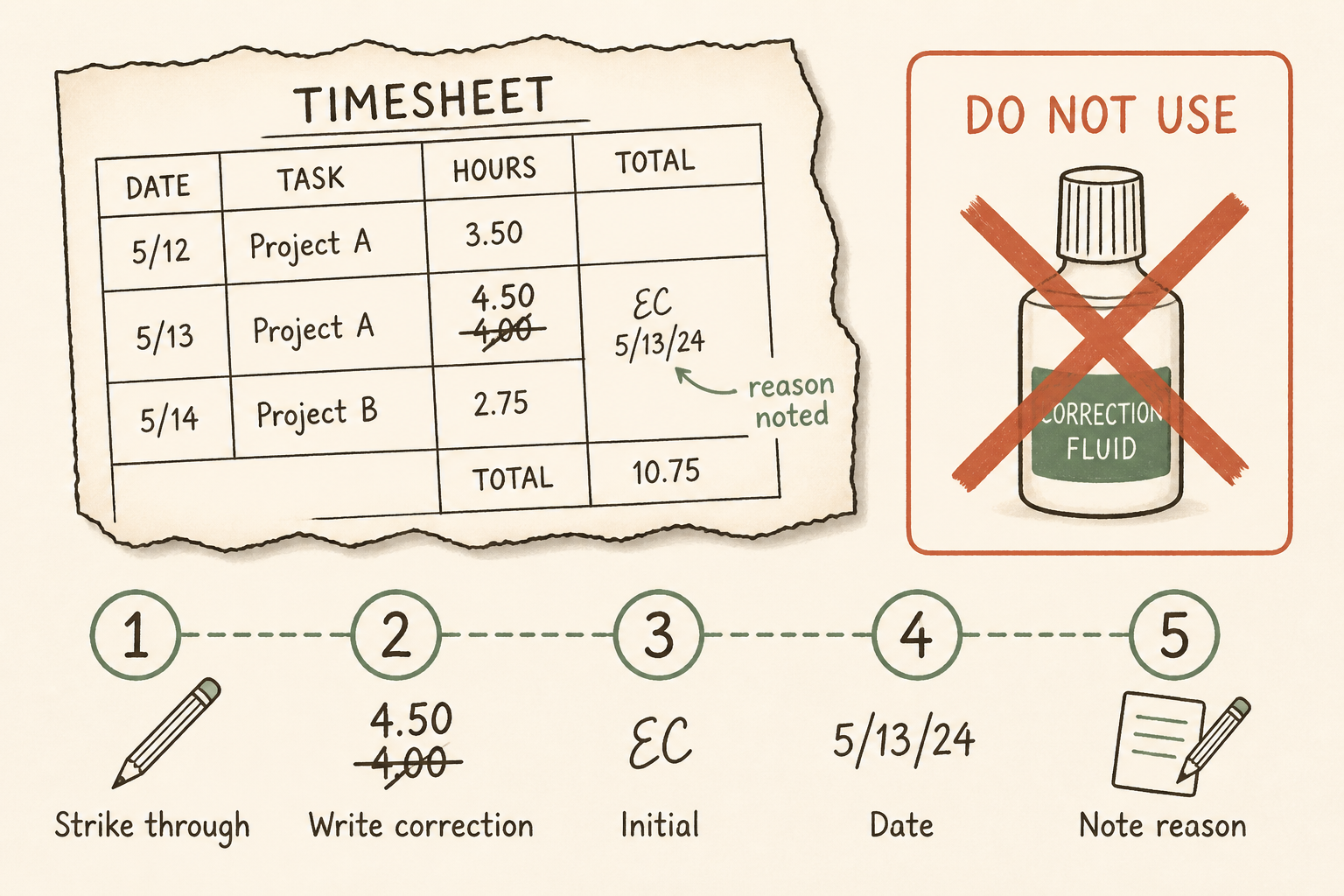
If it doesn't, this is a conservative paper correction method that many auditors and finance staff recognize:
- Draw a single line through the incorrect entry. Keep the original readable.
- Write the corrected entry next to it. Use the margin or open space nearby.
- Add initials or a signature for the person making the correction. Make it clear who changed the record.
- Add the date of the correction. Use the date the correction was made.
- Add a brief note if the reason isn't obvious. Example: “Math error in daily total” or “Wrong service category entered.”
- Check whether revised approval is required. If the correction changes reported service hours, allowable activities, or another item that your process requires someone to approve, obtain that approval under your written policy and award terms.
That last step matters.
A clerical correction and a correction that changes the basis for reporting aren't the same thing.
Electronic records need a correction process too
Electronic records aren't automatically cleaner.
What matters is whether the system, together with your procedures, preserves enough information to show the correction and the approval path.
If your system has an amendment or edit-history function, use it.
If it doesn't, keep a linked correction record outside the system. That can be a dated memo, a correction form, or another document your organization uses consistently.
Don't assume silent overwriting is fine because the final screen looks accurate.
Accuracy without history is fragile.
Late signing and batch approval are real risk points
When members or supervisors sign weeks or months of timesheets all at once, the records become less persuasive.
I'm choosing those words carefully.
I'm not saying every late-signed timesheet is automatically invalid. I'm saying late or batch completion and approval can undermine reliability and may conflict with your AmeriCorps award terms, program guidance, or written procedures.
If the record supports employee compensation charged to the federal award, 2 CFR § 200.430(g) requires records that are supported by a system of internal control and that reasonably reflect the total activity for which the employee is compensated. That section is often cited in timekeeping discussions, but it isn't a blanket rule for every AmeriCorps member service log in every program. Member service records may also be governed by program-specific rules and terms. Check your own award.
A monitor who sees many records signed on one date may treat that pattern as a reliability concern and ask for other contemporaneous support.
That support might include schedules, site calendars, attendance records, service logs, or supervisor notes created at the time.
What to do when you find months of bad records
Take a breath.
Then do these steps in order.
| Step | What to do | What not to do |
|---|---|---|
| 1 | Assess the scope: which members, which periods, what type of defect | Don't start rewriting forms before you know the full problem |
| 2 | Preserve the existing records as they're | Don't discard originals, even if they're messy |
| 3 | Gather other contemporaneous support | Don't create substitute records and make them look original |
| 4 | Write a factual summary of what happened | Don't speculate or assign blame in the file |
| 5 | Check the notice of award, pass-through agreement, program guidance, and internal escalation procedure | Don't assume an informal call satisfies formal notice requirements |
| 6 | Follow the required reporting channel, if reporting is required | Don't guess whether your state commission, pass-through entity, or AmeriCorps official is the right contact |
| 7 | Put corrective controls in place for future periods | Don't stop at fixing the old paperwork |
You may need to notify a state service commission, a pass-through entity, an AmeriCorps award official, or another party named in your award documents. That varies. Your terms and conditions control.
If you can substantiate service through other records created at the time, label that support honestly.
Say what it's.
Reconstructed support isn't the same thing as an original contemporaneous timesheet. That doesn't make it worthless. It means you shouldn't disguise it.
Preserve the original. Tell the truth about the correction. Let the file show its own history.
Build the workflow that prevents the next one
Most timesheet problems aren't ethics problems.
They're workflow problems.
A process that depends on one person remembering, every week, under pressure, with no backup, will fail eventually.
Use a routine that's boring enough to survive real life:
- a fixed submission day
- a fixed review day
- a written deadline
- a documented follow-up when a record is late
- a supervisor who knows what review is required before approval
That isn't glamorous.
It's what good internal control looks like under 2 CFR § 200.303.
Train supervisors to review, not only approve
You know this already.
A signature with no review behind it doesn't protect the program.
Supervisors should do the review required by your form, policy, and award terms before approving a record. That may include checking whether the dates make sense, whether the hours align with the member's schedule or the employee's work pattern, and whether the activities fit the approved category.
If you've never shown supervisors how to correct a record, do that now.
People reach for the eraser when nobody has handed them a better procedure.
Bottom line
Don't hide the original entry.
Correct the record in a way that preserves its history. Follow your written procedure. If your procedure is thin, tighten it. If the problem is larger than one entry, preserve what exists, gather support, and check the reporting path in your award documents before you assume anything.
And before publishing a policy memo or training staff, verify every requirement you rely on against the current eCFR.
A quick reminder
AmeriCorps grants can vary from one to the next. If you’re unsure how a rule applies to your program, check with your commission or designated point of contact at the AmeriCorps agency for any additional guidance and clarifications. They know your award terms best.
Questions people ask
- Can you white out a mistake on a signed AmeriCorps timesheet?
As a conservative practice, no. White-out or erasure can obscure the original entry and weaken the record's audit trail. The safer approach is to follow your written correction procedure so the original remains readable and the file shows the correction, who made it, and when. This fits the internal-control and record-retention expectations in 2 CFR § 200.303 and 2 CFR § 200.334.
- What's an audit trail on a timesheet?
It's the visible history of the record: the original entry, the correction, who made the change, and when. On paper, that often means the original stays legible. In an electronic process, it may mean change history or a linked correction log. The goal is a recordkeeping system that remains reliable and reviewable under 2 CFR § 200.303.
- Why is retroactive batch signing of timesheets a compliance problem?
Because it can make the records less reliable and may conflict with your award terms, program guidance, or written procedures. If the record supports employee compensation charged to the award, 2 CFR § 200.430(g) is often relevant. For member service records, requirements may come from AmeriCorps-specific rules and terms instead. In both cases, a pattern of late signing can lead a reviewer to ask for other contemporaneous support.
- What should a program do if it discovers months of improperly documented timesheets?
First, preserve the existing records. Second, assess the scope of the problem. Third, gather other contemporaneous support such as schedules or attendance records. Fourth, document the issue factually without backdating or creating replacement records that look original. Fifth, check the notice of award, pass-through agreement, program guidance, and internal procedures to determine whether and where notice is required, because the reporting path varies.
- How should electronic timekeeping corrections be handled?
Use the correction workflow authorized by your organization. If the system retains edit history, use that feature. If it doesn't, maintain a separate dated correction record linked to the original entry and required approvals. The point isn't a specific software feature. The point is preserving reliable records and internal controls consistent with 2 CFR § 200.303 and your award terms.
- What if my grant comes through a state or territory service commission?
- Check your commission’s current requirements too. They may be stricter than the federal floor, and stricter is what you follow. What a commission can’t do is override controlling federal law, regulation, or your AmeriCorps award terms, and it can grant only the waivers it’s authorized to grant. Read this post alongside your commission’s guidance, your award terms, and your written policies — and when something looks like a real conflict, ask your commission or program officer rather than guessing.
About the author
Gary Kosman is the founder and CEO of America Learns. He has worked with AmeriCorps programs and state service commissions for more than two decades, helping organizations strengthen the systems they use to manage members, grants, reporting, compliance, and impact. Reach him at gary@americalearns.net or 310-689-0542 x101.
Last reviewed August 9, 2026. Regulations change. Verify every citation against the current eCFR text and your own grant terms and conditions before you rely on it.
Looking for another topic?
Browse all compliance topics — from timesheets and member files to financial and progress reporting.
Browse topicsKeep reading on member timesheets and related topics
Member Timesheets/August 12, 2026
What AmeriCorps Members Cannot Do on Service Time
The first question is about time and duties. If a member or staff person engages in a prohibited activity while charging time to the AmeriCorps program, accumulating service or training hours, or otherwise performing activities supported by the AmeriCorps program or AmeriCorps, your program should review the record promptly under its written procedures, award terms, and any applicable AmeriCorps or pass-through instructions. Private-citizen participation in the listed activities has its own conditions too, including a logo instruction in the regulation.
Member Timesheets/August 5, 2026
What OIG Notices First in Timekeeping Records
You may not be worried about a fraudster. You are worried about exhausted staff, late timesheets, and records that get cleaned up after the fact. That's exactly why this matters.
Member Timesheets/July 21, 2026
What Has to Be on an AmeriCorps Member Timesheet
For AmeriCorps State and National, a member timesheet is evidence about service hours, hour categories, and approvals under the rules that apply to your award. It isn't the same thing as payroll support for staff salaries.
OIG Findings/September 4, 2026
How Commissions Can Catch Timesheet and Term Errors Early
When education awards are tied to weak time records or unsupported service-term changes, the cost lands late and hard. A commission can catch most of it before exit with a tighter review sequence.
Performance Measurement/September 2, 2026
Your Data-Collection System Is Part of Your Audit Trail
Surveys, logs, and tests can become Federal award records. Federal rules do not require you to keep every draft or form configuration — they require retention of the records and supporting documentation that substantiate what you reported. ([2 CFR § 200.334](https://www.ecfr.gov/current/title-2/section-200.334))