Internal Controls That Save a Two-Person Program
When your office is tiny, internal controls can sound like a luxury meant for bigger shops. They aren't. They're the repeatable habits that catch mistakes early, document review, and protect your AmeriCorps grant later.
Drafted with AI assistance, checked against primary sources, reviewed and approved by Gary Kosman on August 9, 2026.
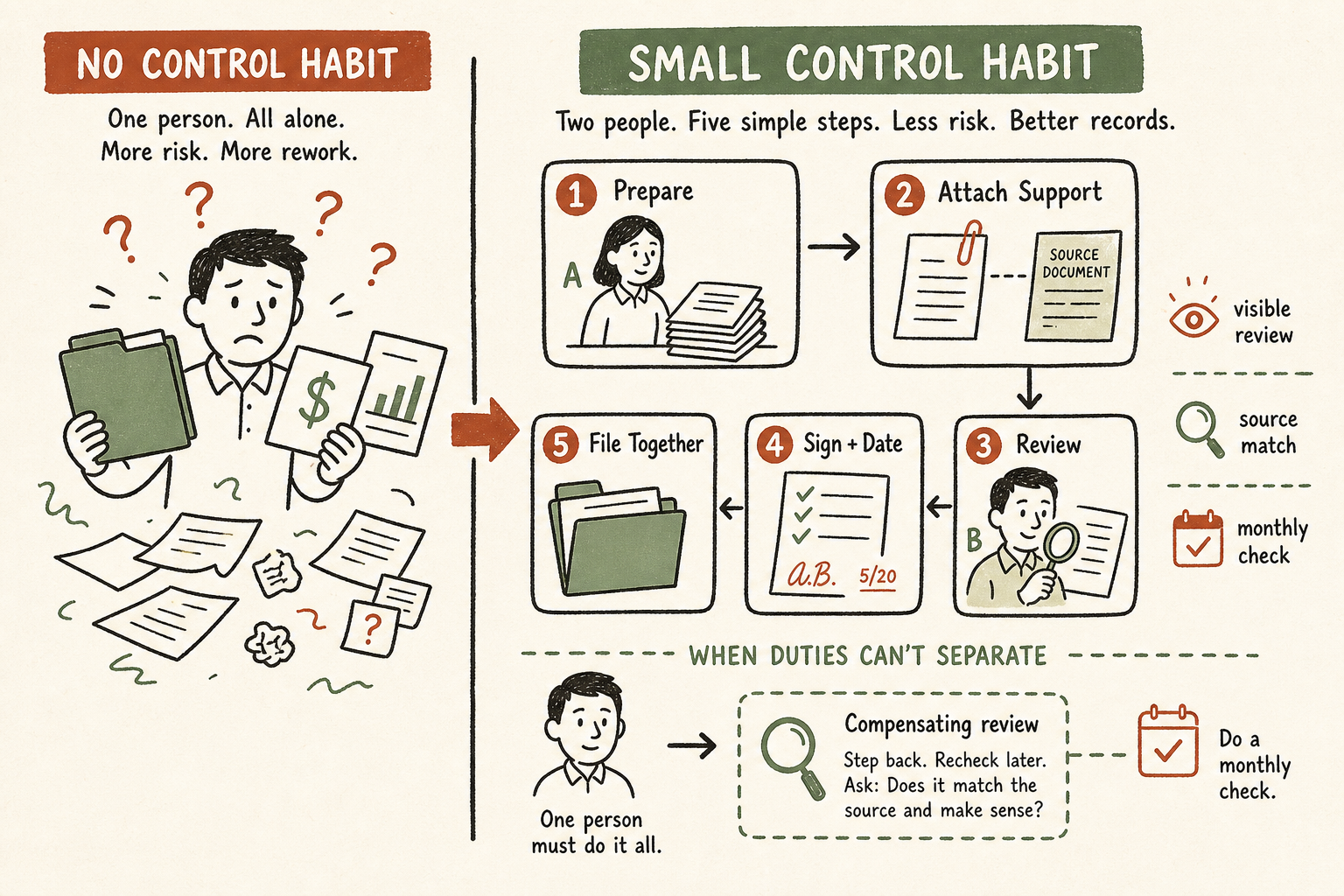
Internal controls aren't extra paperwork
They're the habits that keep a bad week from becoming an audit finding.
You know the feeling.
A reimbursement is due. A member file is half-updated. Someone's waiting on your answer. You're also the one who approves invoices, reviews timesheets, trains staff, and remembers where the signed forms live.
That doesn't mean you're careless.
It means you're carrying too much in too few hands.
That's why internal controls matter.
Under the Uniform Guidance, recipients and subrecipients must establish, document, and maintain effective internal control over the federal award that provides reasonable assurance they are managing the award in compliance with federal statutes, regulations, and the terms and conditions of the award. That's in 2 CFR § 200.303.
Reasonable assurance.
Not perfection.
That matters, because self-criticism shows up fast in compliance work.
When something's missing, people hide. They postpone the folder review. They tell themselves they'll fix it next week. They avoid asking a basic question because they think they should already know the answer.
You don't need more self-criticism.
You need a control set small enough to survive real life.
The AmeriCorps Office of Inspector General Anti-Fraud Advisories page includes an advisory titled Vol. 8: Why Do You Need Internal Controls? If you want the OIG's framing, check the current advisory text there. And before you update your procedures, verify the current regulatory text in the eCFR.
What internal control means in a two-person office
In a larger organization, people talk about segregation of duties as if it's a switch you can flip.
One person initiates.
Another approves.
A third reconciles.
A fourth monitors.
That's lovely when you have four people.
A lot of AmeriCorps programs don't.
If there are only two of you, or one and a part-time finance lead somewhere else in the building, the question isn't whether you can create perfect separation.
You probably can't.
The question is whether you can create a second look that's real.
Enough friction that errors get noticed.
Enough friction that fraud is harder to pull off.
Enough documentation that an auditor or monitor can see who did what, when, and on what basis.
For a small office, that's a practical way to support the reasonable-assurance standard in 2 CFR § 200.303.
So if one person has to prepare something, build a second step that's visible when you can.
Visible is the word that matters.
A review that leaves evidence is far easier to demonstrate and sustain than one that exists only in memory.
The smallest control set worth having
If your office is stretched thin, start here.
Not with a twenty-page manual.
With five habits.
1. Separate preparation from review whenever you can
If one person prepares a transaction, report, draw request, journal entry, or member-related record, another person should review it before it's final whenever staffing allows.
In a two-person office, that often means one person prepares and the other person reviews.
If your structure makes that impossible for a specific task, move the review up a level or outward. That could be an executive director, fiscal officer, grants manager, or board treasurer, depending on your organization's structure, internal approval authorities, and grant terms.
Practice varies here, so check your own terms and conditions.
The key is this: the reviewer needs enough information to verify the item, not merely bless it.
That means the preparer attaches or points to the support.
Not "looks right."
Support.
2. Leave evidence that review happened
A documented control will help you much more later.
For every recurring compliance task, decide what review evidence will look like.
Then use the same evidence every time.
For example, your review evidence might be:
- initials and date on a printed checklist,
- an approval email saved with the record,
- tracked changes or comments on a draft,
- a sign-off line on a reconciliation,
- a dated note on a cover sheet,
- a routing log that shows preparation and approval.
Pick one method per process if you can.
Consistency saves time.
It also keeps you from arguing with your future self about whether review really happened.
3. Match records to source support
Amounts charged to a federal award must be adequately documented under 2 CFR § 200.403(g). Federal award records also have to be retained and available as required by 2 CFR § 200.334.
That doesn't mean "attach everything."
It means you should know what supports the charge, report, or file entry, and keep that support where a reviewer can find it.
A source document.
A supporting schedule.
An approved form.
A roster.
An invoice.
A payroll record.
A certification, if one is required by the program or the award.
The exact support will differ by process, and your grant terms may add requirements beyond the baseline federal rule.
The control isn't the folder.
The control is the match.
4. Reconcile on a schedule
Some mistakes don't look like mistakes until you compare two records that should agree.
That's what reconciliation is for.
A monthly cadence is often a practical management choice for grant and accounting processes, but required timing depends on the award, applicable rules, and your organization's policies.
On the scheduled date, compare the report to the ledger.
Compare the roster to the files.
Compare the payments to the approvals.
Compare the checklist to the actual documents.
Then document who reconciled, what period was covered, what differences were found, and how they were resolved.
If nothing was off, write that down too.
No one remembers a clean review six months later.
5. Use a checklist for recurring high-risk tasks
Checklists don't make work bureaucratic.
They make work repeatable.
That's different.
For every process you do more than once, create a one-page checklist in the exact order the task should happen.
Short.
Specific.
Complete enough that a tired person can still use it.
A good checklist includes:
| Element | What to include |
|---|---|
| Task name | The process being reviewed |
| Trigger date | When the review happens |
| Preparer | Who completes the first step |
| Reviewer | Who checks it |
| Source documents | What records must be present |
| Review steps | The exact checks, in order |
| Sign-off | Name, date, and outcome |
| Follow-up | Where corrections are noted |
That one page does a lot of work.
It trains.
It standardizes.
It proves review.
It lowers the odds that stress will erase a step.
What to do when segregation of duties isn't fully possible
Say it plainly in your procedures.
Don't pretend your staffing chart is something it isn't.
If the same person must handle more than one part of a process, the compensating control should also be plain.
For example:
- If the same person prepares and submits a report, another person reviews the supporting documentation after submission or on a set schedule and signs a dated review log.
- If the same person collects documentation and maintains files, a supervisor performs a periodic spot check against a file checklist and notes exceptions.
- If the same person enters financial information, someone outside the process reviews the reconciliation to source support on a set schedule.
Those are practical examples.
They aren't universal federal scripts.
The point isn't to imitate a big organization's org chart.
The point is to design a second look that's real.
And documented.
Small offices don't need perfect separation. They need visible review they can show later.
Review evidence has to be boring
Boring is good.
Boring means repeatable.
If your review evidence depends on a reviewer composing a thoughtful paragraph every time, it probably won't happen every time.
Use a predictable format.
Date.
Name.
Scope of review.
Result.
Correction, if needed.
For many routine internal reviews, those elements can create useful evidence. Add detail when the transaction, risk, award terms, or organizational policy requires it.
What's not enough is an unexplained check mark floating on a page with no date and no reviewer name.
You know how this goes in real life.
Someone leaves.
Someone else takes over.
The monitor asks, "Who reviewed this?"
Silence won't help you then.
A practical monthly control routine
If you need a starting point, use one standing monthly appointment with yourself and your reviewer.
Put it on the calendar, then use the same sequence each month.
- Pull the recurring records for the month.
- Use the checklist for each process.
- Confirm the source documents are present.
- Compare the item to its support.
- Note any correction needed.
- Make the correction.
- Record who reviewed and when.
- File the checklist with the supporting record.
Do it in that order.
Don't file first and plan to review later.
Later is where missing evidence goes to live.
What this looks like in policy
Your written procedure doesn't need to be fancy.
It does need to answer five questions.
For each recurring grant process, state:
- What is being reviewed?
- Who prepares it?
- Who reviews it?
- What documents support it?
- What proves the review occurred?
That's enough to turn good intentions into an actual control routine.
And yes, some organizations will want more detail.
But if your current system is mostly tribal knowledge and crossed fingers, this is a strong upgrade.
The regulation, the OIG, and your day-to-day work
The federal rule gives you the obligation to maintain effective internal control over the award under 2 CFR § 200.303.
The OIG's Anti-Fraud Advisories page gives you a place to check current OIG guidance, including the advisory titled Vol. 8: Why Do You Need Internal Controls?
Your daily work is where those two meet.
Not in a binder no one opens.
In a dated sign-off.
A saved approval.
A checklist with initials.
A periodic review that happened when it was supposed to happen.
If you're running a two-person office, don't wait to build the ideal control environment.
Build the smallest one that will hold.
Then use it every time.
That's what saves you later.
A quick reminder
AmeriCorps grants can vary from one to the next. If you’re unsure how a rule applies to your program, check with your commission or designated point of contact at the AmeriCorps agency for any additional guidance and clarifications. They know your award terms best.
Questions people ask
- Can a two-person AmeriCorps office still have adequate internal controls?
Yes. 2 CFR § 200.303 requires effective internal control that provides reasonable assurance of compliance. In a small office, that often means using documented review steps, source support, reconciliations, and other compensating controls when full segregation of duties isn't feasible.
- What counts as evidence that a review happened?
Good review evidence is dated, attributable, and tied to the record being reviewed. That can be initials and date on a checklist, an approval email saved with the file, a signed reconciliation, or comments on a draft. For many routine internal reviews, the key is that an outside reviewer can tell who reviewed the item, when, and what was reviewed; higher-risk items or specific award terms may require more detail.
- What if the same person has to prepare and submit the report?
Then add a compensating control. A common approach is to have a second person review the supporting documentation after submission or on a set schedule and document that review. 2 CFR § 200.303 doesn't prescribe one exact method, so your procedure should say who reviews, what they compare, when they do it, and what record shows it happened.
- Do internal controls have to be written down?
Not as a universal rule in the text of 2 CFR § 200.303. That section requires effective internal control. Separate recordkeeping and award requirements may require documentation for specific transactions, costs, reports, or files, including support for allowable costs under 2 CFR § 200.403(g) and retention of award records under 2 CFR § 200.334. In practice, short written procedures and checklists make controls easier to perform consistently and prove later.
- What if my grant comes through a state or territory service commission?
- Check your commission’s current requirements too. They may be stricter than the federal floor, and stricter is what you follow. What a commission can’t do is override controlling federal law, regulation, or your AmeriCorps award terms, and it can grant only the waivers it’s authorized to grant. Read this post alongside your commission’s guidance, your award terms, and your written policies — and when something looks like a real conflict, ask your commission or program officer rather than guessing.
About the author
Gary Kosman is the founder and CEO of America Learns. He has worked with AmeriCorps programs and state service commissions for more than two decades, helping organizations strengthen the systems they use to manage members, grants, reporting, compliance, and impact. Reach him at gary@americalearns.net or 310-689-0542 x101.
Last reviewed August 9, 2026. Regulations change. Verify every citation against the current eCFR text and your own grant terms and conditions before you rely on it.
Looking for another topic?
Browse all compliance topics — from timesheets and member files to financial and progress reporting.
Browse topicsKeep reading on oig findings and related topics
OIG Findings/September 4, 2026
How Commissions Can Catch Timesheet and Term Errors Early
When education awards are tied to weak time records or unsupported service-term changes, the cost lands late and hard. A commission can catch most of it before exit with a tighter review sequence.
OIG Findings/August 5, 2026
What to Reconcile Before AmeriCorps Grant Closeout
Closeout is where old mistakes stop hiding. Before the final package leaves your desk, make sure your cash, reports, and supporting records tell the same story.
OIG Findings/July 31, 2026
The AmeriCorps OIG Findings That Keep Coming Back
Published AmeriCorps OIG reports often point to the same kinds of compliance breakdowns. Here's where the patterns tend to show up, why good organizations still get caught there, and the control that helps.
Performance Measurement/September 2, 2026
Your Data-Collection System Is Part of Your Audit Trail
Surveys, logs, and tests can become Federal award records. Federal rules do not require you to keep every draft or form configuration — they require retention of the records and supporting documentation that substantiate what you reported. ([2 CFR § 200.334](https://www.ecfr.gov/current/title-2/section-200.334))
2 CFR 200 Basics/August 18, 2026
When Staff Duties and Timesheets Don’t Match
Salary costs get vulnerable when payroll support, payroll charges, and the role described in your award materials stop lining up. The fix starts with a clean match between supported work, the amount charged, and the staffing picture your award says you funded.