Uniform Guidance for AmeriCorps: 2 CFR part 200 AmeriExplained
If you run an AmeriCorps grant, 2 CFR part 200 shapes much of your daily compliance work. This guide translates the rule into program language and shows how it fits with AmeriCorps regulations and award terms.
Drafted with AI assistance, checked against primary sources, reviewed and approved by Gary Kosman on August 17, 2026.
You don't need to memorize the Uniform Guidance.
You do need to know where it touches your day.
For AmeriCorps programs, that means budgets, internal controls, procurement, reporting, records, closeout, personnel documentation, subrecipient monitoring, and audit readiness.
The Uniform Guidance is 2 CFR part 200. It's the federal government-wide rulebook for managing federal awards.
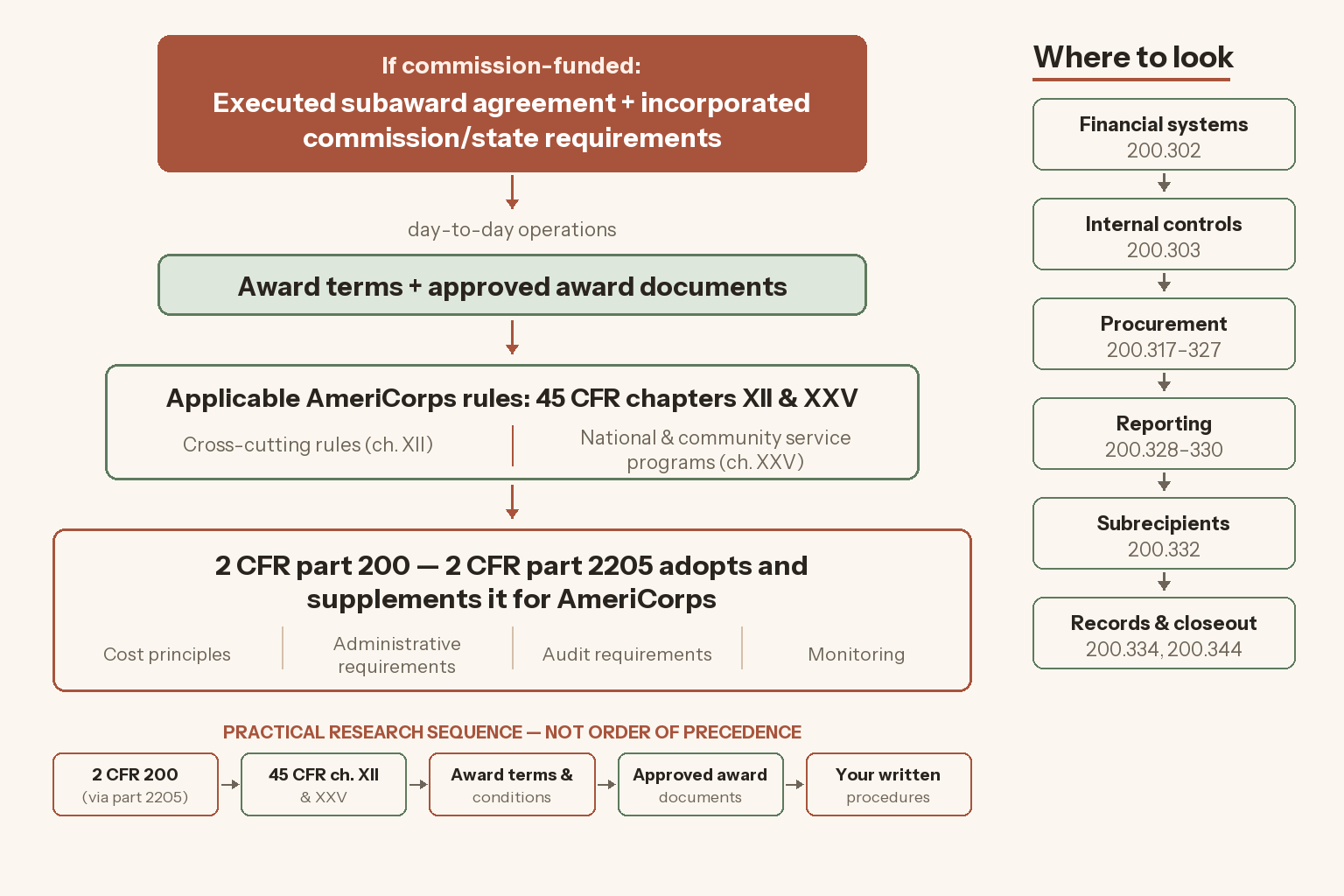
AmeriCorps adopts 2 CFR part 200 through 2 CFR part 2205, alongside the agency's own regulations and the terms incorporated into your award.
If you receive funds through a state or territory commission, you'll also need your executed subaward agreement, any commission or state requirements incorporated into it, and the commission's subaward instructions and required processes. Those instructions may govern how you administer the subaward, but they don't override applicable federal law, regulations, or incorporated award terms.
What 2 CFR part 200 is
Think of 2 CFR part 200 as the baseline federal grants framework.
It tells recipients and subrecipients what the government expects before award, during the award, and after the project ends.
It's not AmeriCorps-specific.
That's why it won't answer every AmeriCorps question about members, service terms, living allowances, criminal history checks, or member files. For those, you also need the AmeriCorps regulations in 45 CFR chapter XXV and the Terms and Conditions attached to your award year.
For State and National programs, that award-terms layer includes the FY 2026 General Terms and Conditions (revised January 27, 2026), which apply across AmeriCorps awards, plus the program-specific 2026 AmeriCorps State and National Terms and Conditions (revised June 23, 2026). Programs operating on an earlier award follow that year's terms, not the newest document by default.
Why it applies to AmeriCorps grants
Because AmeriCorps has adopted this grants framework for its awards.
AmeriCorps adopts 2 CFR part 200 through 2 CFR part 2205, with agency-specific implementation where relevant.
That means when you're building internal controls, reviewing allowability, retaining records, or preparing for audit, the Uniform Guidance isn't background reading. It's part of the controlling authority for the award.
The orientation map you can keep
When you're not sure where a question belongs, start here.
| If your question is about... | Start with... | Then check... |
|---|---|---|
| What a term means | 2 CFR part 200, subpart A | Your award terms if AmeriCorps uses a more specific program term |
| General federal grant rules | 2 CFR part 200, subpart B | 2 CFR part 2205 |
| Applying for or receiving an award | 2 CFR part 200, subpart C | Notice of funding opportunity and award terms |
| Financial systems, reporting, procurement, records, closeout | 2 CFR part 200, subpart D | AmeriCorps regulations and your current Terms and Conditions |
| Whether a cost is allowable | 2 CFR part 200, subpart E | Approved budget, award terms, and agency prior approval rules |
| Audit requirements | 2 CFR part 200, subpart F | Your auditor and current compliance supplement materials |
| Members, service rules, exits, benefits, files | 45 CFR chapter XXV | Program-specific Terms and Conditions |
Start broad with 2 CFR part 200, then move to the AmeriCorps-specific layer that fits your award.
How the subparts map to daily work
Subparts A through C: the setup
Subpart A covers definitions.
That sounds dry until you're trying to decide whether an organization is a contractor or a subrecipient, what counts as equipment, or what a period of performance means. Those definitions shape the compliance path that follows.
Subpart B covers general provisions.
Subpart C covers pre-federal award requirements and contents of federal awards. Most frontline program staff spend less time here once the award is active, but this is part of the framework behind the award document you received.
Subpart D: the part you feel every week
This is where many daily compliance questions land.
The financial management rule is 2 CFR § 200.302, Financial management. It requires financial management systems that can identify federal awards, track funds, and support accurate reporting.
The internal controls rule is 2 CFR § 200.303, Internal controls. It requires the recipient and subrecipient to establish, document, and maintain effective internal control over the federal award; evaluate and monitor compliance; take prompt action when noncompliance is identified; and take reasonable cybersecurity and other measures to safeguard information, including protected personally identifiable information and other sensitive information.
If you're the only person in the office who knows where everything is, this is where the pressure shows up. Internal controls aren't only about fraud. They're also about making sure the work still holds together when someone is out sick, leaves the job, or remembers a step differently than you do.
The procurement standards run from 2 CFR § 200.317, Procurements by States and Indian Tribes through 2 CFR § 200.327, Contract provisions — the range that 2 CFR § 200.318, General procurement standards identifies in paragraph (a). Under 2 CFR § 200.317, Procurements by States and Indian Tribes, a State or Indian Tribe conducting procurement under a Federal award follows the same policies and procedures it uses for procurements with non-Federal funds; if it has no such policies and procedures, it must follow 2 CFR § 200.318, General procurement standards through 2 CFR § 200.327, Contract provisions. In addition to its own policies, it must comply with 2 CFR § 200.321, Contracting with small businesses, minority businesses, women's business enterprises, veteran-owned businesses, and labor surplus area firms, 2 CFR § 200.322, Domestic preferences for procurements, 2 CFR § 200.323, Procurement of recovered materials, and 2 CFR § 200.327, Contract provisions. All other recipients and subrecipients — including subrecipients of a State or Indian Tribe — follow 2 CFR § 200.318, General procurement standards through 2 CFR § 200.327, Contract provisions.
A vendor may be excellent. A longtime partner may be trusted. The federal question is different: did you follow the required process, maintain the required documentation, and avoid conflicts of interest?
Reporting rules sit in 2 CFR § 200.328, Financial reporting, 2 CFR § 200.329, Monitoring and reporting program performance, and 2 CFR § 200.330, Reporting on real property.
The CFR sets outer limits. Under 2 CFR § 200.328, Financial reporting, annual financial reports are due no later than 90 calendar days after the reporting period, quarterly or semiannual reports no later than 30 calendar days, and the recipient's final financial report no later than 120 calendar days after the conclusion of the period of performance. A subrecipient's final financial report to the pass-through entity is due no later than 90 calendar days after the conclusion of the period of performance. Under that same paragraph, the Federal agency or pass-through entity may extend the due date for any financial report with justification from the recipient or subrecipient. 2 CFR § 200.329, Monitoring and reporting program performance sets parallel outer limits for performance reports. Your AmeriCorps award terms and reporting instructions tell you the specific form, schedule, and content expected for your program within that framework.
Subrecipient monitoring is 2 CFR § 200.332, Requirements for pass-through entities.
If you are a pass-through entity, this section isn't optional reading. It covers what has to be in the subaward and what the pass-through entity must do to monitor compliance and performance.
Record retention requirements are in 2 CFR § 200.334, Record retention requirements. Under that section, the general rule is three years from the date of submission of the final financial report. For awards renewed quarterly or annually, the baseline runs three years from the date of submission of that quarterly or annual financial report. Specific exceptions and extensions apply.
One useful line to keep close: under 2 CFR § 200.334, Record retention requirements, Federal agencies and pass-through entities may not impose other record-retention requirements except as that section allows.
Don't rely on muscle memory for the retention period. The answer can change with the record type and with open litigation, claims, or audit activity. Name the record first. Then verify the eCFR version applicable to your award.
Closeout is 2 CFR § 200.344, Closeout.
Closeout isn't the same thing as "we spent the funds." It includes the reporting and financial wrap-up that ends the award administratively. Under that section, recipients generally must submit all required reports no later than 120 calendar days after the period of performance ends, and liquidate all financial obligations no later than 120 calendar days after the period of performance ends. A subrecipient must do both no later than 90 calendar days after the conclusion of the period of performance of the subaward, or an earlier date agreed upon by the pass-through entity and the subrecipient. When justified, the Federal agency or pass-through entity may approve a longer period.
Subpart E: whether a cost can stay in your budget
Subpart E is the cost principles section.
One important distinction: fixed-amount awards aren't administered like cost-reimbursement awards. Under 2 CFR § 200.101(b)(4)(ii), most of subpart E — including § 200.430 — doesn't apply to fixed-amount awards, though §§ 200.400(g), 200.402 through 200.405, and 200.407(d) still do. The personnel-documentation discussion below therefore primarily concerns cost-reimbursement awards. Fixed-amount recipients should follow 2 CFR § 200.201 and the specific terms incorporated into their awards.
The anchor rule is 2 CFR § 200.403, Factors affecting allowability of costs.
This is the test for whether a cost may be charged to the award. A cost has to meet the allowability standards in the rule, be consistent with your award, and not be prohibited elsewhere.
That's the part people miss.
An item can sound reasonable and still fail because the Terms and Conditions, approved budget, prior approval rules, or program-specific restrictions say no.
For personnel documentation, the section most people need is 2 CFR § 200.430(g), Standards for Documentation of Personnel Expenses. That paragraph sits within 2 CFR § 200.430, Compensation—personal services and covers records that accurately reflect the work performed and support the distribution of salary and wages charged to federal awards.
In AmeriCorps settings, this matters for staff payroll allocation and supporting documentation. It's separate from member timekeeping rules that may come from AmeriCorps regulations or award terms.
Subpart F: audit requirements
Subpart F covers audit.
The threshold rule is in 2 CFR § 200.501, Audit requirements. A non-Federal entity that expends $1,000,000 or more in Federal awards during its fiscal year generally must obtain a single audit. It may elect a program-specific audit only if it meets the conditions in that section.
That threshold is based on total federal expenditures in the entity's fiscal year.
It's not based only on your AmeriCorps award amount.
How AmeriCorps rules layer on top
For AmeriCorps, the Uniform Guidance is the base layer.
Then come the applicable AmeriCorps regulations in 45 CFR chapters XII and XXV. Chapter XII carries cross-cutting rules on subjects like nondiscrimination, nondisplacement, electoral and lobbying activities, and disability. For many State and National program issues, you'll often be in 45 CFR part 2520, 45 CFR part 2522, and 45 CFR part 2540, depending on the question.
Then come the annual General Terms and Conditions and your program-specific Terms and Conditions.
This matters because not every operating rule lives in the CFR.
The FY 2026 General Terms and Conditions (revised January 27, 2026) say recipients must comply with the General Terms, the program-specific terms, applicable statutes, executive orders, regulations, guidelines, and amendments, and must operate in accordance with the approved application and budget and supporting materials. They also require the recipient to include in all awards and subawards those General Terms, the program-specific terms, all applicable Federal statutes, applicable executive orders, regulations and guidelines, and any amendments. The 2026 AmeriCorps State and National Terms and Conditions (revised June 23, 2026) add program-specific requirements for State and National awards on topics like member recruitment, enrollment, records, benefits, and budget and programmatic changes.
Those State and National terms aren't universal across every AmeriCorps award. Other award types have their own program-specific terms. Use the terms incorporated into your own award.
Which rule wins when they differ
Use the order-of-precedence section in the terms incorporated into your award.
The current General Terms and Conditions include Section II.C, Order of Precedence. Read that section in the version attached to your award year, because that is the source of record for your grant. The publicly posted FY 2026 General Terms and Conditions (revised January 27, 2026) are one example. An earlier-year award, or a different program award, follows its own incorporated terms.
As a research sequence — not as a substitute for the order of precedence in your award — review:
- The statute and applicable agency regulations.
- The Notice of Grant Award and signature page, and the notice of funding opportunity your award was made under.
- The award's General Terms and program-specific Terms.
- The approved application and budget.
- If you're commission-funded, your executed subaward agreement, any incorporated commission or state requirements, and the commission's subaward instructions.
If two sources seem to point in different directions, don't guess based on the older document you know best.
Check the current award year's Terms. Then verify the eCFR version applicable to your award — a later amendment isn't automatically the one that governs your grant (see 2 CFR § 200.110).
A practical way to use this tomorrow morning
When a compliance question lands on your desk, sort it in this order:
- Is this a federal grants management question, a member-program rule, or both?
- If it's grants management, start in 2 CFR part 200.
- If it's AmeriCorps-specific, go next to the applicable AmeriCorps regulations in 45 CFR chapters XII and XXV.
- Then read the General Terms and the program-specific Terms for your award year.
- If you're under a commission subaward, follow your executed subaward agreement, any incorporated commission or state requirements, and the commission's required process and forms as well.
You don't need every citation in your head.
You need a reliable map.
That's what keeps the work steady.
A quick reminder
AmeriCorps grants can vary from one to the next. If you’re unsure how a rule applies to your program, check with your commission or designated point of contact at the AmeriCorps agency for any additional guidance and clarifications. They know your award terms best.
Questions people ask
- Does 2 CFR part 200 apply to all AmeriCorps programs?
2 CFR part 200 is the baseline federal grants framework that AmeriCorps applies to its awards through 2 CFR part 2205. But it's not the only rule set. AmeriCorps programs also need the applicable regulations in 45 CFR chapter XXV and the General and program-specific Terms and Conditions incorporated into the award.
- What part of the Uniform Guidance matters most in day-to-day grant management?
For most program and fiscal staff, 2 CFR part 200, subpart D comes up most often. It covers financial management, internal controls, procurement, reporting, subrecipient monitoring, records, and closeout. Key sections include 2 CFR § 200.302, Financial management, 2 CFR § 200.303, Internal controls, 2 CFR § 200.332, Requirements for pass-through entities, 2 CFR § 200.334, Record retention requirements, and 2 CFR § 200.344, Closeout. Procurement also lives in that subpart. Under 2 CFR § 200.317, Procurements by States and Indian Tribes, a State or Indian Tribe conducting procurement under a Federal award follows the same policies and procedures it uses for procurements with non-Federal funds; if it has no such policies and procedures, it must follow 2 CFR § 200.318, General procurement standards through 2 CFR § 200.327, Contract provisions. In addition to its own policies and procedures, a State or Indian Tribe must also comply with 2 CFR § 200.321, Contracting with small businesses, minority businesses, women's business enterprises, veteran-owned businesses, and labor surplus area firms, 2 CFR § 200.322, Domestic preferences for procurements, 2 CFR § 200.323, Procurement of recovered materials, and 2 CFR § 200.327, Contract provisions. All other recipients and subrecipients — including subrecipients of a State or Indian Tribe — follow 2 CFR § 200.318, General procurement standards through 2 CFR § 200.327, Contract provisions.
- If the Uniform Guidance and AmeriCorps Terms seem different, which one controls?
Start with Section II.C, Order of Precedence, in the General Terms and Conditions incorporated into your award, because that document tells you how AmeriCorps structures controlling authorities for that award. The publicly posted FY 2026 General Terms and Conditions (revised January 27, 2026) include Section II.C, Order of Precedence, as one example, but an earlier-year or different-program award follows its own incorporated terms. Then verify against the current eCFR text.
- Where do I look for rules on allowable costs and staff time documentation?
Begin with 2 CFR part 200, subpart E. The main allowability test is 2 CFR § 200.403, Factors affecting allowability of costs. For salary and wage support, see 2 CFR § 200.430(g), Standards for Documentation of Personnel Expenses within 2 CFR § 200.430, Compensation—personal services. Then check your approved budget, any prior approval requirements, and the current AmeriCorps Terms and Conditions incorporated into your award. For AmeriCorps member timekeeping, don't stop with 2 CFR § 200.430, Compensation—personal services; member rules may come from 45 CFR chapter XXV or your award terms.
- What is the current single audit threshold for AmeriCorps recipients?
Under 2 CFR § 200.501, Audit requirements, a non-Federal entity that expends $1,000,000 or more in Federal awards during its fiscal year generally must obtain a single audit. It may elect a program-specific audit only if it meets the conditions in that section. The threshold is based on total federal expenditures for the entity's fiscal year, not only on the size of the AmeriCorps award.
- What if my grant comes through a state or territory service commission?
- Check your commission’s current requirements too. They may be stricter than the federal floor, and stricter is what you follow. What a commission can’t do is override controlling federal law, regulation, or your AmeriCorps award terms, and it can grant only the waivers it’s authorized to grant. Read this post alongside your commission’s guidance, your award terms, and your written policies — and when something looks like a real conflict, ask your commission or program officer rather than guessing.
About the author
Gary Kosman is the founder and CEO of America Learns. He has worked with AmeriCorps programs and state service commissions for more than two decades, helping organizations strengthen the systems they use to manage members, grants, reporting, compliance, and impact. Reach him at gary@americalearns.net or 310-689-0542 x101.
Last reviewed August 17, 2026. Regulations change. Verify every citation against the current eCFR text and your own grant terms and conditions before you rely on it.
Looking for another topic?
Browse all compliance topics — from timesheets and member files to financial and progress reporting.
Browse topicsKeep reading on 2 cfr 200 basics and related topics
2 CFR 200 Basics/August 18, 2026
When Staff Duties and Timesheets Don’t Match
Salary costs get vulnerable when payroll support, payroll charges, and the role described in your award materials stop lining up. The fix starts with a clean match between supported work, the amount charged, and the staffing picture your award says you funded.
2 CFR 200 Basics/August 14, 2026
A Calm 60-Day Plan for Start-Up Compliance
If you're starting late and carrying the grant mostly alone, you don't need a perfect launch. You need the right compliance pieces in the right order so member files, timekeeping, financial controls, and data collection can hold up.
2 CFR 200 Basics/August 6, 2026
Terms and Conditions Beat Assumptions Every Time
When the Uniform Guidance leaves room for interpretation, your AmeriCorps award documents often decide the operational answer. The control isn't knowing every rule by memory. It's keeping the executed award, its incorporated terms, and any modifications in front of every person who approves spending.
OIG Findings/September 4, 2026
How Commissions Can Catch Timesheet and Term Errors Early
When education awards are tied to weak time records or unsupported service-term changes, the cost lands late and hard. A commission can catch most of it before exit with a tighter review sequence.
Performance Measurement/September 2, 2026
Your Data-Collection System Is Part of Your Audit Trail
Surveys, logs, and tests can become Federal award records. Federal rules do not require you to keep every draft or form configuration — they require retention of the records and supporting documentation that substantiate what you reported. ([2 CFR § 200.334](https://www.ecfr.gov/current/title-2/section-200.334))