What OIG Notices First in Timekeeping Records
You may not be worried about a fraudster. You are worried about exhausted staff, late timesheets, and records that get cleaned up after the fact. That's exactly why this matters.
Drafted with AI assistance, checked against primary sources, reviewed and approved by Gary Kosman on August 9, 2026.
You don't need a villain for a timekeeping problem to become an OIG problem.
You need a rushed month. A supervisor covering two vacancies. A staff member who plans to fix the record later. A total that looks close enough. Avoidance does the rest.
When records are messy, people hide. They postpone corrections. They fill in blanks from memory. They change a line without writing down why. Not because they're criminal masterminds. Because they're embarrassed, tired, and trying to keep the program moving.
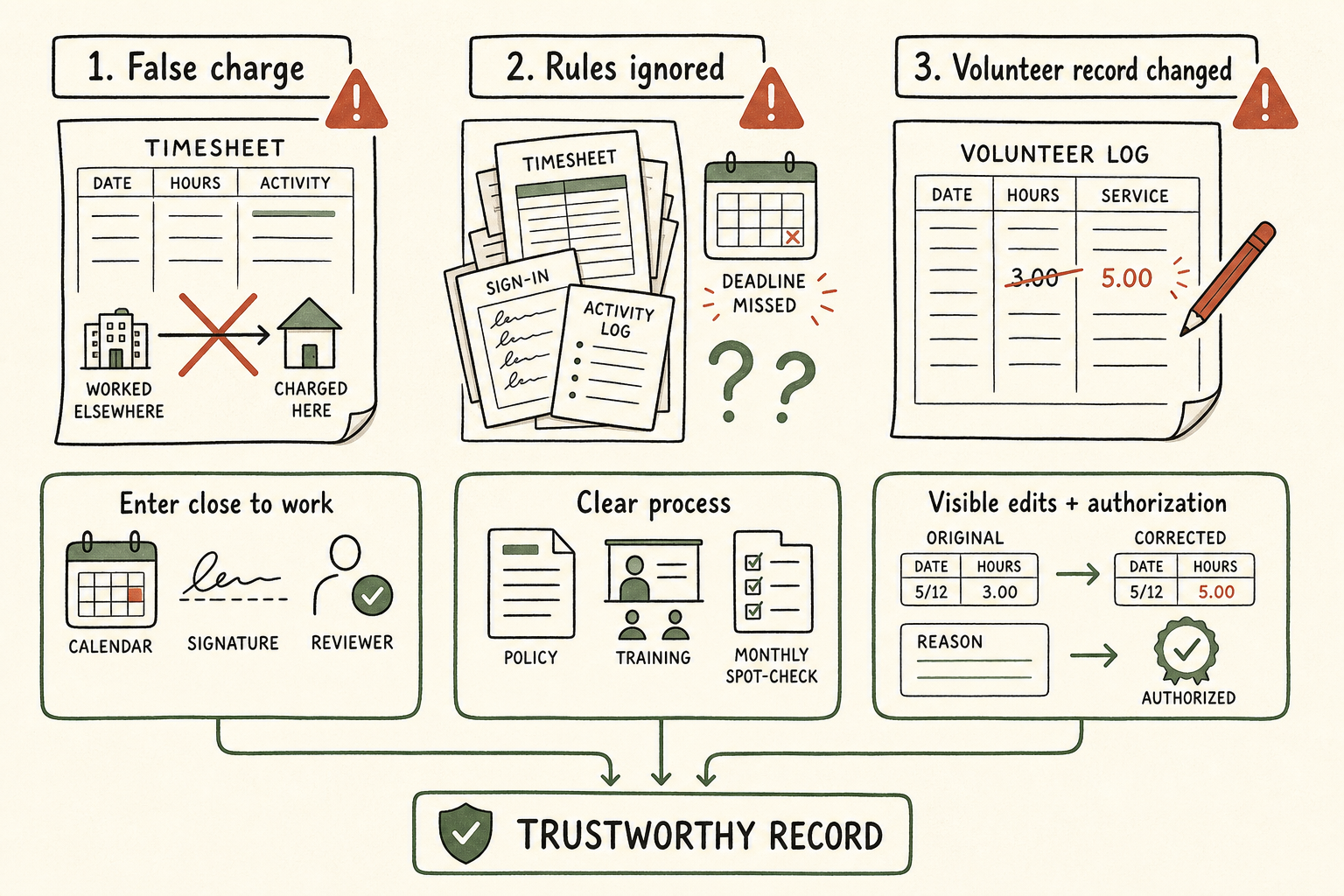
The AmeriCorps Office of Inspector General's Anti-Fraud Advisory Vol. 2: What is Timekeeping Fraud describes three patterns the OIG is watching for: intentionally charging time to an AmeriCorps grant that is knowingly false or incorrect, reckless disregard for timekeeping laws, rules, and regulations, and staff modifying volunteer time records without any basis or authorization. The advisory also says that 30% of OIG investigation cases opened since 2019 related to allegations of false or problematic timekeeping.
That's not niche.
It's management.
And if you're the person holding the grant together, the useful question isn't, "How do I catch a fraudster?"
It's, "What control keeps an ordinary bad month from becoming a false record?"
Sloppy systems create the cover that intentional misconduct needs.
Start with the baseline rule. For compensation charged to a federal award, 2 CFR § 200.430(g) requires records that accurately reflect the work performed; are supported by internal controls providing reasonable assurance that charges are accurate, allowable, and properly allocated; are incorporated into official records; and reasonably reflect the employee's total activity, including federally assisted and other activities. AmeriCorps State and National programs must also follow applicable program-specific requirements in 45 CFR part 2520 and 45 CFR part 2522, along with the terms of the particular award. Those parts address program and member requirements. The core federal personnel-cost documentation rule is still 2 CFR § 200.430(g). Check your own award, and verify against the current eCFR text before you revise a form or process.
Pattern one: knowingly false or incorrect charges
This is the one people picture first.
Someone charges time to the AmeriCorps grant that they know isn't true.
The OIG names it directly in the advisory. You don't need a dramatic scheme for this to happen. You need a record that can be filled out after memory has faded, without a specific review against actual work performed.
The control that matters most is contemporaneous accountability.
Not theater.
Not a signature at the bottom of the month.
A record created close enough to the work that the person entering time is documenting what happened, not reconstructing what ought to have happened.
Here's what that looks like in practice.
Control set for pattern one
-
Set the reporting period in advance. Decide whether staff and members report daily, weekly, or by another fixed interval allowed by your system and award terms. Write it down. Use the same interval every period.
-
Require entry close to the work performed. Daily entry or entry within a short, defined window is a common internal-control practice. The regulation doesn't prescribe one universal daily deadline for every situation, so if your practice varies, say so in policy and confirm it fits your award terms.
-
Use activity lines that match real work. If your categories are vague, people guess. If your categories mirror actual grant-funded activities, cost share activities, leave, and non-grant work, people can choose accurately.
-
Use documented confirmation by the person who performed the work or service when your rules call for it. Your award, program rules, or internal procedure may require a certification, signature, or electronic attestation. Even where a signature isn't specifically required, the record still has to meet the documentation standards in 2 CFR § 200.430(g).
-
Assign review to someone who can assess the record meaningfully. As an internal-control practice, the reviewer should know enough about the work, assignments, or supporting information to tell whether the record is plausible and coded correctly. Follow any more specific review requirements in your award or policy.
-
Document corrections in a visible, retained way. This is a strong internal-control practice, not a universal format required by 2 CFR § 200.430(g). If a correction is needed, keep the original entry or other retained correction record, plus the date of the change, who made it, and why.
-
Separate correction from approval when possible. If one person can enter, edit, and approve the same record without review, you're depending on trust alone.
What breaks this control?
Backdating.
Pre-populating full schedules and calling them actual time.
Approving from memory.
Treating certification as a formality.
None of that proves fraud by itself. But all of it creates the condition where knowingly false charging can sit in plain view.
Pattern two: reckless disregard for timekeeping rules
This pattern feels less dramatic. It should worry you more.
Because reckless disregard grows in offices full of good people.
The OIG's advisory includes reckless disregard for timekeeping laws, rules, and regulations as timekeeping fraud. That's a high-stakes reminder that "we were overwhelmed" doesn't fix a record that wasn't maintained with care.
You don't protect your team by pretending the rules are obvious.
You protect them by making the right action the easy action.
The control that matters most here is clarity before discretion.
If staff have to improvise the rules, your system is already failing them.
Control set for pattern two
| Risk point | Preventive control | What to check monthly |
|---|---|---|
| People don't know what counts as grant time | Written timekeeping instructions tied to actual roles and activities | Ask one employee and one supervisor to explain the categories without prompts |
| Deadlines slide until everyone reconstructs time later | Fixed due dates and fixed approval dates for every period | Compare submission dates to the posted schedule |
| Review happens without enough attention | Reviewer checklist with 3-5 specific questions | Spot-check whether the checklist was completed, not assumed |
| Corrections happen informally | Written correction procedure with reason required | Review all edited records in the period |
| Different sites do it different ways | One organization-wide standard, with documented exceptions only where necessary | Confirm all locations used the same form and instructions, or that approved exceptions were documented |
Now make it procedural.
Start with a one-page policy.
Not ten pages nobody reads.
One page that answers these questions in order:
- Who completes the record.
- When it must be completed.
- What categories to use.
- Who reviews it.
- When approval is due.
- How corrections are made.
- What documentation must be kept with the record, if any.
- Where the final record is stored.
Then train to the policy.
Not once at orientation and never again.
Train when someone changes roles. Train when forms change. Train when you see the same mistake twice.
Then test the policy.
Pick five records from last month.
For each one, ask:
- Was it entered on time under your policy?
- Was any required certification or confirmation completed?
- Was it reviewed the way your procedure requires?
- Were any corrections documented clearly enough that another reviewer could follow them later?
- If activity crossed funding sources or functions, was the allocation understandable from the record?
If you can't answer yes with confidence, don't hide the folder and hope for a better sample next month.
That's worry talking.
Write down the gap. Fix the process. Move forward.
Pattern three: staff modifying volunteer time records without basis or authorization
This one is painfully specific.
And that's why it matters.
The OIG advisory identifies staff modifying volunteer time records without any basis or authorization as a form of timekeeping fraud.
Notice what makes the problem plain.
No basis.
No authorization.
That means your control has to answer two separate questions every time a volunteer record changes:
- Why was this changed?
- Who had authority to make or approve that change?
The control that matters most here is change transparency.
If a volunteer time record can be adjusted quietly because a total "looked off" or a staff person thought they knew what the volunteer meant, your process is unsafe.
Control set for pattern three
-
Define who owns the original volunteer record. Decide whether the volunteer completes it, certifies it, or confirms it in another documented way consistent with your process.
-
Define who may request a correction. Usually that should be the volunteer, or a staff reviewer returning the record for clarification rather than making the change alone.
-
Define who may enter the correction. If staff enter corrections on behalf of a volunteer, the record should show the basis for the change and the volunteer's authorization or confirmation, according to your procedure and any applicable award requirements.
-
Require a reason for every change. "Math correction," "date transposed," or "activity reclassified after review" is better than silence. Specific beats vague.
-
Retain the history. Keep the original entry, the changed entry, who changed it, when, and the authorization or basis supporting it, or keep another retained correction record that shows the same information.
-
Review edited volunteer records separately. Don't bury them in the full batch. A short monthly edited-records review catches patterns early.
This is where many teams get into trouble while trying to be helpful.
A staff person sees an incomplete volunteer record and fixes it to keep the file moving.
A coordinator rounds time because the total seems more plausible.
Someone updates several entries before a deadline because they "know what the volunteer meant."
Those practices are risky when they lack a documented basis and appropriate authorization. A legitimate correction should be supported and handled under your documented procedure and any applicable award requirements.
The control map that keeps a sloppy month from becoming a false record
You don't need twenty new forms.
You need three guardrails that match the three patterns.
| OIG pattern | Primary control | Minimum proof the control worked |
|---|---|---|
| Knowingly false or incorrect charging | Contemporaneous entry and meaningful review | Entry timing records, required certification or confirmation if applicable, and evidence the review occurred under policy |
| Reckless disregard for rules | Clear written process and recurring review | Current policy, evidence of training, and documented spot checks |
| Unauthorized modification of volunteer records | Visible correction record and documented authorization | Record of what changed, why it changed, and who authorized it |
That's the strategy.
Make records timely.
Make expectations clear.
Make changes visible.
What to do this month
If your stomach dropped while reading this, start small.
Do these five things in order.
-
Pull one pay period or one service period. Don't audit the whole year first.
-
Identify every edited record in that period. If your system doesn't show edits clearly, determine whether you have another retained correction record that identifies the change, its basis, and approval. If not, treat that as a control gap.
-
Read your current written process against the actual record. Not the process you think people follow. The one the paper proves.
-
Ask two people where they get confused. One preparer. One approver. Confusion is a control finding, not a character flaw.
-
Rewrite one step before the next cycle begins. Tighten due dates. Add a correction reason field. Add a reviewer prompt. Pick one.
Then repeat next month.
This work is unglamorous.
It is also protective.
For your staff.
For your members and volunteers.
For you.
And for the federal record that may someday be read by someone who wasn't in the room when the month went sideways.
When that day comes, what helps most isn't your intention.
It's a record that shows what happened, who knew it, and why any change was made.
That's what trust looks like on paper.
A quick reminder
AmeriCorps grants can vary from one to the next. If you’re unsure how a rule applies to your program, check with your commission or designated point of contact at the AmeriCorps agency for any additional guidance and clarifications. They know your award terms best.
Questions people ask
- Do late timesheets automatically mean fraud?
No. Lateness alone isn't one of the three timekeeping-fraud patterns described in the AmeriCorps OIG's Anti-Fraud Advisory Vol. 2. But late records raise risk because people are more likely to reconstruct time from memory, skip meaningful review, or make undocumented corrections later. They may also violate your award terms or internal policy even when they don't amount to fraud.
- What should a supervisor be looking for when approving time records?
As an internal-control practice, the designated reviewer should have enough knowledge of the work, assignments, or supporting information to assess whether the record is plausible, timely under your policy, and coded correctly. 2 CFR § 200.430(g) requires records that accurately reflect work performed and are supported by internal controls, but it doesn't prescribe one universal approval method. Check your award terms and your own written procedure for any more specific review requirements.
- Can staff ever correct a volunteer time record?
Yes, if your documented process allows it and the change has both a clear basis and appropriate authorization or confirmation. The AmeriCorps OIG's Anti-Fraud Advisory Vol. 2 identifies staff modifying volunteer time records without any basis or authorization as timekeeping fraud. So the safe question isn't whether staff touched the record. It's whether the correction history shows what changed, why it changed, and who authorized it under your procedure.
- What's the core federal rule behind employee timekeeping on grants?
For compensation charged to a federal award, 2 CFR § 200.430(g) requires records that accurately reflect the work performed, are supported by internal controls providing reasonable assurance that charges are accurate, allowable, and properly allocated, are incorporated into official records, and reasonably reflect the employee's total activity, including federally assisted and other activities. For AmeriCorps programs, you should also check applicable requirements in 45 CFR part 2520, 45 CFR part 2522, and your current award terms.
- What if my grant comes through a state or territory service commission?
- Check your commission’s current requirements too. They may be stricter than the federal floor, and stricter is what you follow. What a commission can’t do is override controlling federal law, regulation, or your AmeriCorps award terms, and it can grant only the waivers it’s authorized to grant. Read this post alongside your commission’s guidance, your award terms, and your written policies — and when something looks like a real conflict, ask your commission or program officer rather than guessing.
About the author
Gary Kosman is the founder and CEO of America Learns. He has worked with AmeriCorps programs and state service commissions for more than two decades, helping organizations strengthen the systems they use to manage members, grants, reporting, compliance, and impact. Reach him at gary@americalearns.net or 310-689-0542 x101.
Last reviewed August 9, 2026. Regulations change. Verify every citation against the current eCFR text and your own grant terms and conditions before you rely on it.
Looking for another topic?
Browse all compliance topics — from timesheets and member files to financial and progress reporting.
Browse topicsKeep reading on member timesheets and related topics
Member Timesheets/August 12, 2026
What AmeriCorps Members Cannot Do on Service Time
The first question is about time and duties. If a member or staff person engages in a prohibited activity while charging time to the AmeriCorps program, accumulating service or training hours, or otherwise performing activities supported by the AmeriCorps program or AmeriCorps, your program should review the record promptly under its written procedures, award terms, and any applicable AmeriCorps or pass-through instructions. Private-citizen participation in the listed activities has its own conditions too, including a logo instruction in the regulation.
Member Timesheets/July 23, 2026
How to Fix an AmeriCorps Timesheet Without Making It Worse
Once a signed timesheet exists, it's part of your grant record. Here's how to correct it without hiding the history, and what to do when the problem is bigger than one line item.
Member Timesheets/July 21, 2026
What Has to Be on an AmeriCorps Member Timesheet
For AmeriCorps State and National, a member timesheet is evidence about service hours, hour categories, and approvals under the rules that apply to your award. It isn't the same thing as payroll support for staff salaries.
OIG Findings/September 4, 2026
How Commissions Can Catch Timesheet and Term Errors Early
When education awards are tied to weak time records or unsupported service-term changes, the cost lands late and hard. A commission can catch most of it before exit with a tighter review sequence.
Performance Measurement/September 2, 2026
Your Data-Collection System Is Part of Your Audit Trail
Surveys, logs, and tests can become Federal award records. Federal rules do not require you to keep every draft or form configuration — they require retention of the records and supporting documentation that substantiate what you reported. ([2 CFR § 200.334](https://www.ecfr.gov/current/title-2/section-200.334))