Core AmeriCorps State and National Member File Documents
A baseline checklist for AmeriCorps State and National member files: eligibility, the National Service Criminal History Check, the member agreement, evaluations, service records, exit documentation, and retention.
Drafted with AI assistance, checked against primary sources, reviewed and approved by Gary Kosman on August 18, 2026.
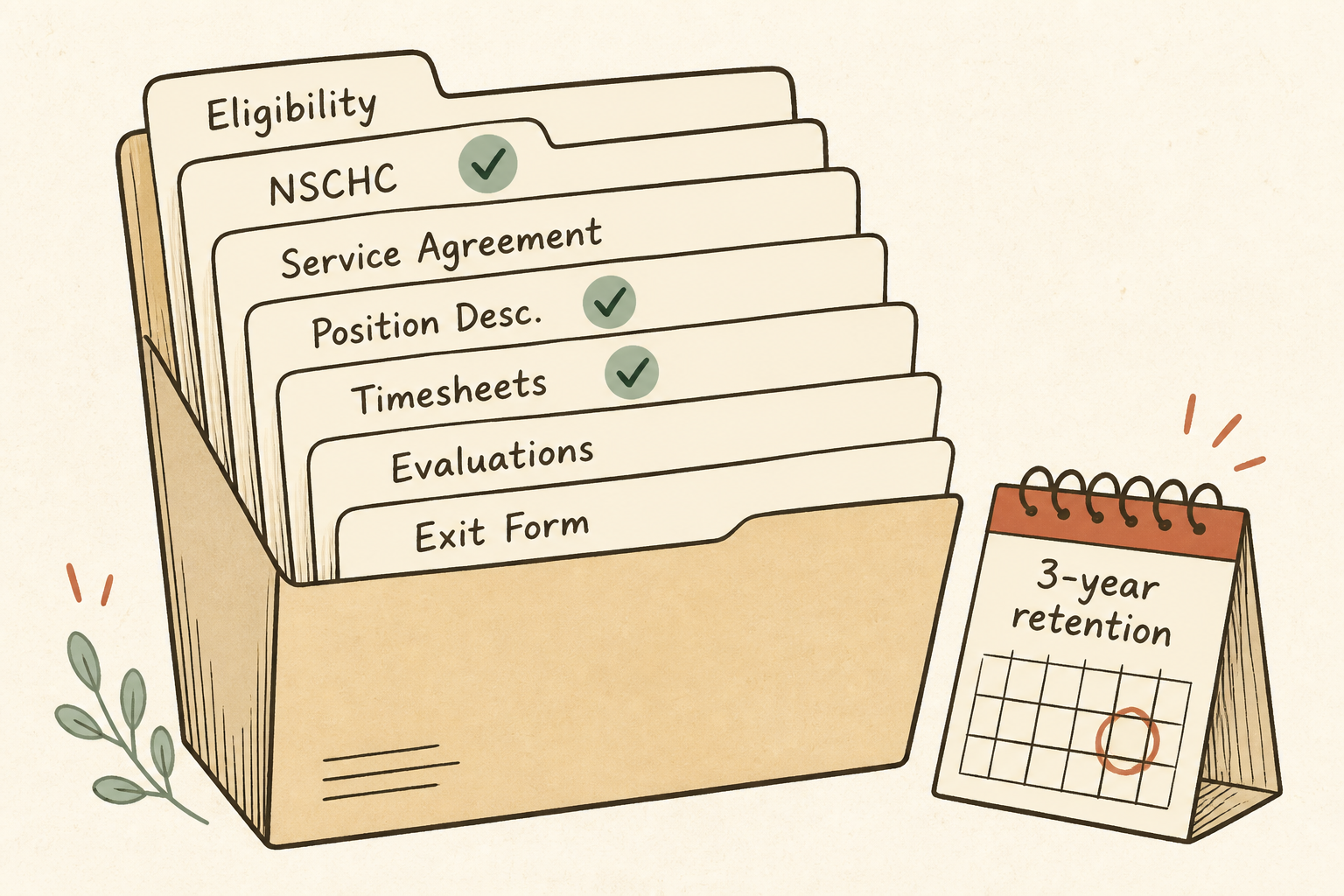
A monitor asks for one member file, and suddenly the whole grant feels exposed.
That feeling doesn't mean you're bad at this.
It means too much compliance risk is sitting inside too few hands.
And avoiding it makes it worse.
When a file is thin, people avoid it. They wait. They hope the missing record will appear later.
Usually, it doesn't.
The member file is where your program proves what happened. Not what you meant to do. Not what people remember. What you can document.
This piece is for AmeriCorps State and National. It's a baseline checklist, not an exhaustive one. Your award terms, commission requirements, and program design may require more. I've kept three things separate all the way through: what regulation requires, what award terms may add, and what many programs keep because it makes review possible.
Start with scope, not folklore
For AmeriCorps State and National, member eligibility rules are in 45 CFR § 2522.200. The required terms of service — hours, evaluations, and educational award eligibility — are in 45 CFR § 2522.220. The written member agreement itself comes from your award terms and your own policy, not from a stand-alone regulation. Record retention under Uniform Guidance is in 2 CFR § 200.334.
The National Service Criminal History Check requirements are in 45 CFR part 2540, subpart B.
That distinction matters.
People say "AmeriCorps" as if one checklist fits every program.
It doesn't.
Eligibility documentation
For AmeriCorps State and National, a member must meet the eligibility rules in 45 CFR § 2522.200. The regulation sets the criteria. Keeping records that substantiate each applicable criterion is how you prove you met them.
That commonly includes documentation supporting age and the person's citizenship, nationality, immigration-status, or allegiance category described in the regulation.
Education belongs here too.
45 CFR § 2522.200 includes education-related eligibility conditions and exceptions. Apply the current text to the member's service term and circumstances, and retain documentation sufficient to support the eligibility determination you made.
Your award or program design may add more.
Use a written checklist that names exactly which documents your program accepts for each eligibility item. Then check that list against current rules before each cohort. Old onboarding habits can outlive the rule they came from.
National Service Criminal History Check
This is the part people dread.
Not because it's impossible.
Because one missed date can create a mess fast.
So stay with the rule itself.
Who's covered
The definition of a covered position is in 45 CFR § 2540.201. For this checklist, the safest move is to use the current regulatory text itself when deciding who must receive the check.
That section also includes exceptions. Don't rely on memory for those.
The required components
The required NSCHC components are in 45 CFR § 2540.204.
For a covered individual, that section requires an NSOPW check, the required State criminal-history repository check or checks, and an FBI criminal-history check, subject to the section's specific methods, exceptions, and qualifications.
The mechanics matter here.
States vary. Access methods vary.
Read the full section before you build your local procedure for the person's state of residence and state of work or service.
Timing
45 CFR § 2540.205(a) requires the check to be conducted, reviewed, and an eligibility determination made before the person begins work or service in a covered position.
Before.
Not during orientation.
Not while results are pending.
The rule also includes a limited consecutive-service or employment provision in 45 CFR § 2540.205(b). If you think it applies, read the full text and confirm every condition before you rely on it.
Eligibility bars and suitability
45 CFR § 2540.202 identifies the NSCHC eligibility criteria.
45 CFR § 2540.203 allows an organization to apply additional suitability criteria.
That doesn't mean anything goes.
Additional criteria still have to fit other applicable law, award requirements, and your own written policy.
What the rule requires you to do
45 CFR § 2540.206 lays out the core procedural requirements, including consent, notice, an opportunity to review and challenge the factual accuracy of results before exclusion, confidentiality protections, and maintaining documentation of the check as grant records.
That last part matters.
45 CFR § 2540.206(a)(5) requires documentation of the check to be maintained as grant records. That paragraph doesn't prescribe a universal form list.
So keep the distinction clear.
The regulation requires documentation.
The exact paperwork you keep to prove compliance is largely your internal control, unless your award terms or other governing rules are more specific.
A file or cross-referenced record set should let you answer these questions:
- Did you obtain the required consent?
- Were all required components completed?
- When were the results reviewed?
- Is there a dated record showing that eligibility was determined before the start date?
- Where is sensitive criminal history information stored, and who can access it?
That's not a citation.
It's a practical test.
Also, don't miss the cost rule. 45 CFR § 2540.206(a)(6) generally requires the recipient or subrecipient to pay for the NSCHC and prohibits charging the individual for the cost unless CNCS approves a waiver under § 2540.207. Read both sections before shifting any cost.
The written member agreement
For AmeriCorps State and National, this isn't optional.
45 CFR § 2522.220 sets the required terms of service. The agreement is where you put those terms in writing, along with whatever your award terms and your own policy require.
Use the current regulation as your checklist.
Then compare your template against your current award terms.
Retain the executed agreement in the member file or another retrievable grant-record system. If your program revises the agreement during the term, keep the version the member served under.
Position description
A position description is a strong internal control.
It helps the rest of the file make sense.
It isn't one of the core documents named in the eligibility or member-agreement regulations cited above. But many programs keep it because it anchors service records, supervision, and prohibited-activity review to the role the member held.
Keep the version that matches the member's actual assignment. If duties changed in a meaningful way, keep the updated version too.
Service records and timesheets
Separate two ideas here.
For employees, 2 CFR § 200.430 governs the allowability and documentation of salaries and wages charged to Federal awards, and specified salary-and-wage costs used for cost sharing. It requires records that accurately reflect the work performed and meet the section's other standards.
Member service-hour records are different.
Uniform Guidance doesn't prescribe a member timesheet format for AmeriCorps members. The operative requirements for member-hour tracking usually come from AmeriCorps award terms, program requirements, and related guidance. Practice varies, so check your own terms and conditions and any commission instructions.
As an internal-control baseline, use records that are complete, contemporaneous, and consistent with the member's approved activities and reported hours.
If your program tracks training hours, leave, or other limits in separate places, those records still need to line up.
Evaluations
This is the section to verify carefully against the current text.
45 CFR § 2522.220 requires a mid-term and an end-of-term evaluation, and ties them to educational award eligibility and eligibility for another term.
Evaluation timing is easy to remember wrong.
Use the current eCFR language for your actual schedule, and don't rely on last year's template.
As a file-management baseline, retain the evaluation records your program is required to complete under the regulation and any applicable award terms. Keeping them in the member file is a sound internal control unless your record system stores them elsewhere in a retrievable way.
Exit documentation
An "exit form" may be a local form. This article isn't identifying that title as a required State and National form in the regulations cited above.
What matters is support for what you reported.
As a records baseline, keep documentation that supports the member's completion or exit status, final service hours, and any status decision your reporting requirements depend on. Then compare that file practice against your award terms and reporting instructions.
If that information lives across multiple records, make sure they point to the same answer.
Record retention
Once the file is complete, keep it.
Under 2 CFR § 200.334, you must retain all federal award records for three years from the date you submit your final financial report. For awards renewed quarterly or annually, the three years run from the date you submit that quarterly or annual financial report. The section then lists the only exceptions a federal agency or pass-through entity can impose, including holding records until litigation, claims, or audit findings are resolved; a written extension; property and equipment records held three years after final disposition; program income earned after the period of performance; and indirect cost rate computations.
That's the Uniform Guidance baseline.
Your award terms or pass-through requirements may call for a longer period. Check those too.
Baseline checklist
| Document | When to collect or update | Authority type |
|---|---|---|
| Eligibility documentation for the criteria that apply to the member | Before service starts | Regulation for the eligibility criteria themselves (45 CFR § 2522.200); the documents you accept are your internal control |
| NSCHC records showing required consent, required components completed, review, and eligibility determined before start | Completed before the person begins work or service, per 45 CFR § 2540.205 | Regulation in 45 CFR part 2540, subpart B; the exact paperwork is partly your internal control unless other governing requirements are more specific |
| Written member agreement | At onboarding, before service under your process | Award terms and local policy; it documents the terms of service in 45 CFR § 2522.220 |
| Position description | At onboarding; update if duties materially change | Recommended internal control; may also be required by award administration in some programs |
| Service records for the full term | Ongoing, contemporaneous | Award terms, program requirements, and local record system design |
| Evaluations required by 45 CFR § 2522.220 and any applicable award terms | Follow the current regulatory and award-term schedule | Regulation and award terms; local policy may add controls |
| Records supporting completion or exit reporting | At separation or completion | Internal control baseline; compare against award terms and reporting instructions |
Build the file while the service is happening. Memory isn't a record.
One honest note
If your files are thin right now, you aren't the only one.
Not knowing everything on day one isn't a character flaw.
And pretending a gap isn't there won't protect you.
Open one file.
Then one more.
Mark what's required by regulation. Mark what your award terms add. Mark what's your own internal control. Close the gaps you still can. For gaps you can't fix, create a dated memo to file explaining what's missing, what you did to try to resolve it, and what records still support the underlying fact.
Then verify the whole list against the current eCFR text before your next cohort starts.
A quick reminder
AmeriCorps grants can vary from one to the next. If you’re unsure how a rule applies to your program, check with your commission or designated point of contact at the AmeriCorps agency for any additional guidance and clarifications. They know your award terms best.
Questions people ask
- What are the components of the National Service Criminal History Check for AmeriCorps members?
The required NSCHC components are set out in 45 CFR § 2540.204. For a covered individual, that section requires an NSOPW check, the required State criminal-history repository check or checks, and an FBI criminal-history check, subject to the section's specific methods, exceptions, and qualifications. Use 45 CFR § 2540.201 to confirm whether the position is covered.
- When must the NSCHC be completed relative to a member's start date?
Under 45 CFR § 2540.205(a), the required check must be conducted, reviewed, and an eligibility determination made before the person begins work or service in a covered position. If you're considering the consecutive-service or employment provision in 45 CFR § 2540.205(b), read the full text and confirm every condition before relying on it.
- What does the NSCHC rule expressly require a program to document?
45 CFR § 2540.206 requires consent, notice, an opportunity to review and challenge the factual accuracy of results before exclusion, confidentiality protections, and maintenance of NSCHC documentation as grant records. 45 CFR § 2540.206(a)(5) requires the documentation to be kept, but it doesn't prescribe one universal form set. Your award terms or other governing rules may require more specific records.
- How long must AmeriCorps grant records be retained?
Under 2 CFR § 200.334, records pertinent to a Federal award generally must be retained for three years from submission of the final financial report. If no final financial report is required, the general period runs from the end of the period of performance. Longer retention can apply under the section's exceptions, including for litigation, claims, and audit findings, and your award or pass-through terms may require more.
- What must a member service agreement include?
For AmeriCorps State and National, 45 CFR § 2522.220 sets the required terms of service, including the mid-term and end-of-term evaluations. The written member agreement isn't a stand-alone regulation — its required elements come from your award terms and your own policy, and the agreement is where those regulatory terms get put in writing for each member. Use the current regulation as your checklist, then compare your template against current award terms. Retain the executed agreement in the member file or another retrievable grant-record system.
- What if my grant comes through a state or territory service commission?
- Check your commission’s current requirements too. They may be stricter than the federal floor, and stricter is what you follow. What a commission can’t do is override controlling federal law, regulation, or your AmeriCorps award terms, and it can grant only the waivers it’s authorized to grant. Read this post alongside your commission’s guidance, your award terms, and your written policies — and when something looks like a real conflict, ask your commission or program officer rather than guessing.
About the author
Gary Kosman is the founder and CEO of America Learns. He has worked with AmeriCorps programs and state service commissions for more than two decades, helping organizations strengthen the systems they use to manage members, grants, reporting, compliance, and impact. Reach him at gary@americalearns.net or 310-689-0542 x101.
Last reviewed August 18, 2026. Regulations change. Verify every citation against the current eCFR text and your own grant terms and conditions before you rely on it.
Looking for another topic?
Browse all compliance topics — from timesheets and member files to financial and progress reporting.
Browse topicsKeep reading on member files and related topics
Member Files/August 12, 2026
Build Member Files Before Enrollment Day Arrives
The cleanest member file is the one you build before the first enrollment rush hits. Set up the file once, in the right order, so eligibility, applicable criminal history check records, and core member documents line up all year.
Member Files/August 6, 2026
Duplication, Displacement, and the Files That Decide
Duplication and displacement problems usually don't begin in the field. They begin on paper. Your position descriptions, host site agreements, and site visit records are often the clearest way to show how an AmeriCorps role was designed and monitored.
OIG Findings/September 4, 2026
How Commissions Can Catch Timesheet and Term Errors Early
When education awards are tied to weak time records or unsupported service-term changes, the cost lands late and hard. A commission can catch most of it before exit with a tighter review sequence.
Performance Measurement/September 2, 2026
Your Data-Collection System Is Part of Your Audit Trail
Surveys, logs, and tests can become Federal award records. Federal rules do not require you to keep every draft or form configuration — they require retention of the records and supporting documentation that substantiate what you reported. ([2 CFR § 200.334](https://www.ecfr.gov/current/title-2/section-200.334))
2 CFR 200 Basics/August 18, 2026
When Staff Duties and Timesheets Don’t Match
Salary costs get vulnerable when payroll support, payroll charges, and the role described in your award materials stop lining up. The fix starts with a clean match between supported work, the amount charged, and the staffing picture your award says you funded.