A Calm 60-Day Plan for Start-Up Compliance
If you're starting late and carrying the grant mostly alone, you don't need a perfect launch. You need the right compliance pieces in the right order so member files, timekeeping, financial controls, and data collection can hold up.
Drafted with AI assistance, checked against primary sources, reviewed and approved by Gary Kosman on August 14, 2026.
You do not need to fix everything this week.
You need to stop the risk from spreading.
That means building the few systems that protect your award before small gaps turn into findings, disallowed costs, or records you can't reconstruct later.
Start with your chain of authority.
Before you use this plan, pull three things into one folder: your approved application, your approved budget, and the award year's Terms and Conditions attached to your award. For FY 2026 AmeriCorps State and National awards, use the 2026 AmeriCorps State and National Grants Terms and Conditions, revised June 23, 2026, together with the FY 2026 General Grant and Cooperative Agreement Terms and Conditions, revised January 27, 2026, and the terms attached to your specific award. If you're operating on a prior-year award, or under a different AmeriCorps program, follow that award's terms.
This roadmap is written mainly for AmeriCorps State and National operating programs.
If you're a subrecipient, check your commission guidance first.
A commission or other pass-through entity may impose deadlines, file checklists, training expectations, prior-approval processes, and monitoring formats through the subaward and its written requirements. Determine which materials are incorporated into your award or subaward. Those are the requirements you need to follow, even when they aren't stated in the CFR.
Also, verify against the current eCFR text before relying on any section citation. Uniform Guidance has been revised over time, and the wording matters.
The rule for the first 60 days
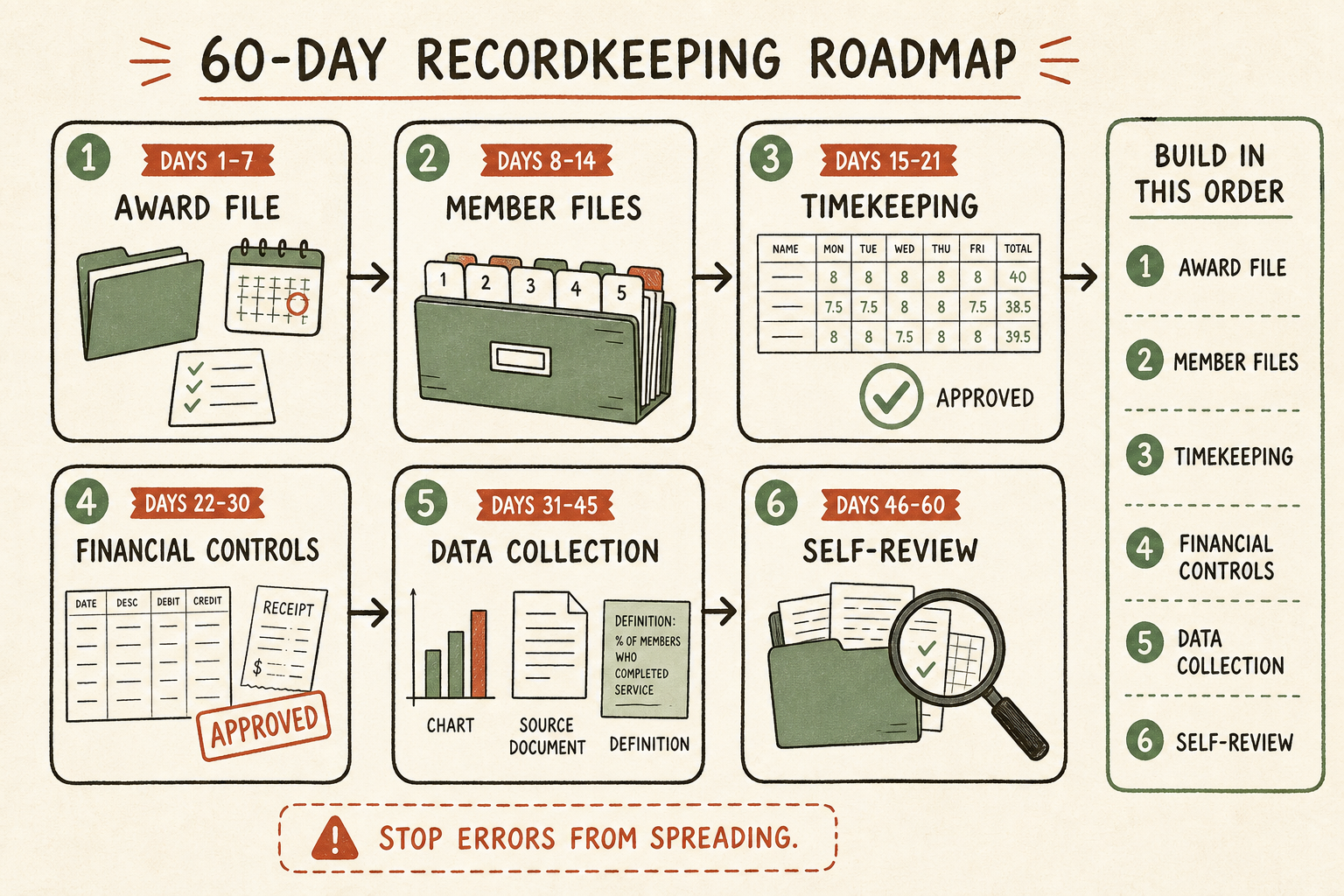
Build in this order:
- Core award file
- Member and staff documentation
- Timekeeping and service documentation
- Financial controls and draw support
- Data collection and reporting support
- Internal review before habits harden
That's the recommended sequence.
It keeps you from rebuilding the same process twice.
Days 1-7: Build the award file and the control list
Your first week is not for polishing.
It's for creating one place where the truth lives.
Create a start-up binder or shared folder with these sections:
<table style="min-width: 75px;"><colgroup><col style="min-width: 25px;"><col style="min-width: 25px;"><col style="min-width: 25px;"></colgroup><tbody><tr><th colspan="1" rowspan="1"><p>Section</p></th><th colspan="1" rowspan="1"><p>What goes in it</p></th><th colspan="1" rowspan="1"><p>Why it matters</p></th></tr><tr><td colspan="1" rowspan="1"><p>Award documents</p></td><td colspan="1" rowspan="1"><p>Notice of award, approved application, approved budget, amendments, special conditions, applicable Terms and Conditions</p></td><td colspan="1" rowspan="1"><p>This is the baseline for allowability and program design.</p></td></tr><tr><td colspan="1" rowspan="1"><p>Reporting calendar</p></td><td colspan="1" rowspan="1"><p>Federal due dates, commission due dates, internal prep deadlines</p></td><td colspan="1" rowspan="1"><p>Late reporting problems often start as calendar problems.</p></td></tr><tr><td colspan="1" rowspan="1"><p>Policies and procedures</p></td><td colspan="1" rowspan="1"><p>Timekeeping, financial management, procurement, travel, member supervision, data collection, confidentiality, records retention</p></td><td colspan="1" rowspan="1"><p>Auditors ask what your process is, not only what happened once.</p></td></tr><tr><td colspan="1" rowspan="1"><p>Staff roles</p></td><td colspan="1" rowspan="1"><p>Who approves timesheets, who reviews expenses, who enters data, who reconciles draws, who keeps [member files](/topics/member-files/guide)</p></td><td colspan="1" rowspan="1"><p>Separation of duties starts with naming the duties.</p></td></tr><tr><td colspan="1" rowspan="1"><p>Risk log</p></td><td colspan="1" rowspan="1"><p>Missing items, open questions, deadlines, responsible person, completion date</p></td><td colspan="1" rowspan="1"><p>If you're behind, you need a visible list, not a mental list.</p></td></tr></tbody></table>Now make a one-page control list.
List each recurring compliance task, the person responsible, the backup person if there is one, the due date, and the document that proves completion. If you are the only person doing the work, still write your own name on each line. It sounds obvious. It prevents dropped steps.
Under 2 CFR § 200.303, Internal controls, recipients and subrecipients must establish, document, and maintain effective internal control over the federal award; evaluate and monitor compliance; take prompt action when noncompliance is identified; and take reasonable measures to safeguard protected personally identifiable information and other sensitive information. The regulation doesn't hand you a template. It expects a real system.
In the same week, confirm your record retention setup. Under 2 CFR § 200.334, Record retention requirements, recipients and subrecipients generally must retain federal-award records for three years from submission of the final financial report. The rule has different timing and extension rules for some awards and for situations such as litigation, claims, audit findings, written extensions, property records, program income, and indirect cost proposals, so review the full section against your award.
Days 8-14: Fix member files before members start generating hours
People are eager to start. And you know a missing eligibility document can become a much bigger problem once service has begun.
Use your award terms and commission guidance to build the member file checklist for your program year. For State and National awards, member records and confidentiality are addressed in the 2026 AmeriCorps State and National Grants Terms and Conditions. Those Terms belong in your checklist because not every file requirement sits in the CFR.
At a minimum, your checklist should separate these categories:
- Eligibility and enrollment documentation
- Position description and service location documentation
- Criminal history check documentation, where required
- Member agreement and required acknowledgments
- Timesheets and service hour support
- Training records
- Leave, suspension, release, or exit records
That's a recommended file structure, not a federal checklist copied from one rule.
Don't keep these as one big pile.
Use a standardized file index. Put the checklist at the front of every file. Mark each item with three options only: received, not applicable, pending. Date each mark.
If something is missing, log the follow-up the same day. Not in your inbox. In the file checklist and your risk log.
Days 15-21: Lock down timekeeping for both staff and members
Timekeeping problems don't typically stay small.
Once people get used to a loose system, each later pay period or service period is harder to defend.
For employees whose salary and wages are charged to the award, support must meet the standards in 2 CFR § 200.430, Compensation—personal services. That section requires records that accurately reflect the work performed and are supported by a system of internal control.
For members, your timesheet process also has to line up with AmeriCorps program requirements, your award terms, and any pass-through instructions that apply.
Set the process in this order:
1. Decide the timesheet period
Choose a period your program can review consistently and promptly.
Many programs use weekly or biweekly periods because problems are easier to catch while memories are still fresh.
2. Define what gets recorded
State in writing:
- service hours
- training hours
- fundraising hours, if relevant (There are different perspectives on whether "Fundraising" needs to be on your timesheet, even if your members will not perform this activity. Check with your program officer if you're not sure.)
- prohibited activities must never be recorded as service
- leave categories, if your program tracks them separately
Use the categories your program and commission require. If your award-year Terms impose specific service documentation expectations, use those terms.
3. Name the approver
The approver should be the person who can reasonably verify what happened.
Not the person who is easiest to reach.
4. Set the review steps
Every submitted timesheet should be checked for:
- missing dates
- math errors
- overlapping entries
- entries on days before enrollment or after exit
- entries that exceed program rules or common sense without explanation
- supervisor approval and date
- member or employee certification and date, if your format requires it
5. Preserve the record
Store the final approved version in a consistent place and prevent later alteration through your normal records controls.
If you find bad habits already in motion, reissue instructions now.
Days 22-30: Put financial controls in writing
Financial compliance is not the accounting software.
It's the decisions around it.
Your financial management system has to meet the standards in 2 CFR § 200.302, Financial management. Your internal controls must meet 2 CFR § 200.303, Internal controls. Your costs must be necessary, reasonable, allocable, and documented under 2 CFR § 200.403, Factors affecting allowability of costs.
By day 30, write and use these five controls:
- Invoice and expense review. Name who reviews charges before posting them to the grant.
- Budget-to-actual review. Compare spending to budget categories at least monthly.
- Draw support. Keep documentation showing how each cash draw ties to allowable, recorded costs.
- Match support, if applicable. Keep the support for match in the same month it is claimed, not in a year-end scramble.
- Reconciliation. Reconcile the ledger, bank activity if relevant, and grant reports on a fixed schedule.
Those are recommended controls.
The exact format can vary, but the control has to be real.
Then add approval thresholds.
Who can approve travel. Who can approve supplies. Who can approve budget shifts. Which changes require prior written approval under federal rules or under your commission's process.
This is where attribution matters.
Some approval requirements come from Uniform Guidance, including the framework in 2 CFR § 200.407, Prior written approval (prior approval). Others may come from your award terms or commission instructions. Say which is which in your procedures.
Also remember that the FY 2026 General Terms and Conditions say the recipient agrees to operate the funded program in accordance with the approved application and budget, supporting documents, and other representations made in support of the approved application. That's a Terms requirement, not a substitute for the CFR. It still matters. If you're on a different award year, read the terms attached to your own award.
Days 31-45: Build data collection that can survive reporting season
If a performance measure lives only in a spreadsheet no one understands, it is not under control.
By the middle of the second month, you need a clear trail from activity to output to report.
Create a one-page data map for each measure:
- exact measure name
- what counts and what doesn't count
- source document
- who collects it
- where it's stored
- how often it's reviewed
- who signs off before reporting
Then test one measure from end to end.
Pick a reported number. Pull the source document. Recalculate it. Confirm that the definition used by staff matches the definition in your approved application and reporting instructions.
If there is a gap, fix the source process first.
Do not wait for the progress report deadline.
Under 2 CFR § 200.329, Monitoring and reporting program performance, recipients and subrecipients must monitor activities under the federal award to ensure compliance and performance, and must submit performance reports required by the award. Your commission or AmeriCorps program office may require more specific definitions, documentation formats, and deadlines than the regulation spells out, so keep that guidance with the award file.
Days 46-60: Run a mini monitoring review on yourself
You are looking for patterns now.
Not isolated mistakes. Patterns.
Pull a sample:
- 3 to 5 member files
- 2 staff timesheets or personnel cost records tied to the grant
- 10 to 15 member timesheets
- one month of expense support
- one reported performance number with source backup
Those sample sizes are a practical starting point.
They are not prescribed by 2 CFR part 200.
Review them against your own checklist.
Use three labels only:
- complete
- incomplete but fixable
- unsupported
That last category matters.
Unsupported means you do not have the record you would need if someone asked today. Treat those items first.
Document the review date, the reviewer, the items tested, the issues found, and the corrective action deadline. Keep this with your monitoring or internal control records.
If your organization is the pass-through entity for a federal award and makes subawards, adapt this start-up review at the pass-through level. 2 CFR § 200.332, Requirements for pass-through entities requires a pass-through entity to identify required subaward terms, assess subrecipient fraud and noncompliance risk, monitor compliance and performance, review financial and performance reports, address significant developments and relevant audit findings, and take other specified actions. Your subaward procedures should translate those duties into concrete start-up expectations.
What to do if you're already behind
Then start narrower.
Do not try to backfill everything at once.
Use this sequence:
- Stop new records from being created incorrectly.
- Identify the highest-risk missing documentation.
- Repair the current month before the prior month.
- Document what you could confirm and what you could not.
- Escalate items that may affect costs claimed, member eligibility, or reporting accuracy.
You are not failing because the system wasn't built on day one.
You are doing the real work now by making the record trustworthy before more time passes.
A practical 60-day checklist
<table style="min-width: 75px;"><colgroup><col style="min-width: 25px;"><col style="min-width: 25px;"><col style="min-width: 25px;"></colgroup><tbody><tr><th colspan="1" rowspan="1"><p>Timeframe</p></th><th colspan="1" rowspan="1"><p>Your priority</p></th><th colspan="1" rowspan="1"><p>Done when...</p></th></tr><tr><td colspan="1" rowspan="1"><p>Days 1-7</p></td><td colspan="1" rowspan="1"><p>Award file and compliance calendar</p></td><td colspan="1" rowspan="1"><p>You can point to the current award documents, due dates, procedures, and risk log in one place.</p></td></tr><tr><td colspan="1" rowspan="1"><p>Days 8-14</p></td><td colspan="1" rowspan="1"><p>Member file structure</p></td><td colspan="1" rowspan="1"><p>Every active file has the same checklist and missing items are logged.</p></td></tr><tr><td colspan="1" rowspan="1"><p>Days 15-21</p></td><td colspan="1" rowspan="1"><p>Timekeeping process</p></td><td colspan="1" rowspan="1"><p>Staff and members are using one written process with named approvers and review steps.</p></td></tr><tr><td colspan="1" rowspan="1"><p>Days 22-30</p></td><td colspan="1" rowspan="1"><p>Financial controls</p></td><td colspan="1" rowspan="1"><p>Expense review, reconciliation, draw support, and approval thresholds are written and in use.</p></td></tr><tr><td colspan="1" rowspan="1"><p>Days 31-45</p></td><td colspan="1" rowspan="1"><p>Data collection</p></td><td colspan="1" rowspan="1"><p>Each reported measure has a definition, source, owner, and review step.</p></td></tr><tr><td colspan="1" rowspan="1"><p>Days 46-60</p></td><td colspan="1" rowspan="1"><p>Self-monitoring review</p></td><td colspan="1" rowspan="1"><p>You have tested a sample, documented gaps, and assigned corrective actions.</p></td></tr></tbody></table>Order is a practical compliance control.
When the first 60 days are calm on paper, the rest of the year is easier to defend.
A quick reminder
AmeriCorps grants can vary from one to the next. If you’re unsure how a rule applies to your program, check with your commission or designated point of contact at the AmeriCorps agency for any additional guidance and clarifications. They know your award terms best.
Questions people ask
- What should I set up first if my AmeriCorps program starts late?
Set up the award file, compliance calendar, and written control list first. Those three items tell you what rules apply, when deliverables are due, who is responsible, and what record proves each task was completed. The baseline federal requirement is 2 CFR § 200.303, Internal controls, which requires recipients and subrecipients to establish, document, and maintain effective internal controls and monitor compliance. Then layer in the Terms and Conditions attached to your own award, because those may add program-specific duties that are not spelled out in the CFR.
- Do member file requirements come only from the CFR?
No. Member file requirements can come from several places: federal regulations, the Terms and Conditions attached to the award, and written pass-through requirements that are incorporated into a subaward. For AmeriCorps State and National programs, member records and confidentiality are addressed in the 2026 AmeriCorps State and National Grants Terms and Conditions. Your checklist should match your award year and program, because a prior-year award follows that year's terms, not the current year's document.
- What is the main federal rule for staff timekeeping charged to the grant?
The main federal rule is 2 CFR § 200.430, Compensation—personal services. For employees whose salaries and wages are charged to a federal award, that section requires records that accurately reflect the work performed and are supported by a system of internal control. Member timesheets are different. They are shaped by AmeriCorps program requirements, award terms, and any applicable commission or pass-through instructions, not only by the employee compensation rule.
- How long do I need to keep AmeriCorps grant records?
The general federal baseline is in 2 CFR § 200.334, Record retention requirements: recipients and subrecipients generally must retain federal-award records for three years from submission of the final financial report. But that is not the end of the analysis. The rule includes different timing and extension rules for some awards and for situations such as litigation, claims, audit findings, written extensions, property records, program income, and indirect cost proposals. Check the full section and your award terms before setting your destruction date.
- How soon should I review my own files after start-up?
Run a small internal review by about day 60. Test a sample of member files, timesheets, expense support, and one reported performance number, then document what was complete, what was fixable, and what was unsupported. That review cadence is a recommended practice, not a federal deadline. It supports your duties under 2 CFR § 200.303, Internal controls and 2 CFR § 200.329, Monitoring and reporting program performance, which require ongoing control, monitoring, and support for required performance reporting.
- What if my grant comes through a state or territory service commission?
- Check your commission’s current requirements too. They may be stricter than the federal floor, and stricter is what you follow. What a commission can’t do is override controlling federal law, regulation, or your AmeriCorps award terms, and it can grant only the waivers it’s authorized to grant. Read this post alongside your commission’s guidance, your award terms, and your written policies — and when something looks like a real conflict, ask your commission or program officer rather than guessing.
About the author
Gary Kosman is the founder and CEO of America Learns. He has worked with AmeriCorps programs and state service commissions for more than two decades, helping organizations strengthen the systems they use to manage members, grants, reporting, compliance, and impact. Reach him at gary@americalearns.net or 310-689-0542 x101.
Last reviewed August 14, 2026. Regulations change. Verify every citation against the current eCFR text and your own grant terms and conditions before you rely on it.
Looking for another topic?
Browse all compliance topics — from timesheets and member files to financial and progress reporting.
Browse topicsKeep reading on 2 cfr 200 basics and related topics
2 CFR 200 Basics/August 18, 2026
When Staff Duties and Timesheets Don’t Match
Salary costs get vulnerable when payroll support, payroll charges, and the role described in your award materials stop lining up. The fix starts with a clean match between supported work, the amount charged, and the staffing picture your award says you funded.
2 CFR 200 Basics/August 17, 2026
Uniform Guidance for AmeriCorps: 2 CFR part 200 AmeriExplained
If you run an AmeriCorps grant, 2 CFR part 200 shapes much of your daily compliance work. This guide translates the rule into program language and shows how it fits with AmeriCorps regulations and award terms.
2 CFR 200 Basics/August 6, 2026
Terms and Conditions Beat Assumptions Every Time
When the Uniform Guidance leaves room for interpretation, your AmeriCorps award documents often decide the operational answer. The control isn't knowing every rule by memory. It's keeping the executed award, its incorporated terms, and any modifications in front of every person who approves spending.
OIG Findings/September 4, 2026
How Commissions Can Catch Timesheet and Term Errors Early
When education awards are tied to weak time records or unsupported service-term changes, the cost lands late and hard. A commission can catch most of it before exit with a tighter review sequence.
Performance Measurement/September 2, 2026
Your Data-Collection System Is Part of Your Audit Trail
Surveys, logs, and tests can become Federal award records. Federal rules do not require you to keep every draft or form configuration — they require retention of the records and supporting documentation that substantiate what you reported. ([2 CFR § 200.334](https://www.ecfr.gov/current/title-2/section-200.334))