When Staff Duties and Timesheets Don’t Match
Salary costs get vulnerable when payroll support, payroll charges, and the role described in your award materials stop lining up. The fix starts with a clean match between supported work, the amount charged, and the staffing picture your award says you funded.
Drafted with AI assistance, checked against primary sources, reviewed and approved by Gary Kosman on August 18, 2026.
You can feel the risk in this one right away.
A staff person is on the budget. A job description is on file. The grant application says one thing. Day-to-day work starts drifting somewhere else. Then payroll keeps moving.
That is enough to create exposure.
You don't need a dramatic fact pattern for salary costs to be questioned. Weak payroll-support records can raise documentation and allocability issues on their own. And if the role no longer matches what you represented in your award materials, you may also have an award-compliance problem.
If you're carrying a grant with thin staffing and constant interruptions, this is the part that can keep you up at night. Not because you meant to misstate anything. Because roles change fast, paperwork lags, and payroll doesn't wait.
Before we go further, one scope note.
The § 200.430 requirements discussed below apply to cost-reimbursement awards and subawards. Section 200.430 does not apply to AmeriCorps State and National fixed-amount awards. Under 2 CFR § 200.101(b)(4)(ii), fixed-amount awards are exempt from most of the Subpart E cost principles, with only §§ 200.400(g), 200.402 through 200.405, and 200.407(d) still applying. Fixed-amount recipients remain subject to applicable award terms, the cost principles identified in § 200.101(b)(4)(ii), record-retention and audit requirements, and applicable employment laws. Section XVII of the 2026 ASN Terms and Conditions repeats that limitation.
And one more piece of reassurance before the checklists start.
Not every change in an employee's duties makes salary costs unallowable or requires an amendment. The questions are whether the work remains allocable to the award, whether the salary charged is supported, and whether the change affects the approved scope, objectives, budget, or another matter requiring approval under the applicable terms.
The control you need is straightforward.
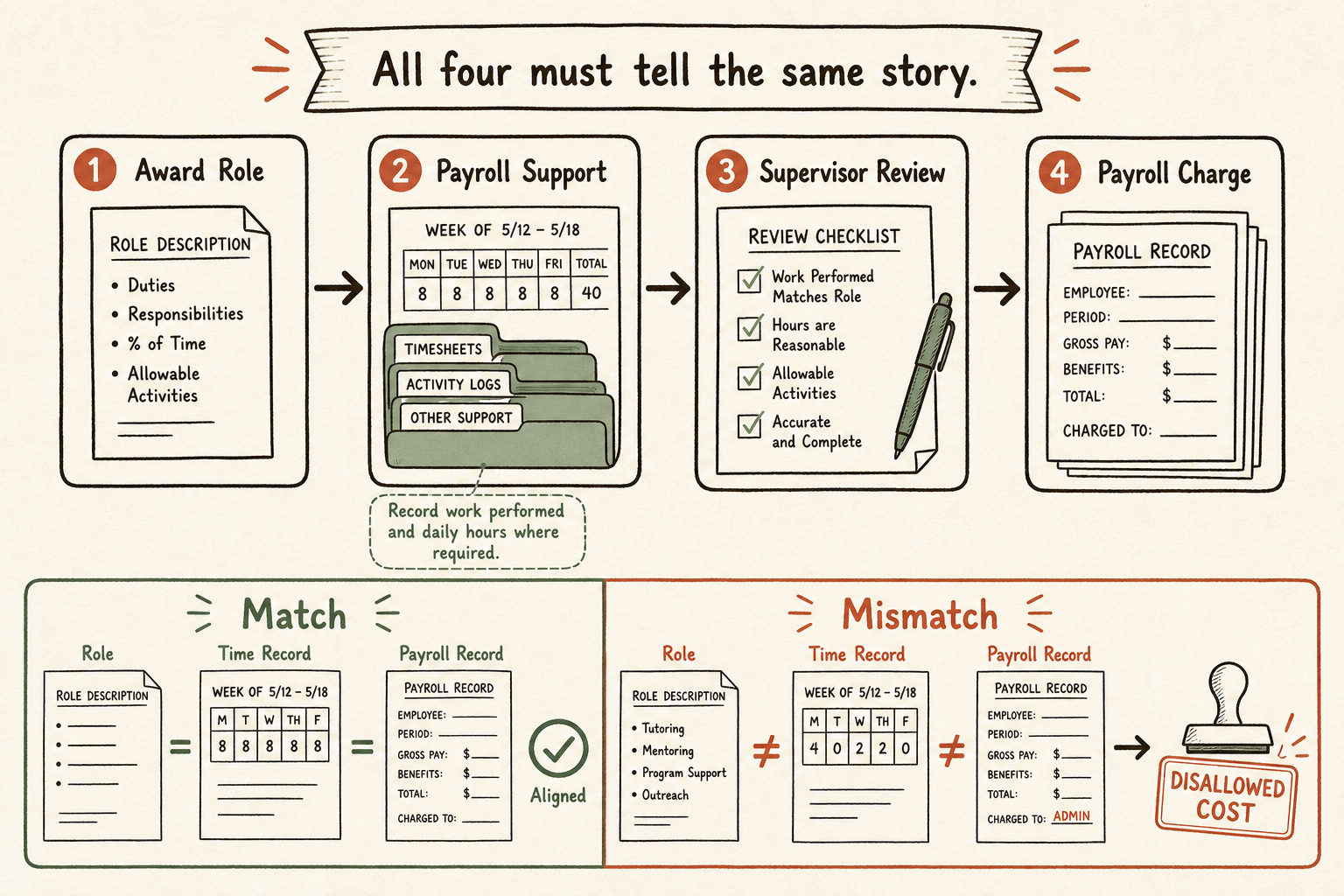
Personnel records supporting salary charges must accurately reflect the work performed and support the salary distribution where the employee works on more than one award or more than one cost objective. As a practical control, compare that supported work to the duties and staffing representations in your approved award materials. If those records drift apart in a material way, you may have separate documentation, allowability, allocability, and award-compliance problems.
What the rule requires, and what the award terms add
Under 2 CFR § 200.430, Compensation—personal services, salary and wage charges to a federal award must be based on records that accurately reflect the work performed. The key paragraph is 2 CFR § 200.430(g)(1). Those records must be part of your official records, reasonably reflect the employee's total compensated activity, and support the distribution of salary among activities or cost objectives when that matters.
Two details in the same subsection matter a lot.
First, 2 CFR § 200.430(g)(1) requires records that reasonably reflect the total activity for which the employee is compensated by the recipient or subrecipient, not exceeding 100 percent of compensated activities.
Second, under 2 CFR § 200.430(g)(3), charges for the salaries and wages of nonexempt employees must also be supported by records indicating the total number of hours worked each day, consistent with 29 CFR part 516. That daily-hours rule is in addition to, not instead of, the broader documentation standard in 2 CFR § 200.430(g)(1).
Under 2 CFR § 200.403, Factors affecting allowability of costs, a cost must be necessary and reasonable for performance of the award, allocable to the award, conform to limitations or exclusions in the cost principles or the award, be treated consistently, and be adequately documented. For this topic, 2 CFR § 200.403(g) is the line to keep in view: the cost must be adequately documented.
And under 2 CFR § 200.334, Record retention requirements, you must retain financial records, supporting documents, and other records for the required period. In most cases, that's three years from the date you submit your final financial report. For awards renewed quarterly or annually, it's three years from the date you submit that quarterly or annual financial report. The rule also extends retention in some situations, including certain litigation, claims, audit findings, or written agency extensions.
AmeriCorps award terms add another layer. The FY 2026 General Terms and Conditions, revised as of January 27, 2026, state that the recipient agrees to operate the funded program in accordance with the approved application and budget, supporting documents, and other representations made in support of the approved application.
That matters here.
If your application or supporting documents represented that a funded role would perform certain grant duties, and the supported work no longer lines up, the issue may not be only timekeeping. It may also be whether the program operated as represented under your award terms.
Program-specific terms matter too. Budget and programmatic-change rules vary by program and award year. For example, the 2026 AmeriCorps State and National Terms and Conditions, revised as of June 23, 2026, include Section X, titled "Budget and Programmatic Changes." Other AmeriCorps program streams have their own terms. Use the version attached to your own award.
If you're on a prior-year award, follow that year's terms. AmeriCorps reissues these documents and may revise them mid-year. Verify against the current eCFR text for 2 CFR part 200 and the terms attached to your own award.
The core control
Don't ask, "Do we have timesheets?"
Ask, "Do our official records support what this employee worked on, and do the payroll charges line up with that support?"
Then ask one more question.
"Does that supported work still fit the role and staffing picture we represented under the award?"
That's the control.
A clean file usually has four things lined up:
| Record | What it should show | Authority or control hook | Common failure point |
|---|---|---|---|
| Approved application, budget narrative, or incorporated staffing representation | The role the organization said it funded under the award | FY 2026 General Terms and Conditions | Award-facing staffing description remains unchanged after a material duty shift |
| Official personnel or payroll-support records | Work performed and, where relevant, support for salary distribution | 2 CFR § 200.430(g)(1), Compensation—personal services | Record shows presence but not enough support for allocation |
| Supervisor review (recommended internal control) | Informed review by someone who knows the work | Recommended control, not an express federal signature requirement; hook: 2 CFR § 200.303, Internal controls | Approval turns into a payroll formality |
| Payroll charge | Salary allocation matches supported work | 2 CFR § 200.430(g)(1) and 2 CFR § 200.403 | Salary remains on the grant after responsibilities move |
If one of those breaks, the rest can still look tidy and not hold up.
A step-by-step process for checking duties against payroll support
1. Start with the role that was represented under the award
Pull the documents that define the position, and keep two piles separate.
Award-facing records: the approved application, the approved budget and budget narrative, incorporated supporting documents, clarifications, and amendments. These are what your organization represented to AmeriCorps.
Internal records: the job description, offer letter, organizational chart, and supervision materials. These are useful for verifying consistency, but an internal job description is not by itself an award representation.
Read them side by side.
You're looking for the award-facing version of the role. What duties did your organization say this position would perform?
Keep your notes concrete.
2. Build a duty map in plain language
Make a one-page list with three columns:
| Award-represented duty | Evidence the duty is being performed | Where the evidence lives |
|---|---|---|
| Example: oversee compliance reporting | Drafts, submission records, review emails | Grants folder |
| Example: supervise project operations | Supervision notes, calendars, agendas | Supervision folder |
| Example: support service sites | Site logs, technical assistance notes | Program operations folder |
Don't make this elegant. Make it usable.
The point is to define what performance of the role looks like in records, not in memory.
3. Review recent payroll-support records against that duty map
Now look at the records you rely on to support salary charges.
That may be narrative timesheets. It may be a broader personnel-activity system. It may include subsidiary records under your written policy.
Do not assume narrative task-by-task timesheet entries are the only acceptable method under 2 CFR § 200.430(g)(1).
But do ask whether the system as a whole accurately reflects the work performed and supports the salary distribution when that applies.
Federal rules do not prescribe narrative timesheets, task-by-task descriptions, or a particular supervisor-certification form. If the organization's records satisfy 2 CFR § 200.430(g)(1), § 200.430(g)(2) generally does not require additional documentation of the work performed, other than the daily-hour records described in § 200.430(g)(3). The cross-checks below are risk-management practices, not federally prescribed forms.
Generic labels such as "admin," "meetings," or "program work" are not automatically inadequate. The question is whether the organization's records, viewed as a whole, support the salary allocation required by § 200.430(g)(1). If an employee works on only one applicable cost objective, task-level labels may not be necessary. If the employee works across multiple activities or cost objectives, generic labels may not provide enough information to support the distribution.
4. Confirm the supervisor's review is informed
Ask one direct question in writing:
"Based on your firsthand knowledge, do the official records for this pay period support the work performed and the payroll allocation charged?"
If your organization also relies on a position description or award narrative for this role, ask whether the work still matches that role.
A signature is not the same as informed review. And to be clear, this step is a recommended internal control. The regulation does not spell out a supervisor-signature form.
If the supervisor doesn't know, that's a control problem.
5. Check daily-hour records for nonexempt employees
This step gets missed.
For nonexempt employees, 2 CFR § 200.430(g)(3) requires records indicating the total number of hours worked each day, consistent with 29 CFR part 516.
For nonexempt employees, daily hour totals are required in addition to the organization's § 200.430(g)(1)-compliant payroll-support system. The regulation still does not require task-by-task narratives.
One more paragraph in the same subsection matters a lot for AmeriCorps programs. Under 2 CFR § 200.430(g)(4), salaries and wages used to meet cost-sharing requirements must be supported in the same manner as salaries and wages claimed for reimbursement from the federal award. If a position is partly counted as match, the match side needs the same quality of support as the federal side.
6. When duties have changed, update the underlying record set
This is the step people postpone because it feels like cleanup.
It's evidence.
If an employee's real duties have changed, review what must be updated:
- internal job description
- supervision records
- salary allocation method
- budget support documents
- organizational chart
- any award documents or approvals your terms require
Whether prior approval is needed depends on the change and your program-specific terms. Don't guess. Check the budget-and-programmatic-change section in the terms attached to your award.
7. Separate "present at work" from "support for charging the grant"
A person can be busy all week and still not have enough support for the salary amount charged to the award.
That's not a character issue. It's a documentation and allocability issue.
The records have to support the grant charge.
That distinction sits underneath 2 CFR § 200.403, Factors affecting allowability of costs and 2 CFR § 200.430(g)(1), Compensation—personal services.
8. Document corrections without rewriting history
When you find a mismatch, preserve the original record.
Then document:
- what was missing or inaccurate
- who identified the issue
- what supporting facts were reviewed
- what correction was made
- whether the payroll charge changed
- whether earlier charges need review
Keep an auditable correction trail.
9. Check the payroll allocation, not only the time record
Sometimes the record is thin.
Sometimes the record is fine and the salary distribution is wrong.
Compare the supported work to the payroll charge. If the work no longer supports the percentage charged to the award, promptly correct the allocation and review current and earlier charges as needed. If your system uses interim charges based on budget estimates, follow 2 CFR § 200.430(g)(1)(vii): promptly record significant changes and make necessary adjustments so final charges are accurate, allowable, and properly allocated.
10. Set a recurring cross-check that fits your risk
A recurring review can be a reasonable control.
It does not have to look the same everywhere.
Under 2 CFR § 200.303, Internal controls, recipients and subrecipients must establish, document, and maintain effective internal control over the federal award that provides reasonable assurance the award is managed in compliance with federal statutes, regulations, and award terms, and must take prompt action when noncompliance is identified.
That does not prescribe a quarterly cadence, a specific sample, or one reviewer.
It does mean your process should be real, documented, and appropriate to the size and risk of your program.
What to do this week if you're worried about one position
Start with the one position that makes you pause.
Then do these five things in order:
- Pull the award documents and HR records that define the role.
- Pull the last three pay periods of payroll-support records.
- Check whether those records support the work performed and the salary allocation.
- Confirm whether the work still matches the role your award materials describe.
- Write down any mismatch and the correction path.
If everything lines up, you'll feel steadier.
If it doesn't, you'll know where to act.
The safest record set is the one where supported work, payroll allocation, and award role all tell the same story.
Why this issue matters
Payroll-support weaknesses are a recurring risk pattern in federal grant oversight.
This article doesn't depend on the specifics of one OIG case.
The compliance point is enough on its own.
When payroll-support records do not accurately reflect the work performed, or do not support the salary distribution where that matters, salary charges can be questioned. When the funded role no longer matches what the award materials said, award terms may be in play too.
AmeriCorps OIG audit and investigative materials are published on the AmeriCorps OIG reports page. If you plan to rely on a particular report, verify the exact title, date, case number, findings, and live document link on the OIG site before citing it.
Because drift is common. Delay is common. The urge to hide the file is common.
And the way out is plain.
Make sure your payroll-support records, supervision, payroll charges, and award-facing role documents still describe the same real job.
A quick reminder
AmeriCorps grants can vary from one to the next. If you’re unsure how a rule applies to your program, check with your commission or designated point of contact at the AmeriCorps agency for any additional guidance and clarifications. They know your award terms best.
Questions people ask
- Is a signed timesheet enough to support salary charged to an AmeriCorps award?
Not by itself. Under 2 CFR § 200.430(g)(1), Compensation—personal services, salary and wage charges must be supported by official records that accurately reflect the work performed and, where the employee works on more than one award or more than one cost objective, support the distribution of the employee's salary or wages among those activities or cost objectives. A signed timesheet may be part of that system, but a signature does not cure records that are too thin or inconsistent with the allocation charged. And for nonexempt employees, 2 CFR § 200.430(g)(3) also requires records indicating the total number of hours worked each day, consistent with 29 CFR part 516.
- Why do job descriptions matter in a timesheet or payroll-support review?
Because they help you test a separate question from timekeeping: whether the role you are charging to the award is still the role your organization represented it would fund. The FY 2026 General Terms and Conditions, revised as of January 27, 2026, say the recipient agrees to operate the funded program in accordance with the approved application and budget, supporting documents, and other representations made in support of the approved application. If you're on a different award year, use the terms attached to that award.
- What should I do if a staff person's duties changed but the file was never updated?
Update the record set and review affected charges. Start with the role description, supervision records, and salary allocation method. Then assess whether salary charges remain supportable under 2 CFR § 200.403, Factors affecting allowability of costs, especially 2 CFR § 200.403(g), and 2 CFR § 200.430(g)(1), Compensation—personal services. If your system uses interim charges based on budget estimates, 2 CFR § 200.430(g)(1)(vii) requires significant changes to be promptly entered into the records and necessary adjustments made so final charges are accurate, allowable, and properly allocated. Whether you also need prior approval or a formal award change depends on your program-specific terms, so check the budget-and-programmatic-change section attached to your own award.
- What do OIG materials add to this issue?
This article does not rely on the specifics of any single OIG report. The compliance point does not depend on one case: where payroll-support records do not accurately reflect the work performed, or do not support the salary distribution where that matters, salary charges can be questioned on documentation and allocability grounds under 2 CFR § 200.430(g)(1), Compensation—personal services and 2 CFR § 200.403, Factors affecting allowability of costs. AmeriCorps OIG audit and investigative materials are published on the AmeriCorps OIG reports page.
- What if my grant comes through a state or territory service commission?
- Check your commission’s current requirements too. They may be stricter than the federal floor, and stricter is what you follow. What a commission can’t do is override controlling federal law, regulation, or your AmeriCorps award terms, and it can grant only the waivers it’s authorized to grant. Read this post alongside your commission’s guidance, your award terms, and your written policies — and when something looks like a real conflict, ask your commission or program officer rather than guessing.
About the author
Gary Kosman is the founder and CEO of America Learns. He has worked with AmeriCorps programs and state service commissions for more than two decades, helping organizations strengthen the systems they use to manage members, grants, reporting, compliance, and impact. Reach him at gary@americalearns.net or 310-689-0542 x101.
Last reviewed August 18, 2026. Regulations change. Verify every citation against the current eCFR text and your own grant terms and conditions before you rely on it.
Looking for another topic?
Browse all compliance topics — from timesheets and member files to financial and progress reporting.
Browse topicsKeep reading on 2 cfr 200 basics and related topics
2 CFR 200 Basics/August 17, 2026
Uniform Guidance for AmeriCorps: 2 CFR part 200 AmeriExplained
If you run an AmeriCorps grant, 2 CFR part 200 shapes much of your daily compliance work. This guide translates the rule into program language and shows how it fits with AmeriCorps regulations and award terms.
2 CFR 200 Basics/August 14, 2026
A Calm 60-Day Plan for Start-Up Compliance
If you're starting late and carrying the grant mostly alone, you don't need a perfect launch. You need the right compliance pieces in the right order so member files, timekeeping, financial controls, and data collection can hold up.
2 CFR 200 Basics/August 6, 2026
Terms and Conditions Beat Assumptions Every Time
When the Uniform Guidance leaves room for interpretation, your AmeriCorps award documents often decide the operational answer. The control isn't knowing every rule by memory. It's keeping the executed award, its incorporated terms, and any modifications in front of every person who approves spending.
OIG Findings/September 4, 2026
How Commissions Can Catch Timesheet and Term Errors Early
When education awards are tied to weak time records or unsupported service-term changes, the cost lands late and hard. A commission can catch most of it before exit with a tighter review sequence.
Performance Measurement/September 2, 2026
Your Data-Collection System Is Part of Your Audit Trail
Surveys, logs, and tests can become Federal award records. Federal rules do not require you to keep every draft or form configuration — they require retention of the records and supporting documentation that substantiate what you reported. ([2 CFR § 200.334](https://www.ecfr.gov/current/title-2/section-200.334))