How AmeriCorps Fixed Amount Drawdowns Change for FY 2027
More funding becomes available at the start of the budget period. Later access depends on enrollment and retention. Here’s what the new policy means for National Direct programs, state commission subgrantees, and the people keeping their records straight.
Drafted with AI assistance, checked against primary sources, reviewed and approved by Gary Kosman on October 14, 2026.
If your team has been calculating payment requests from each member’s approved service hours, this is a meaningful change. It changes when funding becomes available and which records support that access.
It also gives program staff and finance staff a good reason to sit down together before the next award begins.
Start with your award year
The policy lists an effective date of October 1, 2026, the beginning of federal FY 2027. But that date does not move every active award onto the new rules. FAQ 1 expressly keeps FY 2026 and previous awards under the terms and conditions for the fiscal year in which their funds were awarded. (Policy, p. 1 and FAQ 1.)
That means “we’re operating after October 1” is not enough to determine which payment process to use.
A practical first step: put the applicable funding year and payment method beside each award in your grants calendar. If your organization manages awards from different funding years, plan for the possibility of using both processes at the same time.
Who the new policy covers
The policy applies to FY 2027 AmeriCorps State and National fixed amount awards, including competitive and formula awards. It identifies Education Award Program (EAP), Professional Corps, and Full-Cost fixed amount awards. Its applicability is subject to superseding federal statutes, regulations, award terms and conditions, or program-specific requirements. (Policy, p. 1 and FAQs 1–2.)
It reaches both funding routes:
- Direct awards from AmeriCorps, including National Direct fixed amount grants.
- Fixed amount subawards through state service commissions. FAQ 20 requires commission payment structures to be consistent with the policy’s enrollment and retention milestones and cumulative payment limits. (Policy, p. 1 and FAQ 20.)
A commission may call the transaction a payment request rather than a drawdown. The underlying limits still apply. (Policy, FAQ 20.)
This is a fixed amount award policy. It does not establish a new payment schedule for cost reimbursement awards. (Policy, applicability statement, p. 1.)
The new payment schedule
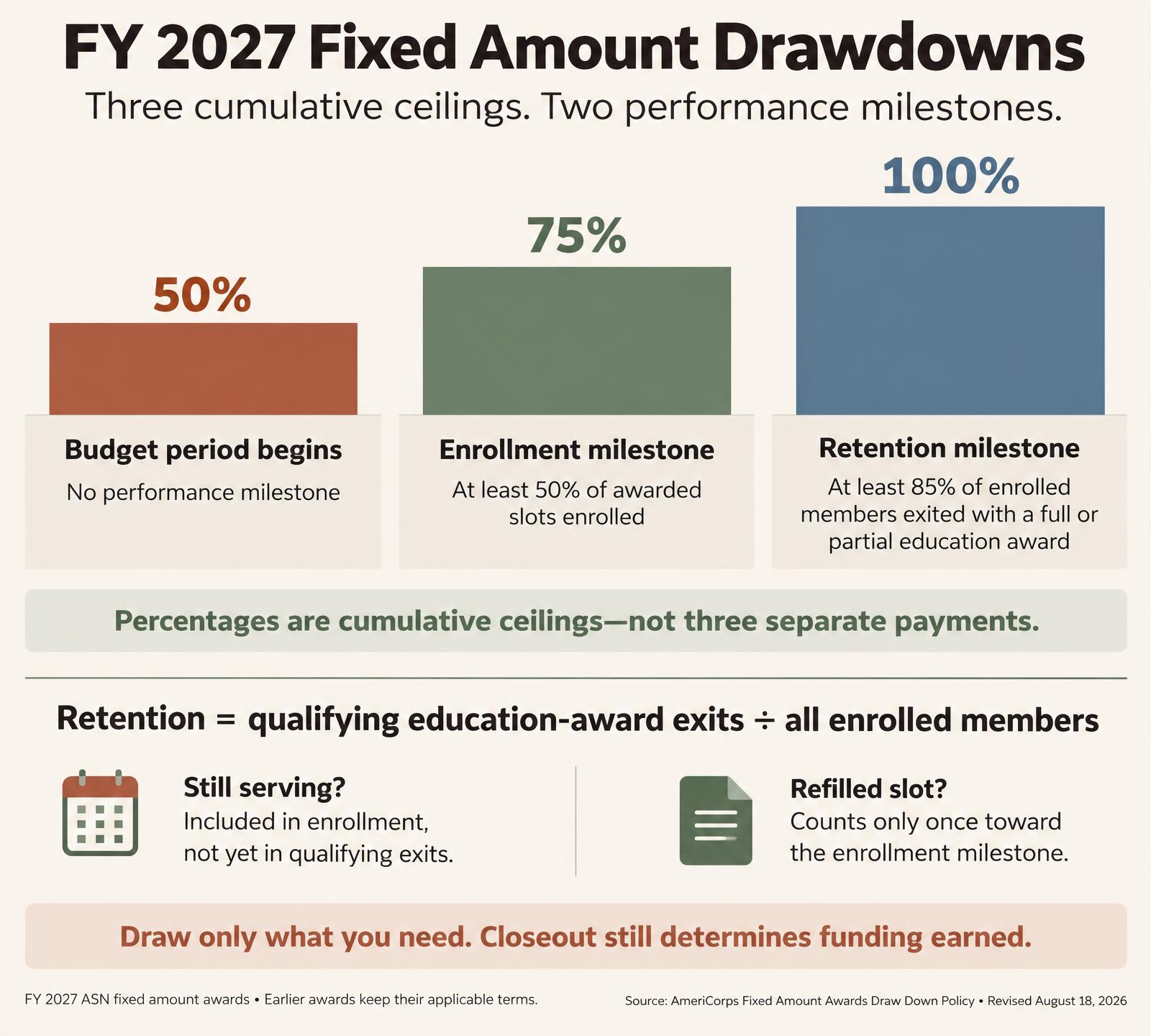
The schedule establishes how much of the total federal award may be drawn cumulatively. Each percentage is a ceiling, not a required payment. (Policy, p. 2 and FAQ 10.)
| Point in the budget period | Maximum cumulative drawdown | On a hypothetical $400,000 award |
|---|---|---|
| The budget period begins | 50% | $200,000 |
| At least 50% of awarded member slots have been enrolled | 75% | $300,000 |
| At least 85% of enrolled members have exited with a full or partial education award | 100% | $400,000 |
Source: Policy, p. 2 and FAQs 8–9. Dollar amounts are an illustrative calculation; access remains subject to applicable award conditions.
The initial 50% is available beginning on the first day of the budget period without a performance milestone. Grantees may make multiple draws within the applicable ceiling. They should draw only what is needed to operate the program and must comply with applicable federal cash management requirements. (Policy, FAQs 5–7.)
So “up to 50% is available” does not mean “transfer half the award immediately, regardless of need.”
Enrollment opens access to the next portion
Once at least 50% of awarded slots have been enrolled, the cumulative ceiling rises to 75% of the total award. (Policy, FAQ 8.)
Think cumulative totals rather than three mandatory transactions.
For a hypothetical $400,000 award, suppose the program has drawn $120,000 before reaching the enrollment threshold. After reaching it, the ceiling becomes $300,000. The program could draw up to another $180,000, subject to its needs and applicable cash management requirements. This follows the cumulative approach in the policy’s Example 2. (Policy, pp. 2–3 and FAQ 5.)
Refills need special attention. For the enrollment milestone, each awarded slot counts only once. Enrolling another member to refill that slot does not increase the number of slots counted toward the 50% threshold. (Policy, FAQ 15.)
Retention means an exit with an education award
For access to the final 25%, the policy calculates retention as:
Members who exited with a full or partial education award ÷ all enrolled members. (Policy, FAQ 9.)
That definition matters. A member who is still serving counts in the enrolled total but does not count as retained until they exit with a full or partial education award. A member who exits for compelling personal circumstances and receives a partial education award counts as retained; an exit without either award does not. (Policy, FAQs 13–14.)
For example, if 100 members have enrolled and 82 have exited with qualifying education awards, the retention rate is 82%. The program cannot access the final 25% yet. It may recalculate as more members exit with education awards and becomes eligible when it reaches at least 85%, subject to the award period and applicable terms. (Policy, Example 3 and FAQs 11–12.)
For cash flow planning, this means projected completion dates and documented exits deserve attention alongside recruitment. A strong enrollment number alone does not unlock the entire award.
Access to funds and funding earned are separate questions
There is an important distinction between permission to draw money during the budget period and the amount a program ultimately earns.
FAQ 17 says funds properly drawn under the initial or enrollment-based stages are not repayable solely because the program later misses the 85% retention milestone. Missing that milestone prevents access to the final 25%. (Policy, FAQ 17.)
Separately, the policy requires closeout review using the prime grantee’s Fixed Award Certification. Funds drawn above the amount earned must be returned. It says EAP earnings are based on enrollment, while Full-Cost and Professional Corps earnings are based on members retained. (Policy, Closeout Requirements, p. 1.)
Read those provisions together. Missing the retention threshold does not, by itself, trigger repayment of properly drawn earlier funds. But permission to draw funds does not eliminate the closeout reconciliation.
The guidance does not provide a complete dollar calculation for every closeout scenario. Before budgeting on the assumption that all available funds can ultimately be kept, ask your commission or AmeriCorps how the applicable certification and award terms calculate the amount earned.
What records should support a payment request
The policy requires records sufficient to demonstrate the applicable drawdown requirement, including awarded slots, enrolled members, exits with full or partial education awards, and the retention calculation supporting the draw. It also identifies an eGrants enrollment report as a source of enrollment information. (Policy, FAQs 18–19.)
A practical internal control is to save a dated supporting record with each request showing:
- The award and its applicable funding year.
- The payment stage and cumulative ceiling.
- The enrollment or retention records supporting that stage.
- Prior payments, the current request, and the resulting cumulative total.
- Who checked the calculation and when.
Those are suggested workflow fields, not an additional federal checklist.
Keep service records connected to the process, too. The new drawdown policy ties retention to documented exits with education awards; it does not say to discontinue timesheets or change education award eligibility rules. (Policy, FAQs 9, 13–14 and 18.)
What to prepare now
For program leaders and finance teams, we recommend three conversations:
Confirm the transition. Which active awards keep the earlier payment method, and which will use the FY 2027 structure?
Test your records. Can your team distinguish awarded slots from refill enrollments, identify qualifying exits, and reproduce the calculation behind a payment request?
Plan for the final portion. What would your cash flow look like if members are still serving when you need additional funding? What happens if retention remains below 85%?
For commissions, add a review of subaward payment instructions, request forms, and system calculations. FAQ 20 makes alignment with the new milestones and cumulative limits part of the transition. (Policy, FAQ 20.)
The useful question for your next staff meeting is simple: when we request funds, can program staff and finance staff show the same numbers—and explain what makes that amount available?
Source
AmeriCorps, AmeriCorps State and National Fixed Amount Awards Draw Down Policy, last revised August 18, 2026; effective October 1, 2026 (FY 2027), six pages. Citations above refer to the agency guidance linked below. The policy states that it remains effective until rescinded, modified, or superseded.
Read the full AmeriCorps Fixed Amount Awards Draw Down Policy (PDF).
A quick reminder
AmeriCorps grants can vary from one to the next. If you’re unsure how a rule applies to your program, check with your commission or designated point of contact at the AmeriCorps agency for any additional guidance and clarifications. They know your award terms best.
About the author
Gary Kosman is the founder and CEO of America Learns. He has worked with AmeriCorps programs and state service commissions for more than two decades, helping organizations strengthen the systems they use to manage members, grants, reporting, compliance, and impact. Reach him at gary@americalearns.net or 310-689-0542 x101.
Last reviewed October 14, 2026. Regulations change. Verify every citation against the current eCFR text and your own grant terms and conditions before you rely on it.
Looking for another topic?
Browse all compliance topics — from timesheets and member files to financial and progress reporting.
Browse topicsKeep reading on financial reporting and related topics
Financial Reporting/September 30, 2026
Documenting In-Kind Supervisor Hours That Hold Up
Separate employee salary match from donated services, then connect eligible work, supported time, the applicable rate, and the amount reported.
Financial Reporting/August 6, 2026
Fraud Risk Climbs at the End of a Grant
When a grant is ending, people are often tired + moving fast as they race to get the next program year off the ground. That's exactly when weak approvals, missing records, and rushed final reports can turn into findings.
Financial Reporting/August 6, 2026
The Four Tests Every AmeriCorps Cost Must Pass
Most questioned costs don't start with fraud. They start with hurry, assumptions, and a missing piece of paper. A practical review starts with four questions: is the cost necessary, reasonable, allocable, and documented well enough to prove it. Then you confirm the rest of the allowability rules and your award terms.
2 CFR 200 Basics/October 5, 2026
How AmeriCorps State and National Grant Funding Works
Every AmeriCorps State and National award answers two questions: who awards it, and how it's funded. Here's how to sort out both before you apply, and what your organization would be signing up for.
Member Files/September 30, 2026
Exit Paperwork That Leaves the Member File Clean
When a member leaves, the file needs to tell a clear story. The evaluation and release decision establish the member's service outcome and eligibility; retaining the supporting records helps you substantiate those decisions later.