Documenting In-Kind Supervisor Hours That Hold Up
Separate employee salary match from donated services, then connect eligible work, supported time, the applicable rate, and the amount reported.
Drafted with AI assistance, checked against primary sources, reviewed and approved by Gary Kosman on September 30, 2026.
This article is for AmeriCorps State and National cost-reimbursement programs documenting required match. If you have a fixed amount award, pause here: per the FY 2026 AmeriCorps State and National funding notice, fixed amount awards don't have a matching requirement. Your award terms control, so confirm your award type before building a file.
The first distinction saves a lot of confusion: your own employee's salary used as match isn't the same thing as services donated by a third party. Both can support cost sharing, but the documentation rules aren't identical.
For AmeriCorps program operating costs, your share may be met with cash or third-party in-kind contributions. Those contributions must be verifiable from your records, not counted toward another federally assisted program, necessary and reasonable for the program, and allowable under the applicable cost principles. (45 CFR § 2521.45(b))
The goal isn't a perfect form. It's a connected record showing who did the work, what they did, how much time they spent, and how you valued it.
Start by naming whose time you're counting
There are two common paths.
Your employee's salary used as match. Salaries and wages used to meet cost-sharing requirements must be supported in the same manner as salaries and wages claimed for reimbursement. The records must accurately reflect work performed and meet the personnel-expense documentation standards. (2 CFR § 200.430(g))
A third party's donated services. Donated services may be used to meet cost sharing under § 200.306. To the extent feasible, those services must be supported by the same methods used to support the allocability of regular personnel services. Their fair market value must be documented and, to the extent feasible, supported by the recipient's or subrecipient's internal methods. (2 CFR § 200.434(c)–(d)) (2 CFR § 200.306(j))
That distinction is why one blanket rule for every supervisor can mislead you. Use the path that fits the contributor.
Five labels for a file someone else can follow
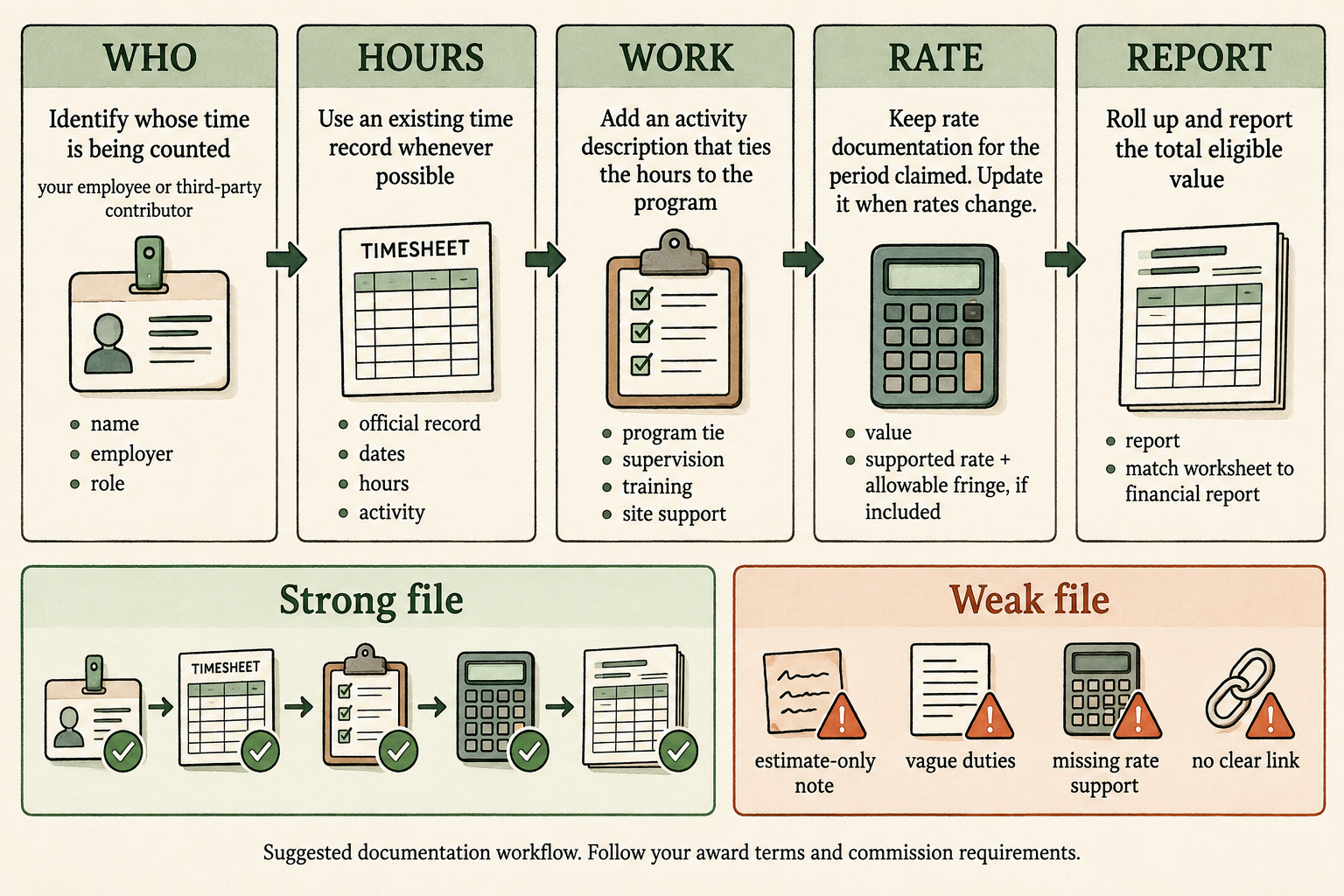
Who: identify the contributor
Keep the person's name, employer, role, the program or cost objective supported, and whether the person is your employee or a third-party contributor.
A short roster can help, but it isn't a federally prescribed form. Its job is to keep the source of the time and the valuation method clear.
There's also an AmeriCorps-specific boundary. You may not count the value of direct community service performed by volunteers. You may count volunteer services contributed to organizational functions, such as accounting, audit, and training of staff and AmeriCorps programs. If a site supervisor also delivers direct service, separate the organizational support from the excluded direct community service before assigning value. (45 CFR § 2521.45(b)(3))
Hours: use an existing record when possible
For your own employee, use the official personnel-expense records that support salary allocation. Those records must accurately reflect work performed, be incorporated into official records, reasonably reflect total compensated activity, and support distribution among activities or cost objectives when needed. (2 CFR § 200.430(g))
For a third-party contributor, start with the partner's regular time record or personnel record if it captures dates, hours, and duties. The donated-services standard points to comparable personnel support to the extent feasible; it doesn't turn the contributor into your employee or make every detail of § 200.430 apply identically. (2 CFR § 200.434(d))
Work: tie the activity to the AmeriCorps program
Hours alone don't explain why the contribution belongs in the award. Add a brief, concrete description, such as:
- member supervision meeting
- review of a service-site issue
- staff or member training
- coaching on prohibited-activities boundaries
- program administration or financial review
Be careful with a description such as “community service.” The AmeriCorps rule excludes the value of volunteers' direct community service while allowing qualifying organizational functions. (45 CFR § 2521.45(b)(3))
Rate: support the value for the period claimed
For an individual volunteer, use rates your organization pays for similar work. If those skills aren't in your workforce, use rates paid for similar work in the labor market where your organization competes for those services. Allowable, allocable, and reasonable fringe benefits may be included in either case. (2 CFR § 200.306(e))\n\nWhen a third-party organization furnishes its employee's services, value them at that employee's regular rate of pay, plus reasonable, necessary, allocable, and otherwise allowable fringe benefits. Indirect costs may be included at the third party's approved federally negotiated indirect cost rate or a rate allowed under § 200.414(d). This method applies when the donated services use the same skills for which the employee is normally paid. (2 CFR § 200.306(f))
Keep rate documentation for the period claimed. Update it when pay, fringe, or indirect rates change. If fringe isn't included, don't add it to the worksheet. If it is included, retain support for the applicable amount or method and effective dates.
For your own employee's salary used as match, retain the payroll and allocation support required for employee compensation rather than relabeling it as donated service. (2 CFR § 200.430(g)(4))
Report: connect the source record to the amount reported
A lean worksheet can show the date range, contributor, activity, hours, supported rate, allowable fringe if included, total eligible value, budget category, report period, and source-record location.
Your financial management system must identify the amount, source, and expenditure of Federal award funds and must support entries with source documentation. (2 CFR § 200.302(b)(3))
The worksheet is the bridge. It shouldn't replace the underlying time, activity, payroll, or rate support.
Strong file, weak file
A strong file connects the contributor, time record, program activity, applicable rate documentation, and reported amount. Someone reviewing it can move from source record to report without guessing.
A weak file relies on an estimate-only note, vague duties, missing rate support, or no clear link to the amount reported.
Budget estimates can be used for interim accounting under § 200.430 only when the system produces reasonable approximations, significant changes are entered promptly, periodic after-the-fact reviews occur, and needed adjustments are made. An estimate by itself isn't final support for an employee salary allocation. (2 CFR § 200.430(g))
For donated services, the governing standards include the applicable volunteer or third-party employee valuation rule, fair-market-value documentation, and comparable allocability support to the extent feasible. (2 CFR § 200.306(j)) (2 CFR § 200.434(d))
Is a monthly certification required?
Not as a universal federal rule.
A monthly certification can be a useful internal control, especially when it helps a supervisor or manager review time after the work occurs. But § 200.430 doesn't prescribe a separate monthly certification for every compliant system. When records meet § 200.430(g)(1), the recipient or subrecipient isn't required to provide additional support beyond the documentation referenced in § 200.430(g)(3). The rule also recognizes records that express categories of activity as percentage distributions of total activities. (2 CFR § 200.430(g)(2)) (2 CFR § 200.430(g)(1)(viii))
Choose a review rhythm that fits your official records, internal controls, award terms, and commission requirements. Label it as your procedure, not as a federal form mandate.
If you're rebuilding the process midyear
Start by fixing the process going forward. Then review earlier periods using the best contemporaneous records you have, such as official time records, payroll records, calendars, supervision logs, or partner records.
Reconstruction doesn't automatically make previously unsupported match acceptable. Document how you reconstructed the record and which sources you used, without creating backdated certifications. Review the result with finance or grants staff and your commission or pass-through entity. If the remaining support isn't enough to verify the match in your records, determine whether a reported amount needs correction. (45 CFR § 2521.45(b)(2)(i))
A closing check
Before reporting supervisor time as match, ask:
- Is this our employee's salary or a third party's donated service?
- Is the activity eligible, rather than excluded direct community service by a volunteer?
- Do the records show who did the work, when, and for which program activity?
- Does the rate support cover the period claimed and the skills performed?
- If fringe or indirect costs are included, are they allowable and supported?
- Can finance trace the value from the source record to the report?
- If we use a certification or review note, have we described it as our control rather than a universal federal requirement?
Your award terms or commission may require more. Follow those requirements, and keep the distinction between employee salary match and donated services visible from the first record to the final report.
A quick reminder
AmeriCorps grants can vary from one to the next. If you’re unsure how a rule applies to your program, check with your commission or designated point of contact at the AmeriCorps agency for any additional guidance and clarifications. They know your award terms best.
Questions people ask
- Can we count a partner supervisor's donated time as AmeriCorps match?
Potentially. The service must benefit the program, meet the cost-sharing conditions, and be documented and valued under the applicable rules. Don't include the value of a volunteer's direct community service; qualifying organizational functions may be counted. (45 CFR § 2521.45(b))
- Do we need a special AmeriCorps form for in-kind supervisor hours?
Not as a universal federal requirement. Use records that fit the contributor: compliant official personnel records for your employee's salary used as match, or comparable allocability support to the extent feasible for donated services. Your award terms or commission may add requirements. (2 CFR § 200.430(g)) (2 CFR § 200.434(d))
- Is a monthly certification required?
No universal federal rule requires a separate monthly certification for every compliant system. When records meet § 200.430(g)(1), additional support generally is not required beyond the documentation referenced in § 200.430(g)(3), and the rule recognizes percentage distributions of total activities. A monthly certification can be a useful internal control, but it should be identified as your procedure unless your award terms or commission require it. (2 CFR § 200.430(g)(2)) (2 CFR § 200.430(g)(1)(viii))
- How should we value donated services?
For an individual volunteer, use rates your organization pays for similar work—or comparable rates in your labor market when those skills aren't in your workforce. Allowable, allocable, and reasonable fringe benefits may be included. When a third-party organization furnishes its employee's services, use the employee's regular rate of pay, allowable fringe, and indirect costs at the organization's approved federally negotiated rate or a rate allowed under § 200.414(d), provided the employee uses the same skills for which the employee is normally paid. (2 CFR § 200.306(e)–(f))
- What if my grant comes through a state or territory service commission?
- Check your commission’s current requirements too. They may be stricter than the federal floor, and stricter is what you follow. What a commission can’t do is override controlling federal law, regulation, or your AmeriCorps award terms, and it can grant only the waivers it’s authorized to grant. Read this post alongside your commission’s guidance, your award terms, and your written policies — and when something looks like a real conflict, ask your commission or program officer rather than guessing.
About the author
Gary Kosman is the founder and CEO of America Learns. He has worked with AmeriCorps programs and state service commissions for more than two decades, helping organizations strengthen the systems they use to manage members, grants, reporting, compliance, and impact. Reach him at gary@americalearns.net or 310-689-0542 x101.
Last reviewed September 30, 2026. Regulations change. Verify every citation against the current eCFR text and your own grant terms and conditions before you rely on it.
Looking for another topic?
Browse all compliance topics — from timesheets and member files to financial and progress reporting.
Browse topicsKeep reading on financial reporting and related topics
Financial Reporting/October 14, 2026
How AmeriCorps Fixed Amount Drawdowns Change for FY 2027
More funding becomes available at the start of the budget period. Later access depends on enrollment and retention. Here’s what the new policy means for National Direct programs, state commission subgrantees, and the people keeping their records straight.
Financial Reporting/August 6, 2026
Fraud Risk Climbs at the End of a Grant
When a grant is ending, people are often tired + moving fast as they race to get the next program year off the ground. That's exactly when weak approvals, missing records, and rushed final reports can turn into findings.
Financial Reporting/August 6, 2026
The Four Tests Every AmeriCorps Cost Must Pass
Most questioned costs don't start with fraud. They start with hurry, assumptions, and a missing piece of paper. A practical review starts with four questions: is the cost necessary, reasonable, allocable, and documented well enough to prove it. Then you confirm the rest of the allowability rules and your award terms.
2 CFR 200 Basics/October 5, 2026
How AmeriCorps State and National Grant Funding Works
Every AmeriCorps State and National award answers two questions: who awards it, and how it's funded. Here's how to sort out both before you apply, and what your organization would be signing up for.
Member Files/September 30, 2026
Exit Paperwork That Leaves the Member File Clean
When a member leaves, the file needs to tell a clear story. The evaluation and release decision establish the member's service outcome and eligibility; retaining the supporting records helps you substantiate those decisions later.