Exit Paperwork That Leaves the Member File Clean
When a member leaves, the file needs to tell a clear story. The evaluation and release decision establish the member's service outcome and eligibility; retaining the supporting records helps you substantiate those decisions later.
Drafted with AI assistance, checked against primary sources, reviewed and approved by Gary Kosman on September 30, 2026.
You can feel the pressure at exit.
The member is leaving. The supervisor is busy. The file has pieces in three places. And you know this is the moment when a loose end can turn into a finding later.
The good news is that the rules give you a workable structure.
Your exit paperwork has two jobs.
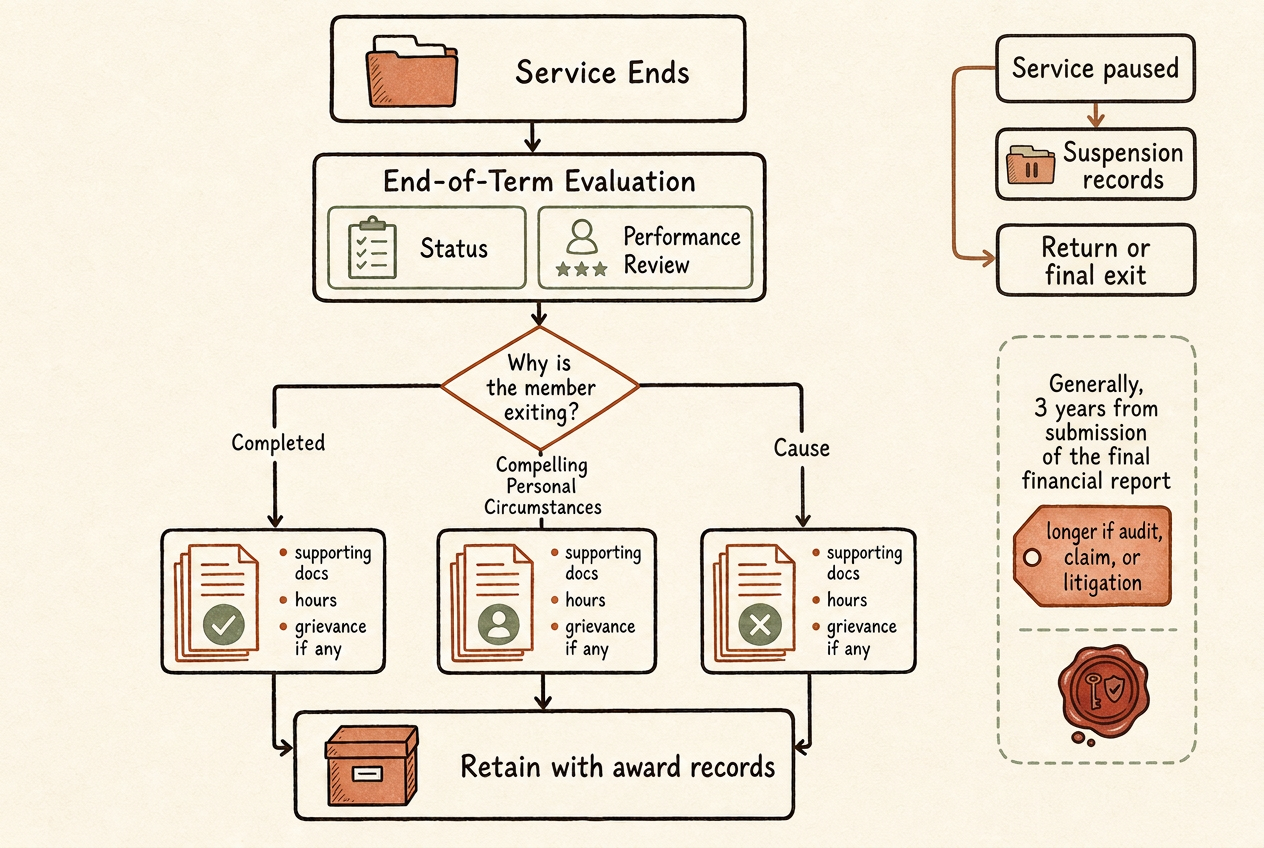
First, it documents what happened to the term of service and whether the member is eligible for an education award or a later term. Each AmeriCorps grantee is responsible for conducting an end-of-term evaluation for those purposes. (45 CFR § 2522.220 (c))
Second, it creates the record you will keep with the rest of the Federal award documentation. Recipients and subrecipients must retain all Federal award records for three years from the date of submission of the final financial report. (2 CFR § 200.334)
If you remember nothing else, remember this: the exit file should let an outside reviewer see the member's status, the basis for that status, and the documents that support it without guessing.
A clean exit file tells one consistent story.
Start with the end-of-term evaluation
For AmeriCorps participants, the end-of-term evaluation isn't optional. (45 CFR § 2522.220 (c))
Each AmeriCorps grantee is responsible for conducting a mid-term and end-of-term evaluation for purposes that include education award eligibility and eligibility to serve a second or additional term. (45 CFR § 2522.220 (c))
If the member was released early, a mid-term evaluation isn't required. (45 CFR § 2522.220 (c))
The end-of-term evaluation should include two parts. (45 CFR § 2522.220)
The first part is the status determination.
The evaluation should determine whether the participant successfully completed the required term of service, was released for compelling personal circumstances, or was released for cause. (45 CFR § 2522.220)
The second part is the performance and conduct review.
That review determines whether the participant's service was satisfactory. (45 CFR § 2522.220)
A satisfactory review looks at two things. It assesses whether the participant satisfactorily completed assignments, tasks, or projects, or if released early, made a satisfactory effort to complete what could reasonably have been addressed in the time served. (45 CFR § 2522.220 (c)(2)(i)) It also assesses whether the participant met other criteria that had been clearly communicated both orally and in writing at the beginning of the term of service. (45 CFR § 2522.220)
That last phrase matters.
Any additional criteria used in the performance and conduct review must have been clearly communicated both orally and in writing at the beginning of the term. (45 CFR § 2522.220)
One practical way to handle this is to keep a copy of the member agreement, handbook acknowledgment, position description, and any written performance standards together in the same section of the file as the final evaluation. That way, the file doesn't force anyone to hunt for the standards you used.
Certify the service outcome with care
The end-of-term evaluation should state which of these three outcomes applies: successful completion, release for compelling personal circumstances, or release for cause. (45 CFR § 2522.220)
If the member successfully completed the required term of service, the evaluation should say that plainly. (45 CFR § 2522.220)
If the member did not complete the term and you are treating the separation as compelling personal circumstances, your file needs more than a label.
An AmeriCorps program may release a participant for compelling personal circumstances if the program determines the participant is unable to complete the term because of compelling personal circumstances, the participant has otherwise performed satisfactorily, and the participant has completed at least fifteen percent of the agreed term of service. (45 CFR § 2522.230 (a)(1))
A participant released for compelling personal circumstances who completes at least 15 percent of the required term of service is eligible for a pro-rated education award. (45 CFR § 2522.230 (a)(2))
The program must document the basis for any determination that compelling personal circumstances prevent a participant from completing a term of service. (45 CFR § 2522.230)
So the file should show three things when you use this category: the basis for the circumstance, the member's satisfactory performance up to that point, and support that the member completed at least 15 percent of the agreed term. (45 CFR § 2522.230 (a)(1)) (45 CFR § 2522.230 (a)(2)) (45 CFR § 2522.230)
If the member leaves before 15 percent for reasons other than misconduct, that term is not considered one of the terms of service for which an individual may receive the related benefits. (45 CFR § 2522.230 (e))
That detail belongs in your internal exit summary, because it affects how the separation is understood later.
Know when suspension fits better than release
Sometimes the right answer isn't a final separation.
As an alternative to releasing a participant for compelling personal circumstances, an AmeriCorps State and National program may suspend the participant's term of service for up to two years, or longer if AmeriCorps approves it based on extenuating circumstances, to allow completion with the same or similar AmeriCorps program later. (45 CFR § 2522.230)
If you use suspension, the file should make the sequence easy to follow.
One way to handle this is to place a short chronology at the front of the exit section: date service stopped, date suspension was approved, reason category, conditions for return if any, and final disposition. That chronology isn't required by regulation, but it prevents the most common record problem at exit: documents that are all present but don't line up.
There are also situations where suspension is mandatory.
A program must suspend the service of an individual who faces an official charge of a violent felony or sale or distribution of a controlled substance. (45 CFR § 2522.230)
A program must suspend the service of an individual who is convicted of possession of a controlled substance. (45 CFR § 2522.230(c))
AmeriCorps programs must release for cause any participant who is convicted of a felony or of the sale or distribution of a controlled substance during a term of service. (45 CFR § 2522.230(b)(2))
During a period of suspension under those provisions, the individual may not receive a living allowance or other benefits and may not accrue service hours. (45 CFR § 2522.230)
If a release for cause is being contested through the grievance process, the individual's service is considered suspended pending resolution. (45 CFR § 2522.230 (b)(5))
While that grievance is pending, the program may not provide federally funded benefits beyond those attributable to service already performed unless the program receives written approval from AmeriCorps. (45 CFR § 2522.230 (b)(5))
That means your exit record should separate three dates when applicable: last day of performed service, date suspension began, and date final release decision was issued.
Release for cause needs a complete file, not a rushed one
A release for cause covers circumstances other than compelling personal circumstances that warrant release from completing a term of service. (45 CFR § 2522.230)
A participant who is released for cause may not receive any portion of the AmeriCorps education award or any other payment from the National Service Trust. (45 CFR § 2522.230)
An individual released for cause must disclose that fact in any later AmeriCorps applications, and failure to disclose it disqualifies the individual for an education award regardless of whether the individual completes a term of service. (45 CFR § 2522.230 (b)(4))
Even here, the end-of-term performance review still matters.
An individual's eligibility for a subsequent term of service will not be affected by a prior release for cause so long as the individual received a satisfactory end-of-term performance review for the period served in the prior term. (45 CFR § 2522.230 (b)(6))
That is why the file should distinguish between the release category and the performance review. (45 CFR § 2522.230 (b)(6)) (45 CFR § 2522.220)
A participant wishing to contest a program's ruling of unsatisfactory performance may file a grievance under the procedures in part 2540. (45 CFR § 2522.220 (e))
If that grievance or later binding arbitration finds the participant did satisfactorily complete a term of service, the individual will be eligible to receive an educational award and or be eligible to serve a second term of service. (45 CFR § 2522.220 (e))
This is one place where worry can push people to overwrite the file.
Don't do that.
Keep the evaluation factual. Tie statements to documents. Date the decision. Identify who made it. If a grievance is filed, keep the original determination, the grievance materials, and the final outcome together so the file shows the full path.
What belongs in the file after the member leaves
At minimum, the recipient and subrecipient must retain all Federal award records for three years from the date of submission of their final financial report. (2 CFR § 200.334)
For most programs, a clean post-exit file will include these items as a matter of sound practice:
| File item | Why it belongs |
|---|---|
| Final end-of-term evaluation | Supports the end-of-term determination and performance review described in the regulation. (45 CFR § 2522.220) |
| Exit status summary | Gives one plain statement of successful completion, release for compelling personal circumstances, release for cause, or suspension pending later action. |
| Documentation supporting the release decision | Needed when compelling personal circumstances are used. (45 CFR § 2522.230) |
| Service hour support and last approved timesheets | Helps support the status decision, including the 15 percent threshold when relevant. |
| Standards communicated at the start of service | Supports any finding tied to performance or conduct criteria. |
| Grievance materials and outcome, if any | Shows whether the original determination changed. |
| Leave or suspension records, if any | Helps explain whether benefits or hours stopped when required. (45 CFR § 2522.230) |
Be careful with records that include protected personal information.
Federal agencies may not place restrictions on a recipient or subrecipient that limit public access to its records pertinent to a Federal award, except for protected personally identifiable information or other sensitive information when the Federal agency can demonstrate the records will be kept confidential and would have been exempt from disclosure under FOIA or as controlled unclassified information if they had belonged to the agency. (2 CFR § 200.338)
At the same time, unless required by Federal, State, local, or tribal law, recipients and subrecipients are not required to permit public access to their own records. (2 CFR § 200.338)
So a practical file setup is to keep the decision document in the main member file and place medical or similarly sensitive backup in a restricted section with a cross-reference.
How long to keep the exit records
The baseline rule is straightforward.
Recipients and subrecipients must retain all Federal award records for three years from the date of submission of the final financial report. (2 CFR § 200.334)
If the award is renewed quarterly or annually, the retention period runs for three years from the date of submission of the quarterly or annual financial report, respectively. (2 CFR § 200.334)
That same rule says the records include financial records, supporting documentation, and statistical records. (2 CFR § 200.334)
If litigation, a claim, or an audit starts before the three-year period ends, retain the relevant records until all related matters are resolved and final action is taken. (2 CFR § 200.334(a))
If you are notified in writing to extend retention, you must keep the records for the extended period described in that notice. (2 CFR § 200.334)
If records are transferred to or maintained by the Federal agency, the three-year retention requirement does not apply to the recipient or subrecipient for those records. (2 CFR § 200.334)
And if the Federal agency determines records have long-term retention value, it must request transfer to its custody, though it may arrange for you to retain them so long as they remain continuously available to the Federal Government. (2 CFR § 200.335)
For your internal procedures, it helps to put one retention date on the outside of the file and one note inside that says why that date could change, such as an open audit or grievance.
Two habits that make exit files hold up
First, write the decision memo after you have the documents together, not before.
That order matters because it keeps the conclusion tied to the record instead of the other way around.
Second, verify your checklist against the current eCFR text and your current award terms and conditions before you finalize your process.
Practice varies.
When the member leaves, you're not trying to create a perfect archive.
You're trying to leave a file that is calm, complete, and defensible.
That's enough. And done well, it's a gift to your future self.
A quick reminder
AmeriCorps grants can vary from one to the next. If you’re unsure how a rule applies to your program, check with your commission or designated point of contact at the AmeriCorps agency for any additional guidance and clarifications. They know your award terms best.
Questions people ask
- Do we need an end-of-term evaluation if the member leaves early?
Yes. Each AmeriCorps grantee is responsible for conducting an end-of-term evaluation for purposes that include education award eligibility and eligibility for a later term of service. (45 CFR § 2522.220 (c)) A mid-term evaluation is not required for a participant who is released early, but the end-of-term evaluation still matters. (45 CFR § 2522.220 (c))
- What do we have to document for a release based on compelling personal circumstances?
Your file needs to support the basis for the compelling personal circumstances determination. (45 CFR § 2522.230) If the member is to be eligible for a pro-rated education award, the record also needs to support that the participant otherwise performed satisfactorily and completed at least 15 percent of the agreed term of service. (45 CFR § 2522.230 (a)(1))
- Can a member released for cause ever serve again?
Yes, possible future eligibility and the education award are not the same issue. A release for cause makes the participant ineligible for the education award for that term, but future eligibility for a subsequent term of service is not affected if the individual received a satisfactory end-of-term performance review for the period served in the prior term. (45 CFR § 2522.230) (45 CFR § 2522.230 (b)(6))
- What happens while a release-for-cause grievance is pending?
An AmeriCorps*State/National participant's service is considered suspended while a grievance contesting the program's determination to release the participant for cause is pending. (45 CFR § 2522.230 (b)(5)) During that period, the program may not provide federally funded benefits beyond those attributable to service already performed unless it has written approval from AmeriCorps. (45 CFR § 2522.230 (b)(5))
- How long do we keep member exit records?
Federal award records must generally be retained for three years from the date of submission of the final financial report. (2 CFR § 200.334) The retention period can extend if litigation, claims, or audits involving the records begin before the three-year period expires, until resolved and final action is taken, or if specified entities notify the recipient or subrecipient in writing to extend it. (2 CFR § 200.334)
- What if my grant comes through a state or territory service commission?
- Check your commission’s current requirements too. They may be stricter than the federal floor, and stricter is what you follow. What a commission can’t do is override controlling federal law, regulation, or your AmeriCorps award terms, and it can grant only the waivers it’s authorized to grant. Read this post alongside your commission’s guidance, your award terms, and your written policies — and when something looks like a real conflict, ask your commission or program officer rather than guessing.
About the author
Gary Kosman is the founder and CEO of America Learns. He has worked with AmeriCorps programs and state service commissions for more than two decades, helping organizations strengthen the systems they use to manage members, grants, reporting, compliance, and impact. Reach him at gary@americalearns.net or 310-689-0542 x101.
Last reviewed September 30, 2026. Regulations change. Verify every citation against the current eCFR text and your own grant terms and conditions before you rely on it.
Looking for another topic?
Browse all compliance topics — from timesheets and member files to financial and progress reporting.
Browse topicsKeep reading on member files and related topics
Member Files/August 12, 2026
Build Member Files Before Enrollment Day Arrives
The cleanest member file is the one you build before the first enrollment rush hits. Set up the file once, in the right order, so eligibility, applicable criminal history check records, and core member documents line up all year.
Member Files/August 6, 2026
Duplication, Displacement, and the Files That Decide
Duplication and displacement problems usually don't begin in the field. They begin on paper. Your position descriptions, host site agreements, and site visit records are often the clearest way to show how an AmeriCorps role was designed and monitored.
Member Files/July 24, 2026
Core AmeriCorps State and National Member File Documents
A baseline checklist for AmeriCorps State and National member files: eligibility, the National Service Criminal History Check, the member agreement, evaluations, service records, exit documentation, and retention.
Financial Reporting/October 14, 2026
How AmeriCorps Fixed Amount Drawdowns Change for FY 2027
More funding becomes available at the start of the budget period. Later access depends on enrollment and retention. Here’s what the new policy means for National Direct programs, state commission subgrantees, and the people keeping their records straight.
2 CFR 200 Basics/October 5, 2026
How AmeriCorps State and National Grant Funding Works
Every AmeriCorps State and National award answers two questions: who awards it, and how it's funded. Here's how to sort out both before you apply, and what your organization would be signing up for.