How AmeriCorps State and National Grant Funding Works
Every AmeriCorps State and National award answers two questions: who awards it, and how it's funded. Here's how to sort out both before you apply, and what your organization would be signing up for.
Drafted with AI assistance, checked against primary sources, reviewed and approved by Gary Kosman on October 5, 2026.
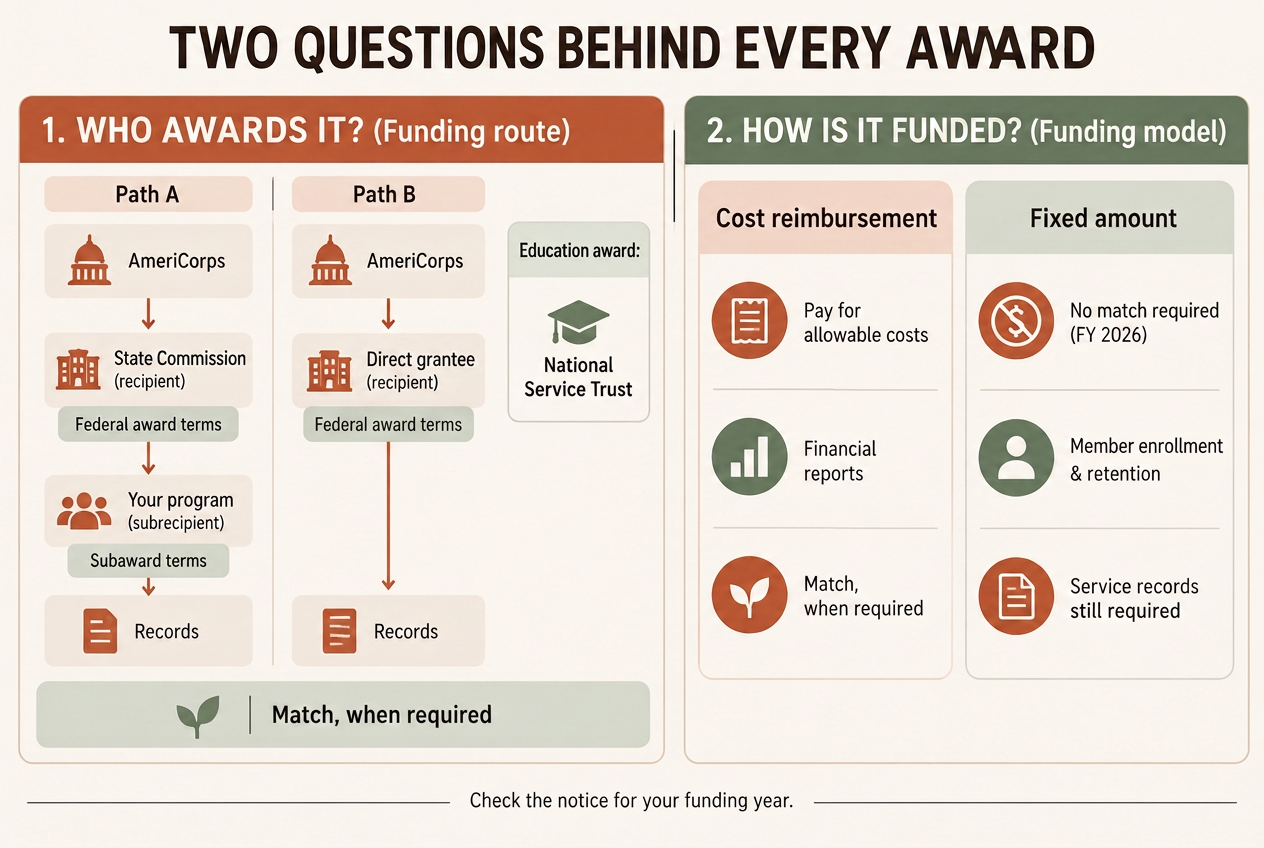
You can run a strong program and still feel fuzzy about where the money starts, who it passes through, and what your organization signs up for when you accept it. That's normal. AmeriCorps State and National funding is layered by design, and most of the confusion clears up once you separate two questions that tend to get blended together.
Start here: four questions to answer before you apply
- Who should we apply through? Your state service commission, or AmeriCorps directly?
- Which grant types can we apply for? Check the notice of funding opportunity for your funding year.
- What expenses and responsibilities would we take on? Including funding you'd need to raise yourself.
- What systems should we have ready before we accept an award? Member records, service-hour records, financial records, and performance data.
Question one: who awards your grant?
This is your funding route. There are two.
Through a state commission. AmeriCorps allocates funds to states by formula and by competition, and it also makes direct competitive grants to other eligible organizations. (45 CFR § 2521.30) When the commission receives the Federal award, it's the recipient. A recipient is an entity that receives a Federal award directly from a Federal agency. (2 CFR § 200.1) When the commission then funds your program, your organization is a subrecipient, meaning it receives a subaward from a pass-through entity to carry out part of a Federal award. (2 CFR § 200.1)
Directly from AmeriCorps. Some organizations, often those operating in more than one state, apply to AmeriCorps directly. Then your organization is the recipient, and there's no commission in between.
One thing that surprises people: being a direct grantee doesn't mean you'll never be a pass-through entity. A pass-through entity is any recipient or subrecipient that provides a subaward to a subrecipient to carry out part of a Federal program. (2 CFR § 200.1) If your organization makes qualifying subawards to operating sites, those pass-through responsibilities are yours, too.
Question two: how is your award funded?
This is your funding model, and it's a separate question from the route. Either route can involve either model.
Cost reimbursement. You're paid for allowable costs you incur, you report on those costs, and you meet any match requirement in your award.
Fixed amount. A fixed amount award provides a specific amount of funding without regard to actual costs incurred, and accountability is based primarily on performance and results. (2 CFR § 200.1) (2 CFR § 200.101 (b)(4)(ii)) In AmeriCorps, that typically means funding tied to member enrollment and service, with Education Award Program (EAP) grants and full-cost fixed amount grants as the common forms.
Here's the part that trips people up. The FY 2027 AmeriCorps State and National notice says fixed amount grants have no cost share or matching requirement. (FY 2027 AmeriCorps State and National NOFO) "No required match" isn't the same as "AmeriCorps covers everything." Your organization still needs enough resources of its own to run the program well.
Fixed amount doesn't mean "no accountability," either. Payments are based on meeting the requirements specified in the award. At the end of the award, the recipient or subrecipient must certify in writing that the required activities were completed or identify any activities that weren't completed, and must certify that expenditures complied with §200.403; the award must be reduced to reflect required activities that were not completed. (2 CFR § 200.201) Routine monitoring of actual costs is not expected and financial reporting isn't required for fixed amount awards, but record retention and the duty to make records available during an audit still apply. (2 CFR § 200.201) (2 CFR § 200.101 (b)(4)(ii)) In practice, your enrollment records, member files, and service-hour records are central to accountability, though financial records can still matter for audits and any cost requirements that apply.
Which awards are available to new applicants?
This changes from year to year, so always read the notice for the competition you're applying to. Under the FY 2027 notice, new applicants can apply for cost reimbursement, EAP, Professional Corps, and no-cost slots grants, but can't apply for full-cost fixed amount grants. (FY 2027 AmeriCorps State and National NOFO)
Your route depends on where you operate. Under the FY 2027 notice, single-state applicants generally apply through their state commission, and multistate applicants apply directly to AmeriCorps; eligible tribes and tribal organizations, and applicants in states or territories without a commission, can also apply directly. (FY 2027 AmeriCorps State and National NOFO) If you're applying through a commission, it may add its own requirements and timelines, so that's a good first phone call.
What you'd be signing up for
Before you budget, it helps to see the practical questions side by side.
| Question | What to look for |
|---|---|
| How much funding could we receive? | The funding limits in the notice and what the award would cover |
| Will we need other funding? | Required match (cost reimbursement) versus the additional resources you'd need to operate (either model) |
| When will we receive money? | Payment timing in your award and the cash flow you'd need in between |
| What must we document? | Financial, member, and performance records that apply to your award |
| What happens if members leave early? | How your award's enrollment and service requirements affect funding |
Member benefits and living allowances
AmeriCorps money is tied to real people serving in real communities, so this section matters.
A member who completes an approved term of service may receive an education award from the National Service Trust, not from your program's budget. (45 CFR § 2522.240)
Living allowances follow their own rules. The regulation sets a minimum for full-time members and a cap of 200 percent of the average VISTA subsistence allowance, except for professional corps programs. (45 CFR § 2522.240) Programs may, but aren't required to, provide living allowances to part-time members. (45 CFR § 2522.240) The regulation's text also reaches education-awards-only programs, but the FY 2027 notice exempts EAP grantees from providing a living allowance, so check the notice that governs your award. (FY 2027 AmeriCorps State and National NOFO)
And here's a distinction worth writing on a sticky note: the FY 2027 notice says a living allowance isn't a salary or wage. (FY 2027 AmeriCorps State and National NOFO) Member living allowances and service-hour records follow different rules from staff salaries and staff time records. Programs still need to meet applicable tax and insurance requirements.
Allowable costs and staff payroll
Start with the basics. To be allowable, a cost must be necessary and reasonable, allocable to the award, consistent with the award's limitations and policies, and adequately documented. (2 CFR § 200.403) A cost is allocable when it's chargeable to the award in proportion to the benefit it receives. (2 CFR § 200.405)
Scope note: the staff payroll rules below apply to cost reimbursement awards. Fixed amount awards are exempt from most of the cost principles in subpart E, including the compensation and fringe benefit sections. (2 CFR § 200.101 (b)(4)(ii))
For cost reimbursement awards, charges for staff salaries and wages must be based on records that accurately reflect the work performed. (2 CFR § 200.430) Budget estimates alone don't qualify as support. (2 CFR § 200.430) Fringe benefits are allowable when they're reasonable and required by law, an organization-employee agreement, or an established policy. (2 CFR § 200.431)
Match, when it's required
For cost reimbursement awards with a match requirement, the match must be verifiable in your records, not counted toward another Federal award, necessary and reasonable, and allowable under the cost principles. (2 CFR § 200.306) Staff salaries used as match need the same support as salaries charged to the award. (2 CFR § 200.430)
If your organization has gone at least five years without an AmeriCorps operational grant from AmeriCorps or a state commission, measured from the end of its most recent grant period, it may restart at the year-one match level. (45 CFR § 2521.80)
Drawing down funds
Payment rules depend on who you are. States follow the payment framework in §200.305(a), which ties to Treasury's cash management rules. (2 CFR § 200.305)
For recipients and subrecipients other than States, §200.305(b) applies. Under that subsection, payment methods must minimize the time between receiving and spending Federal funds, and advance payments must be limited to the minimum amounts needed for immediate cash requirements. (2 CFR § 200.305) For those same non-State entities, when reimbursement is used, payment must be made within 30 calendar days after receipt of the payment request, unless the agency or pass-through entity reasonably believes the request is improper, and advances generally belong in interest-bearing accounts. (2 CFR § 200.305)
This is where finance staff and program staff need each other.
When money passes through
If your commission or organization makes qualifying subawards, it acts as a pass-through entity, and the terms of the Federal award flow down to your subawards unless a section or the award's terms say otherwise. (2 CFR § 200.101) A pass-through entity must evaluate each subrecipient's risk and monitor its activities as needed to ensure compliance and performance. (2 CFR § 200.332)
If you're the program receiving the subaward, that's why your commission asks for more than an invoice. They're not being extra.
AmeriCorps minimum program requirements apply whether a program is supported directly by AmeriCorps or through a subgrant. (45 CFR § 2522.100)
A readiness checklist
This is planning advice, not a federal checklist. Before you apply, name a person for each of these:
- Member recruitment and enrollment
- Member supervision and service-hour records
- Member files, including eligibility and exit paperwork
- Financial management and reporting
- Performance data and progress reports
- Regular coordination between program staff and finance staff
If one person's name shows up on every line, that's worth a conversation before you apply.
One organization, start to finish
Picture a small literacy nonprofit. It calls its state commission and learns which grant types the commission is offering this year. It applies for a cost reimbursement grant, budgets its match, and lines up the remaining funding it'll need to operate. Once the subaward arrives, it enrolls members, keeps service-hour and member file records, requests funds under the payment procedures in its subaward, and reports on performance. The commission reviews those reports and visits the site. Every step has a record behind it, and that's the whole idea.
Questions to ask before you apply
Bring these to your commission (or to AmeriCorps, if you're applying directly):
- Which grant types are you offering in this competition?
- What additional requirements do you impose?
- What funding must we secure ourselves?
- How and when would payments be made?
- What training or application assistance is available?
Reference: allocation and grant types
For readers who want the detail: AmeriCorps distributes funds by population-based formula, by competition among states, and through direct competitive grants, with separate allocations for territories and tribes. (45 CFR § 2521.30) AmeriCorps may make planning, operational, replication, and certain training, technical assistance, and special grants. (45 CFR § 2521.20) An operational grant is negotiated for a term not to exceed three years. (45 CFR § 2521.20)
When the money changes hands, responsibility doesn't disappear. It gets more specific.
A quick reminder
AmeriCorps grants can vary from one to the next. If you’re unsure how a rule applies to your program, check with your commission or designated point of contact at the AmeriCorps agency for any additional guidance and clarifications. They know your award terms best.
Questions people ask
- What's the difference between a recipient and a subrecipient in AmeriCorps funding?
A recipient receives a Federal award directly from a Federal agency, and a subrecipient receives a subaward from a pass-through entity to carry out part of a Federal award. (2 CFR § 200.1) A state commission is usually the recipient and the programs it funds are subrecipients, but any recipient or subrecipient that makes qualifying subawards acts as a pass-through entity, too. Your state commission can tell you how your award is set up.
- Do AmeriCorps fixed amount grants require match?
The FY 2027 AmeriCorps State and National notice says fixed amount grants have no cost share or matching requirement, but your organization still needs enough resources to operate. (FY 2027 AmeriCorps State and National NOFO) Payments depend on meeting the award's requirements, and the award must be reduced to reflect required activities that were not completed. (2 CFR § 200.201) Check with your commission before you apply.
- Can a new applicant apply for a full-cost fixed amount grant?
Not under the FY 2027 notice, which lets new applicants apply for cost reimbursement, EAP, Professional Corps, and no-cost slots grants. (FY 2027 AmeriCorps State and National NOFO) This can change by funding year, so read the notice for your competition and ask your commission.
- Is a member's living allowance the same as a staff salary?
No. The FY 2027 notice says a living allowance isn't a salary or wage, and the FY 2027 notice exempts EAP grantees from providing one. (FY 2027 AmeriCorps State and National NOFO) Staff payroll documentation rules under §200.430 apply to employees on cost reimbursement awards, not to members. (2 CFR § 200.430) Your commission can confirm what applies to your program.
- What if my grant comes through a state or territory service commission?
- Check your commission’s current requirements too. They may be stricter than the federal floor, and stricter is what you follow. What a commission can’t do is override controlling federal law, regulation, or your AmeriCorps award terms, and it can grant only the waivers it’s authorized to grant. Read this post alongside your commission’s guidance, your award terms, and your written policies — and when something looks like a real conflict, ask your commission or program officer rather than guessing.
About the author
Gary Kosman is the founder and CEO of America Learns. He has worked with AmeriCorps programs and state service commissions for more than two decades, helping organizations strengthen the systems they use to manage members, grants, reporting, compliance, and impact. Reach him at gary@americalearns.net or 310-689-0542 x101.
Last reviewed October 5, 2026. Regulations change. Verify every citation against the current eCFR text and your own grant terms and conditions before you rely on it.
Looking for another topic?
Browse all compliance topics — from timesheets and member files to financial and progress reporting.
Browse topicsKeep reading on 2 cfr 200 basics and related topics
2 CFR 200 Basics/August 18, 2026
When Staff Duties and Timesheets Don’t Match
Salary costs get vulnerable when payroll support, payroll charges, and the role described in your award materials stop lining up. The fix starts with a clean match between supported work, the amount charged, and the staffing picture your award says you funded.
2 CFR 200 Basics/August 17, 2026
Uniform Guidance for AmeriCorps: 2 CFR part 200 AmeriExplained
If you run an AmeriCorps grant, 2 CFR part 200 shapes much of your daily compliance work. This guide translates the rule into program language and shows how it fits with AmeriCorps regulations and award terms.
2 CFR 200 Basics/August 14, 2026
A Calm 60-Day Plan for Start-Up Compliance
If you're starting late and carrying the grant mostly alone, you don't need a perfect launch. You need the right compliance pieces in the right order so member files, timekeeping, financial controls, and data collection can hold up.
Financial Reporting/October 14, 2026
How AmeriCorps Fixed Amount Drawdowns Change for FY 2027
More funding becomes available at the start of the budget period. Later access depends on enrollment and retention. Here’s what the new policy means for National Direct programs, state commission subgrantees, and the people keeping their records straight.
Member Files/September 30, 2026
Exit Paperwork That Leaves the Member File Clean
When a member leaves, the file needs to tell a clear story. The evaluation and release decision establish the member's service outcome and eligibility; retaining the supporting records helps you substantiate those decisions later.