Build Member Files Before Enrollment Day Arrives
The cleanest member file is the one you build before the first enrollment rush hits. Set up the file once, in the right order, so eligibility, applicable criminal history check records, and core member documents line up all year.
Drafted with AI assistance, checked against primary sources, reviewed and approved by Gary Kosman on August 12, 2026.
You can feel the squeeze before the first member ever serves.
Applications are moving. Supervisors want start dates. People are asking whether they can go ahead now and fix paperwork later.
This is where next spring gets decided.
If the file is built before enrollment day, you spend the year managing. If it isn't, you spend the year reconstructing.
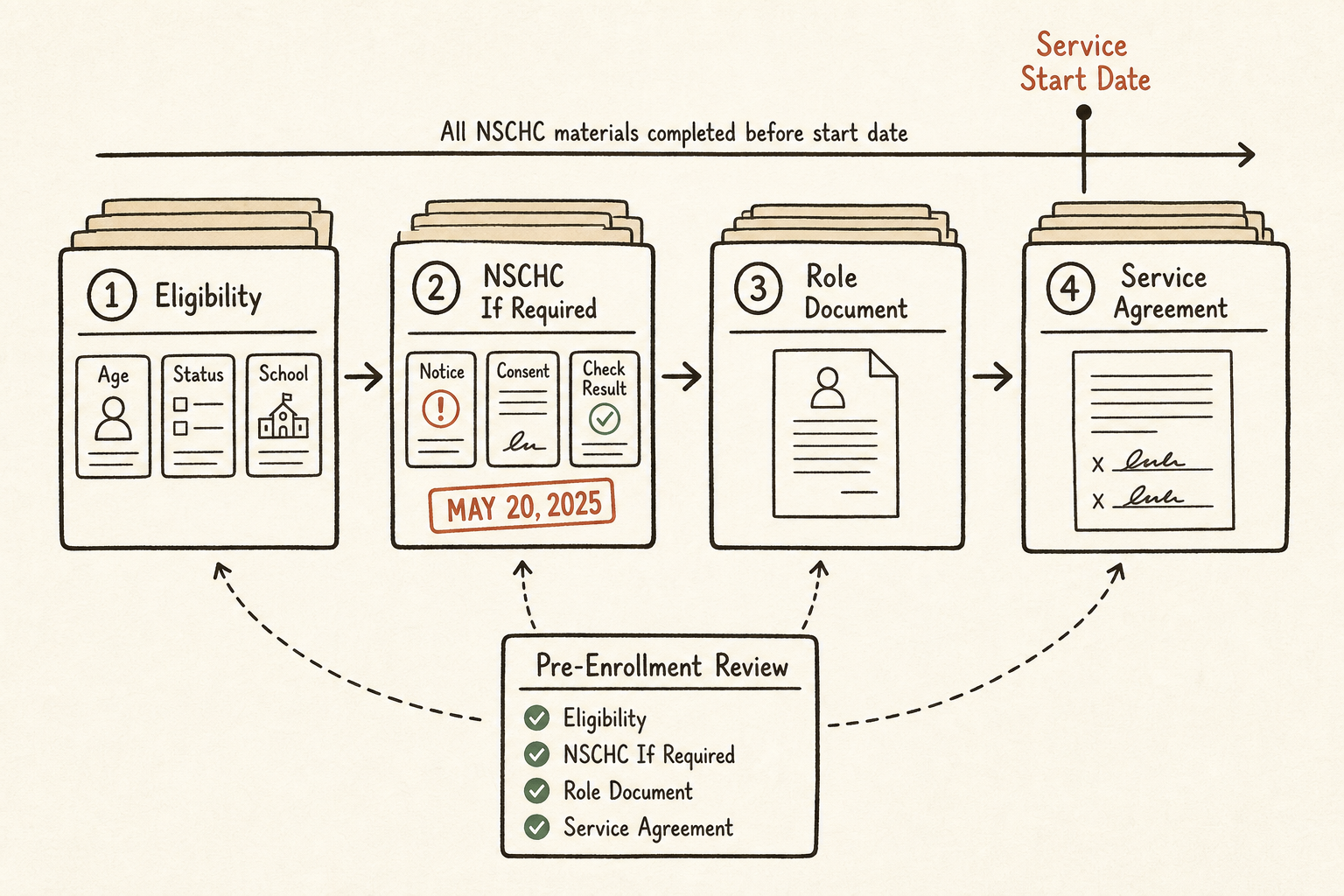
For State and National programs, a practical pre-service member file often includes four core sections:
- eligibility documentation,
- applicable National Service Criminal History Check records,
- the member service agreement required by program rules or award terms, and
- the operative position description or role document your program uses.
That list is a file-design recommendation, not a single four-part rule in the CFR.
The eligibility rule is 45 CFR § 2522.200, What are the eligibility requirements for an AmeriCorps participant?. The NSCHC rules relevant here include 45 CFR § 2540.201, Which individuals require a National Service Criminal History Check?, 45 CFR § 2540.204, What are the components of a National Service Criminal History Check?, 45 CFR § 2540.205, By when must the National Service Criminal History Check be completed?, 45 CFR § 2540.206, What procedural steps are required, in addition to conducting the National Service Criminal History Check described in this subpart?, and 45 CFR § 2540.207, Waiver.
The member service agreement and position description are also shaped by program requirements and award terms. For programs on FY2026 State and National awards, use the FY2026 AmeriCorps State and National Terms and Conditions (revised June 23, 2026). If your program is operating on an earlier award, follow that year's Terms attached to your award.
And because both regulations and award terms can change, verify your process against the current eCFR Title 45 provisions for AmeriCorps and your own award documents before you rely on a checklist.
The setup principle
Don't build files member by member from scratch.
Build one complete structure first.
Then copy it for every member.
That sounds small. It isn't.
A standard file structure does three things:
- it puts documents in the order your staff expects to see them,
- it makes missing items obvious before service begins, and
- it keeps local practice from drifting person by person.
Use one folder, digital or paper, with the same labels every time.
The pre-enrollment file checklist
Set up these sections in this order.
<table style="min-width: 75px;"><colgroup><col style="min-width: 25px;"><col style="min-width: 25px;"><col style="min-width: 25px;"></colgroup><tbody><tr><th colspan="1" rowspan="1"><p>File section</p></th><th colspan="1" rowspan="1"><p>What belongs there</p></th><th colspan="1" rowspan="1"><p>What status you want before enrollment review</p></th></tr><tr><td colspan="1" rowspan="1"><p>1. Recruitment and selection notes</p></td><td colspan="1" rowspan="1"><p>Application, interview materials if you retain them, and selection documentation under your own process</p></td><td colspan="1" rowspan="1"><p>Complete under your local process</p></td></tr><tr><td colspan="1" rowspan="1"><p>2. Eligibility documentation</p></td><td colspan="1" rowspan="1"><p>Records supporting age, citizenship, national, or lawful permanent resident status, education-related eligibility elements that apply, and any NSCHC-related eligibility point your process documents here</p></td><td colspan="1" rowspan="1"><p>Reviewed before enrollment</p></td></tr><tr><td colspan="1" rowspan="1"><p>3. NSCHC records, if required for this member</p></td><td colspan="1" rowspan="1"><p>Required check components, required notices and consents, results, and documentation of review and eligibility determination</p></td><td colspan="1" rowspan="1"><p>Complete before work or service begins in the covered position</p></td></tr><tr><td colspan="1" rowspan="1"><p>4. Position description or role document</p></td><td colspan="1" rowspan="1"><p>Final operative version for the slot or placement</p></td><td colspan="1" rowspan="1"><p>Final before agreement is prepared</p></td></tr><tr><td colspan="1" rowspan="1"><p>5. Member service agreement</p></td><td colspan="1" rowspan="1"><p>Final signed agreement and any permitted amendment or addendum</p></td><td colspan="1" rowspan="1"><p>Check your award terms for timing; as an internal control, have it complete before service begins</p></td></tr><tr><td colspan="1" rowspan="1"><p>6. Enrollment review support</p></td><td colspan="1" rowspan="1"><p>Internal checklist showing the pre-enrollment review occurred</p></td><td colspan="1" rowspan="1"><p>Common practice, not a standalone CFR requirement</p></td></tr></tbody></table>That table separates three different things on purpose: what the regulation requires, what your award terms may add, and what good internal control looks like.
1. Eligibility documentation under 45 CFR 2522.200
Start here.
If eligibility isn't documented, everything else rests on weak footing.
Under 45 CFR § 2522.200, an AmeriCorps participant must meet the rule's age, education, citizenship, national, or lawful permanent resident, and applicable NSCHC-eligibility conditions. For a person who requires an NSCHC, 45 CFR § 2540.202 identifies the criminal-history-check conditions that make an individual ineligible to work or serve in a covered position.
That means your file should include documentation that supports each eligibility element that applies to that person.
There is one important nuance in the rule. For the high-school-education element, 45 CFR § 2522.200(b), What are the eligibility requirements for an AmeriCorps participant? permits a written declaration under penalty of law as sufficient for enrollment, and the program need not obtain additional documentation of that fact. If you rely on that option, retain the declaration.
A clean approach is to keep one eligibility checklist at the front of this section, followed by the source documents you relied on.
Your checklist can identify:
- member name,
- position title,
- proposed service start date,
- date eligibility was reviewed,
- who reviewed it,
- each eligibility factor reviewed, and
- what document was used to verify it.
Be precise about what the document proves.
A date-of-birth document proves age. It may not prove citizenship, nationality, or lawful permanent resident status. A school-related document may satisfy one element and not another.
Don't let one paper do more work on your checklist than it can support.
If your commission, subrecipient, or site has another review layer, that's your process design. Keep it in the file if it helps. Label it as internal review so no one mistakes it for a separate federal standard.
2. NSCHC records: scope first, then timing
This is where start-up season gets tight.
People want to move faster than the rule allows.
Start with scope.
Not every person needs an NSCHC.
Under 45 CFR § 2540.201, Which individuals require a National Service Criminal History Check?, the check applies to individuals in covered positions, with exceptions the rule describes. One important exception: an individual who is under 18 on the first day of work or service in a covered position does not require an NSCHC under that section. The rule also excludes an individual whose activity is entirely included in the grant recipient's indirect cost rate. See 45 CFR § 2540.201(c), Which individuals require a National Service Criminal History Check?.
Then timing.
Under 45 CFR § 2540.205, By when must the National Service Criminal History Check be completed?, the grant recipient or subrecipient must conduct and review the NSCHC and make an eligibility determination before the person begins work or service in a covered position.
If a person serves consecutive terms of service or employment with the same organization in a covered position and does not have a break in service or employment longer than 180 days, no additional NSCHC is required as long as the original check complied with 45 CFR § 2540.204. If no NSCHC was conducted during the prior term because the person was under 18, however, a check must be completed before a subsequent term that begins when the person is 18 or older.
Unless AmeriCorps approves a waiver under 45 CFR § 2540.207, Waiver, 45 CFR § 2540.204, What are the components of a National Service Criminal History Check? requires an NSOPW check, a State criminal history record check covering the individual's State of residence and State of service, and an FBI fingerprint-based check.
Additional procedural steps include obtaining the person's consent before conducting the State and FBI checks; providing notice that selection is contingent on review of the NSCHC results; providing a reasonable opportunity to review and challenge the factual accuracy of a result before exclusion; protecting the confidentiality of NSCHC information; maintaining NSCHC documentation as grant records; and paying the cost of the NSCHC unless AmeriCorps approves otherwise under 45 CFR § 2540.207. See 45 CFR § 2540.206.
For file design, make this section easy to follow.
A practical folder structure—not a prescribed CFR layout—is:
- required notices and consents,
- each required check result,
- documentation showing the results were reviewed,
- the eligibility determination, and
- any record your program keeps to show the date the full review was complete.
If the required NSCHC hasn't been conducted and reviewed and an eligibility determination hasn't been made, do not let the person begin work or service in the covered position.
Whether you also delay the administrative enrollment step is an internal-control choice unless your current award terms or program instructions say more.
3. The member service agreement
No one wants to chase signatures after a member starts.
And yet it happens.
Your file should make the agreement easy to complete, review, and retrieve.
What the CFR says depends on program rule. What your award terms say may be more specific. For State and National grantees, review the member-related sections of the FY2026 AmeriCorps State and National Terms and Conditions (revised June 23, 2026) if you are on an FY2026 award. If you are not, use the Terms attached to your own award.
A fully executed agreement before service begins is a strong control. It may also be required by your program-specific terms. Verify the timing and content against the award year you are operating under.
For file design, keep together:
- the final signed agreement,
- any permitted amendment or addendum, and
- any acknowledgment your program uses for policies incorporated into the agreement.
Before signature, review the agreement against the rest of the file. Position title, term type, start date, end date, and placement details shouldn't conflict across documents.
A small mismatch becomes a large cleanup project later.
If your process uses electronic signatures, keep the final signed output in the member file in a format you can produce later.
4. The position description
This document gets treated like routine paperwork.
It isn't.
It tells you what role the member entered.
That matters for supervision. It matters for monitoring. It matters when someone asks whether the member was placed into the role your award supports.
Set up this section so the operative version is obvious. If you keep drafts, mark them as drafts and store them separately.
At minimum, your pre-enrollment review should confirm that the role document:
- matches the approved program design,
- describes the service activities clearly,
- reflects any boundaries or restrictions your program is using, and
- matches the slot or placement the member will fill.
The FY2026 General Grant and Cooperative Agreement Terms and Conditions (revised January 27, 2026) state that recipients agree to operate the funded program in accordance with the approved application, budget, supporting documents, and other supporting representations, along with applicable program-specific Terms.
That's why this document isn't filler. It's part of the record showing what role you funded and filled.
The order matters more than people think
A workable sequence looks like this:
- Finalize the position description or role document.
- Review eligibility documentation.
- Determine whether NSCHC is required for this individual under the covered-position rules.
- If required, complete the NSCHC review and eligibility determination before work or service begins.
- Prepare the member service agreement using the final role and term details.
- Obtain signatures under your award-year requirements.
- Conduct one pre-enrollment file review.
- Enroll the member under your program process.
- Allow service to begin on or after the documented service start date.
If you skip step 4 for a person who needs NSCHC, you have a compliance problem.
If you sign an agreement with details that don't match the role document, you've created avoidable correction work.
If you let a missing item slide because everyone is tired, you are borrowing trouble from your future self.
Build the file in the order the rules expect life to happen.
A practical file naming system
You don't need a fancy structure.
You need one a tired person can follow in October.
Try this format for digital folders:
LastName_FirstName - ProgramYear - TermType
Then number the documents inside:
01 Eligibility Checklist02 Eligibility Support03 NSCHC Scope and Notices04 NSCHC Results05 NSCHC Review and Eligibility Determination06 Position Description07 Member Service Agreement08 Enrollment Review Checklist
The numbers matter.
They freeze the order.
That helps when different staff touch the file.
What to fix before the first member starts
If you're in the first weeks of the program year, look for these weak spots now:
- old checklists that cite last year's terms,
- NSCHC files that don't show whether the person was in a covered position or within an exception,
- service agreements that don't match current program design,
- role documents saved in draft form with no final version marked, and
- eligibility files that contain documents but no review record showing what those documents were used to verify.
None of that means your program is failing.
It means your system needs one calm pass before the rush becomes your normal.
That's fixable.
And once this file is built well, you won't have to reinvent it for every enrollment. You'll be maintaining a standard, not chasing one.
A quick reminder
AmeriCorps grants can vary from one to the next. If you’re unsure how a rule applies to your program, check with your commission or designated point of contact at the AmeriCorps agency for any additional guidance and clarifications. They know your award terms best.
Questions people ask
- Can a member start serving while we wait for one criminal history check result?
Usually no. For an individual who requires an NSCHC in a covered position, the grant recipient or subrecipient must conduct and review the check and make an eligibility determination before the person begins work or service in that position under 45 CFR § 2540.205, By when must the National Service Criminal History Check be completed?. But start with scope: 45 CFR § 2540.201, Which individuals require a National Service Criminal History Check? includes exceptions, including for an individual who is under 18 on the first day of work or service in the covered position and for an individual whose activity is entirely included in the grant recipient's indirect cost rate. If you are dealing with a repeat term, read 45 CFR § 2540.205 closely for the limited consecutive-term rule.
- What should we keep in the file to show member eligibility?
Keep records that support each eligibility element that applies under 45 CFR § 2522.200, What are the eligibility requirements for an AmeriCorps participant?, including the rule's age, education, citizenship, national, or lawful permanent resident, and NSCHC-eligibility conditions. A strong internal-control approach is to add an eligibility checklist showing what was reviewed, when it was reviewed, by whom, and which document supported each element. For the high-school-education element, 45 CFR § 2522.200(b) permits a written declaration under penalty of law as sufficient for enrollment, so retain that declaration if you rely on it.
- Does the member service agreement have to be signed before the service start date?
A fully executed agreement before service begins is a strong control, but you should not treat that timing as a universal CFR rule unless your program's rule or award terms say so. For State and National grantees, review the applicable award-year FY2026 AmeriCorps State and National Terms and Conditions (revised June 23, 2026) if you are on FY2026; if you are on another award year, use the Terms attached to that award. If your terms prescribe signature timing, follow them.
- Can we use the same position description for several members?
You may be able to use a common position-description template for substantially identical placements, but confirm that against your approved application, your program instructions, and the Terms attached to your award. Keep the operative version, or a clear cross-reference to it, in each member's records. The FY2026 General Grant and Cooperative Agreement Terms and Conditions (revised January 27, 2026) reinforce that recipients operate in accordance with approved award materials and applicable program-specific Terms.
- What if my grant comes through a state or territory service commission?
- Check your commission’s current requirements too. They may be stricter than the federal floor, and stricter is what you follow. What a commission can’t do is override controlling federal law, regulation, or your AmeriCorps award terms, and it can grant only the waivers it’s authorized to grant. Read this post alongside your commission’s guidance, your award terms, and your written policies — and when something looks like a real conflict, ask your commission or program officer rather than guessing.
About the author
Gary Kosman is the founder and CEO of America Learns. He has worked with AmeriCorps programs and state service commissions for more than two decades, helping organizations strengthen the systems they use to manage members, grants, reporting, compliance, and impact. Reach him at gary@americalearns.net or 310-689-0542 x101.
Last reviewed August 12, 2026. Regulations change. Verify every citation against the current eCFR text and your own grant terms and conditions before you rely on it.
Looking for another topic?
Browse all compliance topics — from timesheets and member files to financial and progress reporting.
Browse topicsKeep reading on member files and related topics
Member Files/August 6, 2026
Duplication, Displacement, and the Files That Decide
Duplication and displacement problems usually don't begin in the field. They begin on paper. Your position descriptions, host site agreements, and site visit records are often the clearest way to show how an AmeriCorps role was designed and monitored.
Member Files/July 24, 2026
Core AmeriCorps State and National Member File Documents
A baseline checklist for AmeriCorps State and National member files: eligibility, the National Service Criminal History Check, the member agreement, evaluations, service records, exit documentation, and retention.
OIG Findings/September 4, 2026
How Commissions Can Catch Timesheet and Term Errors Early
When education awards are tied to weak time records or unsupported service-term changes, the cost lands late and hard. A commission can catch most of it before exit with a tighter review sequence.
Performance Measurement/September 2, 2026
Your Data-Collection System Is Part of Your Audit Trail
Surveys, logs, and tests can become Federal award records. Federal rules do not require you to keep every draft or form configuration — they require retention of the records and supporting documentation that substantiate what you reported. ([2 CFR § 200.334](https://www.ecfr.gov/current/title-2/section-200.334))
2 CFR 200 Basics/August 18, 2026
When Staff Duties and Timesheets Don’t Match
Salary costs get vulnerable when payroll support, payroll charges, and the role described in your award materials stop lining up. The fix starts with a clean match between supported work, the amount charged, and the staffing picture your award says you funded.