Duplication, Displacement, and the Files That Decide
Duplication and displacement problems usually don't begin in the field. They begin on paper. Your position descriptions, host site agreements, and site visit records are often the clearest way to show how an AmeriCorps role was designed and monitored.
Drafted with AI assistance, checked against primary sources, reviewed and approved by Gary Kosman on August 9, 2026.
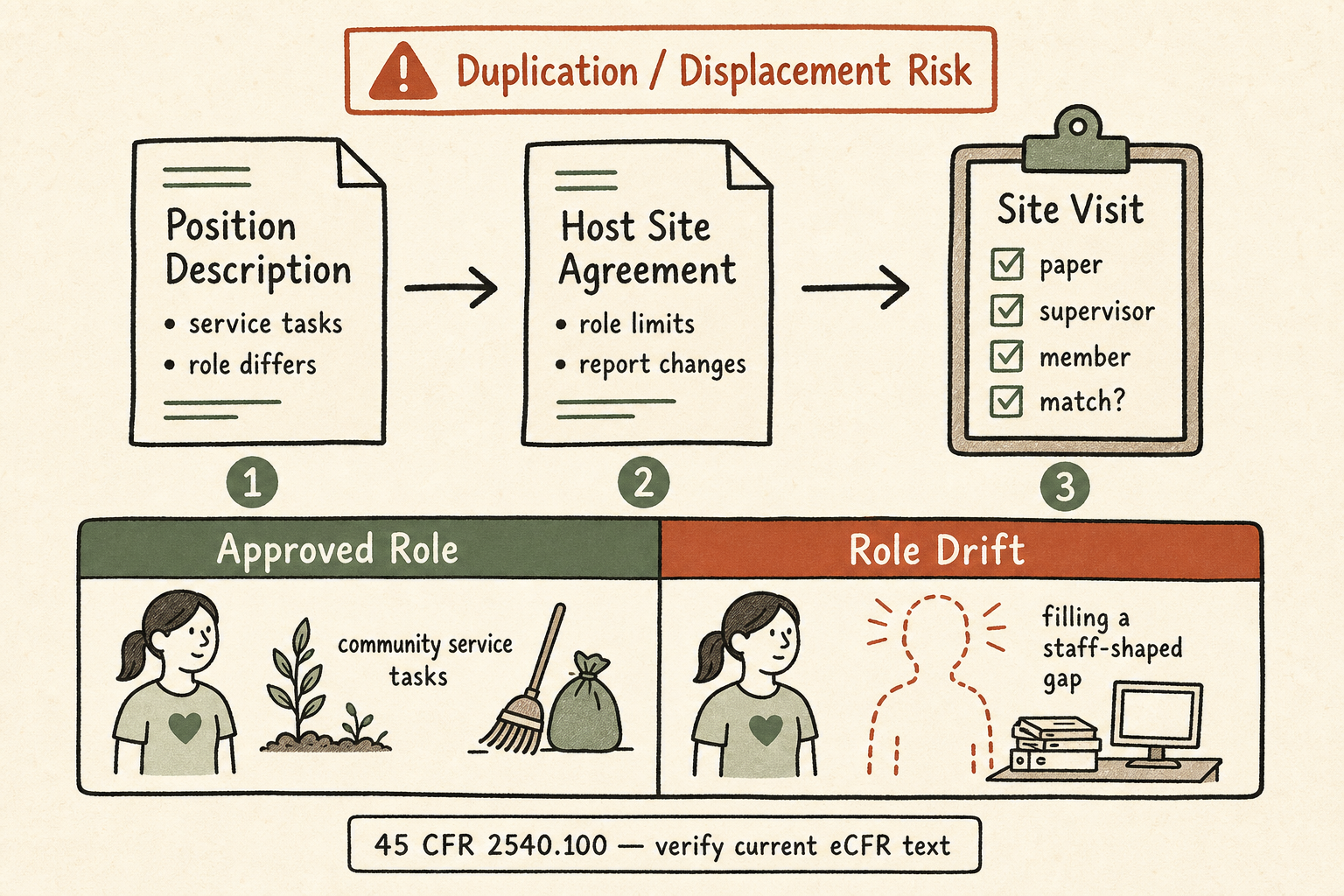
The decision starts before the member starts
You can feel the risk before anyone says the words.
A host site is short-staffed. A supervisor needs help now. A member is eager, capable, and standing right there.
That's when duplication and displacement stop sounding like compliance vocabulary and become a file problem.
The legal rule comes from AmeriCorps regulations, not from the Uniform Guidance.
The controlling definitions are in 45 CFR § 2540.100, including the duplication and nondisplacement provisions in paragraphs (e) and (f).
That matters.
These are AmeriCorps-specific restrictions in title 45. They are not documentation rules created by 2 CFR part 200. Your award terms, commission requirements, or pass-through requirements may add documentation and monitoring expectations on top of that.
So your first control usually isn't a training slide.
It's the paperwork that defines the role before a member ever serves a day.
Start with the regulation, then verify the current text
Start with 45 CFR § 2540.100.
Then verify against the current eCFR text before you update forms, train sites, or make a judgment call during monitoring.
Regulations move.
Terms and conditions change.
State commissions and pass-through entities may also add instructions that are more operational than the regulation itself.
If you've ever read duplication and displacement and felt them blur together, you're not alone.
That confusion is common.
And it's exactly why your records need to be specific.
What duplication and nondisplacement mean
The two terms are related.
They are not the same.
Under 45 CFR § 2540.100(e), duplication is about whether an AmeriCorps program is duplicating an activity that is already available in the locality where the service is organized, or whether a private nonprofit entity is duplicating the activities of a State or local government.
Under 45 CFR § 2540.100(f), nondisplacement is about whether the program uses participants in ways that displace employees, impair employment contracts, or fill roles in the specific employee- and volunteer-related circumstances described in that paragraph.
That's where many people get turned around.
Using a member to perform an existing employee's assigned duties is not the duplication rule in paragraph (e). It's addressed in the nondisplacement rule in paragraph (f).
Those are working descriptions.
They are not a substitute for the full regulatory text.
Read the section itself before you decide a placement is clean, risky, or prohibited. The full text includes conditions and examples that matter.
Why position descriptions matter so much
A member position description isn't decoration.
It's often the clearest evidence of what the program intended the member to do.
If the description is vague, copied from an employee posting, or padded with operational duties that read like regular staff work, you've handed your future self a guessing problem under pressure.
That's not fair to you.
And it isn't fair to the member or the site.
A strong position description usually does three things:
- It states the member's service activities in plain language.
- It ties those activities to the approved program design and service model.
- As an internal control, it explains how the role differs from comparable employee duties at the site.
That third piece often brings relief.
Not because the regulation requires that exact sentence.
It doesn't.
But because the file becomes readable to someone who wasn't in the room when the placement was approved.
A useful position description often answers these questions:
- What need is the member addressing?
- What are the actual service activities?
- Who supervises the member?
- What site staff roles might sound similar?
- How is the member role different from those staff roles?
- Is there any recent vacancy, reduction in hours, or staffing change that makes this assignment sensitive under 45 CFR § 2540.100?
If your template doesn't ask those questions, the answers often don't show up anywhere else.
Why host site agreements carry so much weight
A host site agreement is where good intentions become enforceable expectations.
If the position description describes the role, the host site agreement sets the rules of the room.
The regulation doesn't prescribe a host-site-agreement format.
And 45 CFR § 2540.100 doesn't require a specific certification clause.
Still, as a grant-management control, many programs use the agreement to require the site to confirm in writing that the member won't be assigned in a way that raises duplication or nondisplacement concerns.
It's also the right place to require the site to tell you when conditions change.
And conditions do change.
A staff person resigns. A budget gets cut. A leave becomes permanent. A site starts leaning on the member to hold things together.
That usually isn't how the relationship starts.
It's how risk creeps in.
Your host site agreement should usually cover at least these points:
| Agreement topic | What the record should do |
|---|---|
| Member role | Describe the approved service activities clearly enough to distinguish them from staff duties |
| Site expectations | State that the site must keep the member within the approved assignment and applicable AmeriCorps rules, including 45 CFR § 2540.100 |
| Change notification | Require prompt notice if staffing, supervision, or operations change in a way that could affect the member's duties |
| Supervision | Name the supervisor and confirm they understand the approved role |
| Monitoring access | Confirm the program may review records, interview supervisors, and observe service during monitoring |
| Corrective action | Explain what happens if the member's duties drift from the approved assignment |
Practice varies here.
Some commissions provide templates or required clauses. Some pass-through entities do. Some programs build their own forms.
Check your own terms and conditions.
The site visit is where paper meets reality
A good site visit doesn't start by hunting for fraud.
It starts by comparing what was approved with what is happening now.
As a monitoring practice, reviewers commonly compare actual service with the approved program design, the site assignment, and any award or subaward requirements that apply.
Think in this order.
1. Review the position description
Read it before the visit if you can.
Mark anything broad enough to hide regular staffing duties.
If your forms still say "other duties as assigned," flag it.
In AmeriCorps work, loose language can become expensive language.
2. Review the host site agreement
Check whether it identifies the site, supervisor, and approved scope of the member role.
See whether it says what the site must report when circumstances change.
If there was an amendment, read that too.
3. Ask the supervisor to describe the member's work first
Don't lead with the regulation.
Ask, "Walk me through what the member does in a normal week."
Then ask what changed since placement.
Then ask whether there have been vacancies, reorganizations, leaves, or staffing cuts.
You're listening for drift.
4. Ask the member separately
Ask the member to describe their service in their own words.
Ask who trains them, who assigns work, and what happens when the site is understaffed.
This isn't a trap.
It's a reality check.
Sometimes members reveal role drift because they think they're being helpful.
Sometimes they've absorbed duties that were never formally approved.
Sometimes they're carrying quiet anxiety because they know something changed and nobody updated the file.
That's why a calm tone matters.
Worry makes people hide the very details you need to fix the problem.
5. Compare the answers to the file
Look for consistency.
Do the spoken descriptions match the written role?
Does the work still fit the approved program design?
Did later staffing changes create facts that need to be reassessed under 45 CFR § 2540.100?
If the answers are muddy, don't force certainty too fast.
Document what you heard.
Request clarifying records.
Escalate through your usual monitoring process.
6. Note changed conditions
A role that looked fine at placement can need a second look later.
Not because every staffing change creates a violation.
It doesn't.
But because the facts relevant to duplication or nondisplacement can change.
7. Write the monitoring note so another person could follow it
Your note should say what you reviewed, who you interviewed, what each person described, and what follow-up is required.
If the issue turns into corrective action, you'll need a record that shows the concern was observed and assessed, not guessed.
What weak files tend to have in common
Weak files often aren't malicious.
They're rushed.
They rely on trust, memory, and verbal assurances. Then months later, when someone asks how the program evaluated the placement, there's nothing solid to point to.
Watch for these file problems:
- position descriptions that read like staff job descriptions;
- missing or outdated host site agreements;
- no record of who approved the role;
- no documentation of changed site conditions;
- supervision records that talk about attendance but not duties;
- monitoring notes that say "everything looked fine" without describing what was reviewed.
A thin file doesn't by itself prove duplication or nondisplacement.
But it can make it harder to show how the program assessed and monitored compliance.
If the role isn't clearly distinguished in the file, it may be much harder to explain during monitoring or an audit.
The control that prevents the mess
Annual training alone may not be enough.
Programs usually reduce risk through a sequence of controls.
First, define the member role with enough detail to distinguish it from employee functions.
Second, bind the host site to that role in writing.
Third, train the supervisor on what changes must be reported.
Fourth, monitor for drift.
Fifth, update the file when the facts change.
That sequence matters because most compliance problems aren't born as intentional misconduct.
They start as accommodation.
A site is in trouble. A member is available. Someone makes a temporary choice. Nobody updates the record. Then the temporary choice becomes the normal arrangement.
What to do this week
If you're responsible for member files, here's the cleanup list:
- Pull your current position description template.
- Remove vague duty language that could blur member service and staff work.
- Add a prompt asking how the member role differs from comparable staff duties.
- Pull your host site agreement template.
- Confirm it requires the site to notify you about staffing or duty changes that could affect the member assignment.
- Review a sample of active files for signed agreements, current position descriptions, and any amendments.
- Ask monitors or program officers whether their site visit tool specifically tests for role drift.
- Verify all of it against the current eCFR text, especially 45 CFR § 2540.100, and against your current award terms and conditions.
If that list makes you realize some files are thinner than they should be, take a breath.
That's not failure.
That's the moment you caught it.
And catching it early is the work.
The file is your witness
The regulation controls.
Your file shows how you applied it.
Not glamorous.
Not fast.
Still decisive.
Because when someone asks whether this member was placed appropriately, the answer won't come from intentions alone.
It will come from the facts.
And your records are where those facts become visible.
A quick reminder
AmeriCorps grants can vary from one to the next. If you’re unsure how a rule applies to your program, check with your commission or designated point of contact at the AmeriCorps agency for any additional guidance and clarifications. They know your award terms best.
Questions people ask
- What's the main difference between duplication and displacement in AmeriCorps?
Under 45 CFR § 2540.100, the two rules do different work. Duplication in paragraph (e) is about whether an AmeriCorps program duplicates an activity already available in the locality, or whether a private nonprofit duplicates the activities of a State or local government. Nondisplacement in paragraph (f) is about whether participants are used in ways that displace employees, impair employment contracts, or fill roles in the employee- and volunteer-related circumstances listed there. If you're assessing a real placement, read the full section because the exact wording matters.
- Why are position descriptions so important for duplication and displacement reviews?
Because they often show the program's intended design before service begins. A clear position description can describe the member's service activities, tie them to the approved program model, and explain how the role differs from comparable staff duties. That explanation isn't a specific documentation element required by 45 CFR § 2540.100, but it is a strong internal control when you need to explain the placement later.
- What should a commission or pass-through monitor look for during a site visit?
As a monitoring practice, compare four things: the position description, the host site agreement, what the supervisor says the member does, and what the member says happens. Then check whether staffing or operational changes created facts that need reassessment under 45 CFR § 2540.100. Document what you reviewed, who you interviewed, what each person described, and what follow-up is needed.
- If a host site loses staff after a member is placed, is that automatically a violation?
No. A staffing loss by itself doesn't automatically establish duplication or nondisplacement. But it is a reason to reassess the member's actual duties promptly against 45 CFR § 2540.100, especially if the member begins performing duties previously handled by an employee or starts covering a staffing gap in practice.
- What if my grant comes through a state or territory service commission?
- Check your commission’s current requirements too. They may be stricter than the federal floor, and stricter is what you follow. What a commission can’t do is override controlling federal law, regulation, or your AmeriCorps award terms, and it can grant only the waivers it’s authorized to grant. Read this post alongside your commission’s guidance, your award terms, and your written policies — and when something looks like a real conflict, ask your commission or program officer rather than guessing.
About the author
Gary Kosman is the founder and CEO of America Learns. He has worked with AmeriCorps programs and state service commissions for more than two decades, helping organizations strengthen the systems they use to manage members, grants, reporting, compliance, and impact. Reach him at gary@americalearns.net or 310-689-0542 x101.
Last reviewed August 9, 2026. Regulations change. Verify every citation against the current eCFR text and your own grant terms and conditions before you rely on it.
Looking for another topic?
Browse all compliance topics — from timesheets and member files to financial and progress reporting.
Browse topicsKeep reading on member files and related topics
Member Files/August 12, 2026
Build Member Files Before Enrollment Day Arrives
The cleanest member file is the one you build before the first enrollment rush hits. Set up the file once, in the right order, so eligibility, applicable criminal history check records, and core member documents line up all year.
Member Files/July 24, 2026
Core AmeriCorps State and National Member File Documents
A baseline checklist for AmeriCorps State and National member files: eligibility, the National Service Criminal History Check, the member agreement, evaluations, service records, exit documentation, and retention.
OIG Findings/September 4, 2026
How Commissions Can Catch Timesheet and Term Errors Early
When education awards are tied to weak time records or unsupported service-term changes, the cost lands late and hard. A commission can catch most of it before exit with a tighter review sequence.
Performance Measurement/September 2, 2026
Your Data-Collection System Is Part of Your Audit Trail
Surveys, logs, and tests can become Federal award records. Federal rules do not require you to keep every draft or form configuration — they require retention of the records and supporting documentation that substantiate what you reported. ([2 CFR § 200.334](https://www.ecfr.gov/current/title-2/section-200.334))
2 CFR 200 Basics/August 18, 2026
When Staff Duties and Timesheets Don’t Match
Salary costs get vulnerable when payroll support, payroll charges, and the role described in your award materials stop lining up. The fix starts with a clean match between supported work, the amount charged, and the staffing picture your award says you funded.