The Match Documentation That Survives an Audit
Match failures rarely come from missing dollars alone. They come from records that can't carry the weight months later.
Drafted with AI assistance, checked against primary sources, reviewed and approved by Gary Kosman on August 9, 2026.
The rule everyone half-remembers
The risk isn't always that the contribution never happened.
The risk is that, months later, you can't prove what happened, when it happened, who provided it, or how you valued it.
That's when the second-guessing starts.
You know the work was real. You know the room was used. You know the supervisor spent time on the grant. But when the file is thin, people start hiding in spreadsheets, inboxes, and memory. That's normal. It's also fixable.
When cost sharing or matching is required by a federal award, 2 CFR § 200.306 sets the baseline rules.
What the federal rule requires
Under 2 CFR § 200.306, cost share or match must meet several conditions.
In plain language:
- It must be verifiable from your records.
- It can't be included as match for another federal award.
- It must be necessary and reasonable for accomplishing project or program objectives.
- It must be allowable under the applicable cost principles.
- It generally can't be paid by the federal government under another federal award, unless a federal statute specifically allows those federal funds to be used as match for another federal program.
That's the federal floor.
Your award may add more.
Your state commission may add process expectations.
And your own organization should add internal controls strong enough that you aren't rebuilding a year of support from memory.
The match percentage isn't a vibe
This is where people get tripped up.
There's no single AmeriCorps match rule that applies the same way across every program and funding stream.
For AmeriCorps State and National, the matching requirements are addressed in 45 CFR § 2521.60. Other AmeriCorps programs may work differently. Award terms and conditions can also add requirements or instructions about how match must be documented and reported.
So check in this order:
- The governing program regulation.
- Your Notice of Grant Award and incorporated terms and conditions.
- Current AmeriCorps grantee guidance at AmeriCorps grantees and sponsors.
Don't borrow last year's percentage.
Don't borrow your colleague's percentage.
And before you publish internal guidance, verify against the current eCFR text.
Cash match versus in-kind match
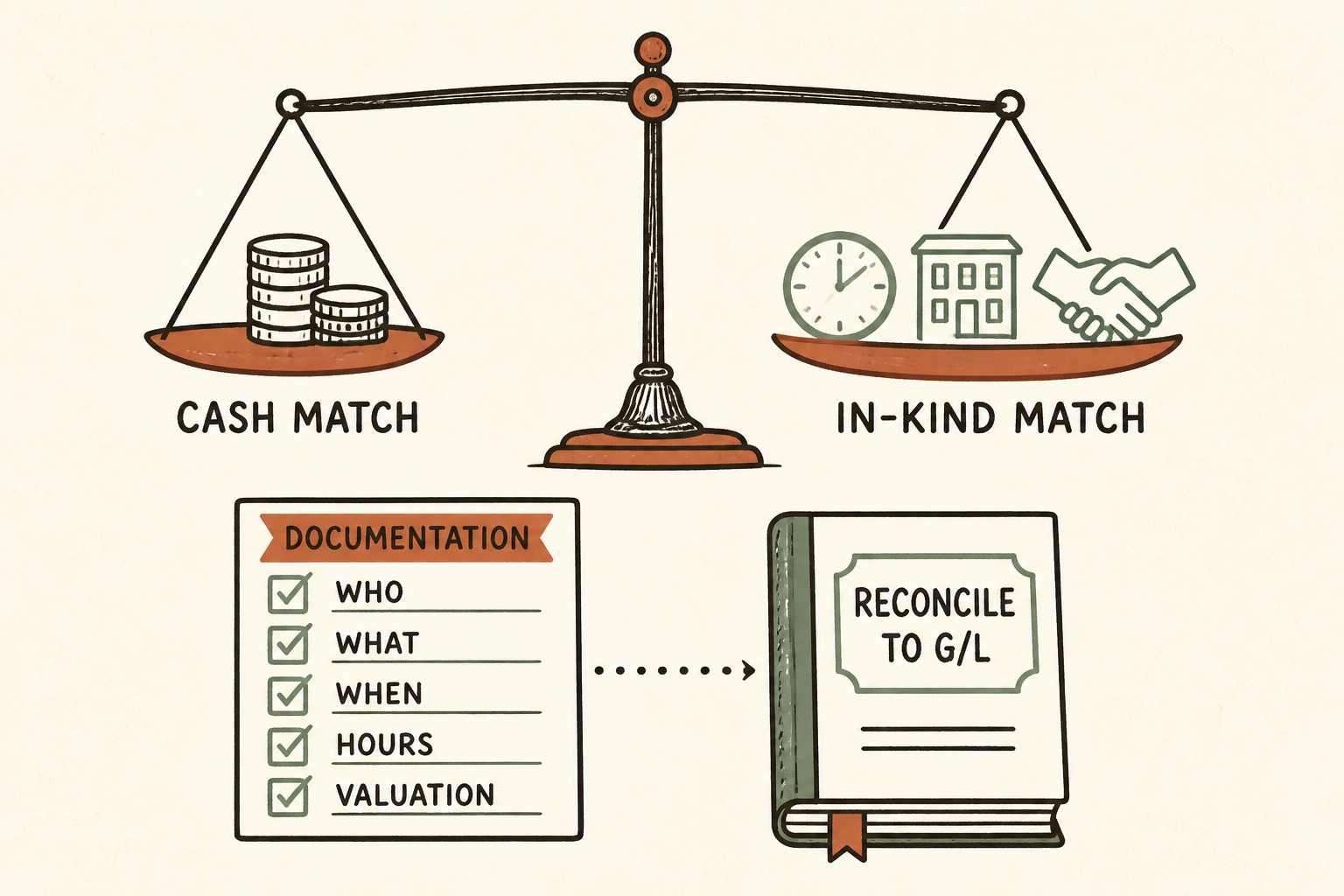
Cash match generally means allowable non-federal cash expenditures or contributions used to support the project.
In-kind match means allowable non-cash contributions.
That can include donated services, space, supplies, or other property.
Not every donated thing counts.
A contribution counts only if it meets the applicable rules in 2 CFR § 200.306, fits the award, and is supported by records that verify both the contribution and the value claimed.
Valuing volunteer time and donated space
This is where good intentions get expensive.
Volunteer services aren't valued by whatever rate feels fair that day.
Under 2 CFR § 200.306(e), volunteer services are valued at rates consistent with those ordinarily paid for similar work by your organization. If your organization doesn't employ people for similar work, use rates ordinarily paid for similar work in your labor market.
A generic published volunteer-hour rate may be a reference point. It isn't automatically the right answer.
Donated employee services can be different.
If another employer donates employee time, the valuation may include reasonable, allowable, and allocable fringe benefits under 2 CFR § 200.306(f).
Space has its own rule.
Under 2 CFR § 200.306(i)(3), donated space is generally valued at the fair rental value of comparable space in a privately owned building in the same locality, subject to the regulation's specific conditions.
That means you need support for the comparable value.
Common practice is to keep market listings, a written comparison, a property manager's email, or another documented rental analysis in the file. The regulation doesn't prescribe one exact format. Your award or pass-through entity might.
The documentation that holds up
The federal rule doesn't require one magic form.
It requires records strong enough to verify the claim.
That means the documentation should fit the contribution type.
| Contribution type | Records you should expect to keep |
|---|---|
| Donated services or volunteer time | Record of who performed the work, dates, hours or units, nature of the work, and valuation method; if your policies or award require certifications or signatures, keep those too |
| Donated employee time | Records supporting the time devoted to the project plus the wage and any allowable fringe basis used for valuation |
| Donated space | Written support for the arrangement, dates or period of use, extent of use if not full-time, and comparable fair-rental support |
| Donated supplies or property | Description, date received or used, basis for valuation, and records showing the item benefited the project |
A spreadsheet can be part of the file.
A spreadsheet alone is usually not the file.
And a signed log by itself isn't enough for donated space or property if the valuation support is missing.
Staff time used as match gets real scrutiny
If staff compensation or donated staff services are being claimed as match, keep records that verify both the work performed and the value claimed.
For salary and wage charges, 2 CFR § 200.430(g) requires records that accurately reflect the work performed and are supported by a system of internal controls. The regulation doesn't impose a universal federal rule that every record must carry dual signatures.
Your award terms, state requirements, or your own organization may be more specific.
Many organizations use signed time records or certifications because they're clear and defensible. That's common practice. It isn't the same thing as saying the Uniform Guidance requires one exact timesheet format for everyone.
Reconcile what you report to what your books say
This part isn't glamorous.
It's where small gaps stop becoming findings.
As an internal-control practice, reconcile three things before each required report:
- The match amount you plan to report.
- The supporting records in the match file.
- The accounting records that support the cash and non-cash amounts.
If those three don't agree, stop there.
Find the reason.
Correct the records before submission if you can.
Resolving a discrepancy before reporting is usually easier than explaining it during monitoring or audit.
Match isn't a number. It's a claim.
Why the later years feel harder
You aren't imagining it.
A light process can seem fine when the required share is small.
Then the amount grows. Or staff turn over. Or the person who understood the in-kind file leaves.
Now a once-casual process is carrying real risk.
That isn't a character flaw.
It's a systems problem.
The answer isn't a prettier tracker.
The answer is to build the record at the time of the contribution, with the valuation support beside it, while the details are still ordinary and easy.
A short story about a donated conference room
Picture a program that uses a donated meeting room twice a month for orientation.
No invoice comes in.
So nobody treats it like a transaction.
Later, someone reports the room as in-kind match using an estimate that sounded reasonable at the time.
That's the trap.
A better file would include a brief written record of the arrangement, the dates or frequency of use, and documented support for comparable rental value in the same locality.
Not because the room was fake.
Because the proof matters as much as the contribution.
A simple match routine
Here's a practical control routine. This is recommended practice, not a one-size-fits-all federal mandate.
- Collect contribution records on a regular schedule that supports accurate reporting. Monthly works well for many programs.
- Keep the valuation support in the same file as the contribution record, not in somebody's head.
- Record cash match through your normal accounting process in line with your established policies.
- Before each required report, reconcile reported amounts to the underlying records and accounting records.
- If your award terms or commission instructions require a specific form, certification, or timing rule, use that.
Small routines protect tired teams.
That matters.
When match falls short
If a shortfall looks likely, raise it early with the entity identified in your award for grants administration.
Don't assume a commission or program officer can waive a statutory or regulatory requirement.
But do ask what authorized options exist under your award.
That might include a permitted budget action, revised reporting approach, or other approved remedy. It might also mean the answer is no.
What you don't want is silence.
And one last thing: before you rely on any article, including this one, verify the current rule text in the eCFR for 2 CFR part 200, the applicable 45 CFR AmeriCorps regulations, and your own award terms and conditions.
A quick reminder
AmeriCorps grants can vary from one to the next. If you’re unsure how a rule applies to your program, check with your commission or designated point of contact at the AmeriCorps agency for any additional guidance and clarifications. They know your award terms best.
Questions people ask
- What does [2 CFR § 200.306](https://www.ecfr.gov/current/title-2/section-200.306) require for match to be accepted?
When a federal award requires cost share or match, 2 CFR § 200.306 says the contribution must be verifiable from the non-federal entity's records, not counted as match for another federal award, necessary and reasonable for the project, allowable under the cost principles, and generally not paid by the federal government under another federal award unless a federal statute specifically allows that use.
- What's the difference between cash match and in-kind match?
Cash match generally means allowable non-federal cash expenditures or contributions used for the project. In-kind match means allowable non-cash contributions, such as donated services, space, supplies, or property. Either type counts only if it meets the award requirements and the standards in 2 CFR § 200.306.
- What documentation is needed for in-kind contributions?
There's no single federally required form for every in-kind contribution. Under 2 CFR § 200.306, you need records sufficient to verify what was contributed, who contributed it, when or over what period, the quantity or level of use, and how you determined the value claimed. Services, space, and property need different support. For example, volunteer services are valued under 2 CFR § 200.306(e), and donated space is valued under 2 CFR § 200.306(i)(3).
- Is my required match percentage the same every year?
Not always. The answer depends on the AmeriCorps program, the governing regulation, and your award terms. For AmeriCorps State and National, see 45 CFR § 2521.60. Other programs may differ. Check the current regulation first, then your Notice of Grant Award and terms and conditions.
- What if my grant comes through a state or territory service commission?
- Check your commission’s current requirements too. They may be stricter than the federal floor, and stricter is what you follow. What a commission can’t do is override controlling federal law, regulation, or your AmeriCorps award terms, and it can grant only the waivers it’s authorized to grant. Read this post alongside your commission’s guidance, your award terms, and your written policies — and when something looks like a real conflict, ask your commission or program officer rather than guessing.
About the author
Gary Kosman is the founder and CEO of America Learns. He has worked with AmeriCorps programs and state service commissions for more than two decades, helping organizations strengthen the systems they use to manage members, grants, reporting, compliance, and impact. Reach him at gary@americalearns.net or 310-689-0542 x101.
Last reviewed August 9, 2026. Regulations change. Verify every citation against the current eCFR text and your own grant terms and conditions before you rely on it.
Looking for another topic?
Browse all compliance topics — from timesheets and member files to financial and progress reporting.
Browse topicsKeep reading on financial reporting and related topics
Financial Reporting/August 6, 2026
Fraud Risk Climbs at the End of a Grant
When a grant is ending, people are often tired + moving fast as they race to get the next program year off the ground. That's exactly when weak approvals, missing records, and rushed final reports can turn into findings.
Financial Reporting/August 6, 2026
The Four Tests Every AmeriCorps Cost Must Pass
Most questioned costs don't start with fraud. They start with hurry, assumptions, and a missing piece of paper. A practical review starts with four questions: is the cost necessary, reasonable, allocable, and documented well enough to prove it. Then you confirm the rest of the allowability rules and your award terms.
Financial Reporting/August 6, 2026
Match Documentation That Holds Up in an Audit
Match problems usually start months before review. The fix is a repeatable routine: confirm the award allows the contribution to count, document value with support that stands on its own, and reconcile reported match before it becomes a questioned cost.
OIG Findings/September 4, 2026
How Commissions Can Catch Timesheet and Term Errors Early
When education awards are tied to weak time records or unsupported service-term changes, the cost lands late and hard. A commission can catch most of it before exit with a tighter review sequence.
Performance Measurement/September 2, 2026
Your Data-Collection System Is Part of Your Audit Trail
Surveys, logs, and tests can become Federal award records. Federal rules do not require you to keep every draft or form configuration — they require retention of the records and supporting documentation that substantiate what you reported. ([2 CFR § 200.334](https://www.ecfr.gov/current/title-2/section-200.334))