Writing a Progress Report Where the Story Matches the Numbers
The fastest way to lose a program officer's trust is a narrative that claims more than the data shows. Here's how to write one that holds up.
Drafted with AI assistance, checked against primary sources, reviewed and approved by Gary Kosman on August 18, 2026.
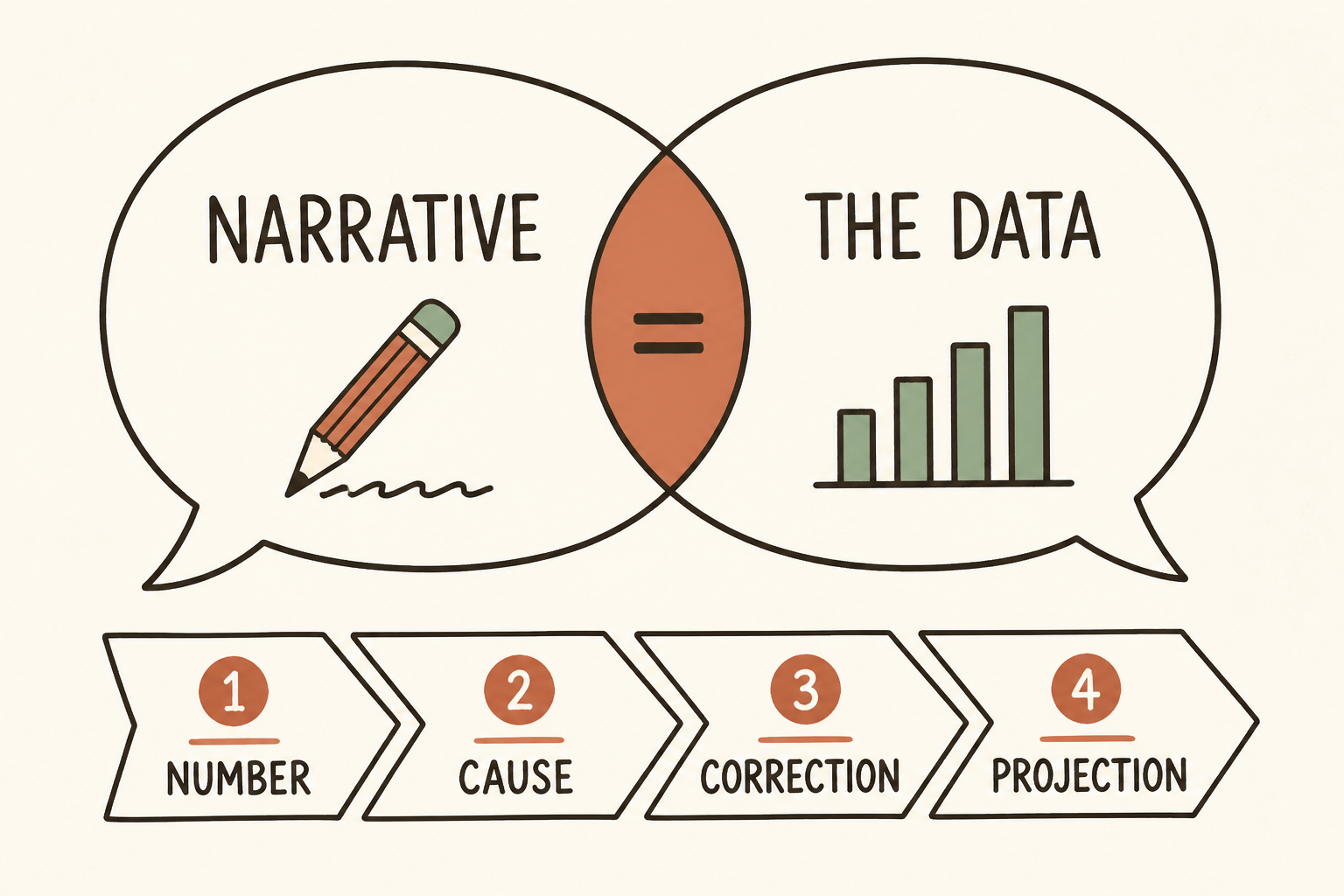
The narrative is where trust gets tested
Let the numbers lead.
You can feel the pressure in this kind of report. The work is real. The quarter was messy. And now you've to explain it to someone who wasn't in the room.
This is where reports drift.
Not because you're careless. Because audits and monitoring can turn ordinary uncertainty into dread, and dread makes people hide drafts, avoid questions, or hope nobody notices the mismatch. That's human. It's also fixable.
If the narrative says more than the source data can support, the whole report gets harder to defend later.
What the federal rule requires
Under 2 CFR § 200.329, recipients must submit performance reports at the intervals required by the Federal award. Those reports compare actual accomplishments with the objectives established for the reporting period. When applicable, the report also has to explain why established goals or objectives weren't met, and it must include information on cost overruns or higher-than-expected unit costs. If a significant development that could affect the award happens between reporting due dates, the recipient has to notify the federal agency or pass-through entity separately.
That's the baseline rule.
AmeriCorps may add more through your award terms and conditions, current reporting instructions, and the reporting system you're required to use. A state commission may also set deadlines or review steps for subrecipients. Those are award-specific requirements, not part of the Uniform Guidance itself.
Check the current eCFR text for 2 CFR part 200 and your own award documents before you submit. The details can change.
What usually has to agree
The exact fields in an AmeriCorps progress report vary by program, funding stream, and current instructions.
But many reports pull together the same basic ingredients.
| Piece of the report | What it does | Common failure point |
|---|---|---|
| Performance results | Shows actual output or outcome results against the applicable target | Numbers are copied from memory instead of source records |
| Narrative explanation | Explains progress, barriers, and material changes | Written before the data is finalized |
| Member, participant, or site information | Reports operational facts required by the award or reporting system | Counts don't reconcile to underlying records |
| Required certifications or responses | Addresses compliance items, corrective actions, or other award-specific prompts | Finished last and not checked against the rest of the report |
Treat it as one report.
Not four separate assignments that never meet each other.
The credibility problem that shows up first
A common risk is a narrative that claims an impact the reported data doesn't support.
The narrative says the tutoring program improved reading outcomes across the district. The performance table shows gains only for the students who completed the full intervention period. Both facts may matter. But if the report doesn't explain that difference, the narrative reads like it outran the evidence.
Write from the data you can trace.
Not from the outcome you hoped the quarter would tell.
How to report a missed target without making it worse
Missing a target is hard. You may feel defensive before anyone asks a question.
Name it anyway.
When a result comes in below projection, use four moves, in this order:
- State the number. Put the actual result next to the target.
- State the cause. Use the real reason you can support from the record.
- State the correction. Describe what you already changed, or what corrective action is now in process.
- State the revised projection. If your instructions call for forward-looking information, give the updated expectation and why it's reasonable.
This isn't a regulatory formula.
It's a reporting practice that makes the variance, its cause, and your response easier to understand.
Cost overruns and significant developments
The same section also asks for more than narrative apologies. When costs run higher than expected or unit costs come in above the projection, the report should explain what drove the difference.
And if something big changes between due dates — a site closure, a major partner delay, a staffing gap that affects milestones — don't wait for the next report. The rule says a significant development that could impact the award must be reported to the agency or pass-through entity when it happens.
That separate notice isn't a suggestion to hide bad news until the quarterly report. It's a way to flag a change while there's still time to respond.
Document where every number came from
Before submission, each figure in the narrative and each figure in the performance table should trace back to a source.
That source might be an attendance record, case note, survey file, assessment spreadsheet, partner report, or system export.
Keep a source key in your grant file. Include:
- the number reported
- the report section where it appears
- the underlying source record or report
- who pulled it
- the date it was pulled
- any denominator or filtering rule used
You won't remember this a year from now.
That isn't a character flaw. That's why records exist.
The copy-forward trap
Deadline pressure makes old narrative look useful.
Sometimes it's. Often it's bait.
A copied paragraph can carry forward a site that closed, a staffing structure that changed, a partnership that stalled, or a measure that's no longer on track. Read the prior report as something to verify line by line, not as text that earned another year of life.
If you can't say where a sentence came from, flag it and re-check it.
What review practices vary on
There's no single required way a program officer, commission, or pass-through entity reviews these reports.
Review practices vary.
What helps in every setting is internal consistency. Reported results, narrative explanations, and award-specific responses shouldn't contradict one another. Clear, supportable reporting helps the reviewer assess performance over time and helps you answer follow-up questions without rebuilding the file from scratch.
A progress report doesn't have to be impressive. It has to be true, and it has to explain itself.
Always check your current AmeriCorps terms and conditions, reporting instructions, and any commission-specific guidance for required fields, due dates, and definitions.
Why data and narrative drift apart
Most mismatches aren't about dishonesty.
They're about sequence.
One person drafts the narrative from field notes. Another finalizes the counts later from source records. Nobody does the last comparison before submission. So the report goes out with two versions of reality inside it.
The fix is procedural.
Finalize the supporting data first, or reconcile the narrative after the final data pull and before submission. Drafting in that order can reduce the risk of inconsistencies.
What good context looks like
Context doesn't inflate a result.
It explains a variance.
Where useful and consistent with your reporting instructions, describe material changes with concrete, supportable facts. A delayed partner-site start date. A staff vacancy that reduced service capacity. A one-time cohort that increased outputs this period but may not repeat next period.
Specific facts do two things at once.
They help the reviewer understand the number.
And they protect you from sounding vague when the record is clear.
Build one fact-check pass into your process
You don't need a perfect process.
You do need a pause between drafting and submitting.
An independent internal review can help identify unsupported or inconsistent statements. The reviewer doesn't need to rewrite the report. The job is narrower than that.
Use this order:
- Read each narrative sentence and underline every factual claim.
- Match each claim to a number, date, or source record.
- Confirm that denominators are stated clearly where they matter.
- Check that the same count is reported the same way everywhere it appears.
- Confirm that any corrective action described is consistent with internal records and current operations.
- Re-read the required certifications or compliance responses last.
If your report includes survey language, be careful with wording. "87% of respondents reported that the training prepared them for service" is more supportable than "members were well prepared," if you've the survey instrument, respondent count, and reporting period documented in the file.
Keep a running log between reports
This is the quiet habit that saves people.
Keep a short running log during the reporting period. Dates. Staff changes. Site openings and closures. One-time events that affected service counts. Notes on when a data pull was corrected and why.
Then, when the report is due, you aren't trying to reconstruct the quarter from memory or from the last narrative you submitted under pressure.
Common practice says this can be a shared document, a dated memo file, or another internal record. The format matters less than the habit.
What matters is that, later, you can show how the story matched the numbers when you signed your name to it.
A quick reminder
AmeriCorps grants can vary from one to the next. If you’re unsure how a rule applies to your program, check with your commission or designated point of contact at the AmeriCorps agency for any additional guidance and clarifications. They know your award terms best.
Questions people ask
- What does 2 CFR 200.329 require of grant recipients?
Under 2 CFR § 200.329, recipients must submit performance reports at the intervals required by the Federal award. Those reports compare actual accomplishments with the objectives established for the reporting period, and the Federal awarding agency may require additional performance-monitoring information. Your AmeriCorps award terms and reporting instructions may add program-specific requirements.
- What's the most common credibility problem in progress reports?
A common credibility problem is a narrative that claims an impact or level of success the reported data doesn't support. When the narrative outruns the evidence, the reviewer may have less confidence in the rest of the report and may ask more follow-up questions.
- How should I report a target I missed?
Use four steps: state the actual result next to the target, state the supported reason for the variance, state the corrective action already taken or underway, and, if your reporting instructions call for it, state the revised projection for the rest of the period. That structure isn't required by regulation, but it makes the variance and your response easier to understand.
- Why is copying last period's narrative risky?
Because copied text carries old facts with it. A prior narrative may still refer to a site that closed, a staffing pattern that changed, or a measure that slipped. Reuse only after re-verifying each sentence against current source records, current report instructions, and the data you're submitting now.
- What if my grant comes through a state or territory service commission?
- Check your commission’s current requirements too. They may be stricter than the federal floor, and stricter is what you follow. What a commission can’t do is override controlling federal law, regulation, or your AmeriCorps award terms, and it can grant only the waivers it’s authorized to grant. Read this post alongside your commission’s guidance, your award terms, and your written policies — and when something looks like a real conflict, ask your commission or program officer rather than guessing.
About the author
Gary Kosman is the founder and CEO of America Learns. He has worked with AmeriCorps programs and state service commissions for more than two decades, helping organizations strengthen the systems they use to manage members, grants, reporting, compliance, and impact. Reach him at gary@americalearns.net or 310-689-0542 x101.
Last reviewed August 18, 2026. Regulations change. Verify every citation against the current eCFR text and your own grant terms and conditions before you rely on it.
Looking for another topic?
Browse all compliance topics — from timesheets and member files to financial and progress reporting.
Browse topicsKeep reading on progress reporting and related topics
OIG Findings/September 4, 2026
How Commissions Can Catch Timesheet and Term Errors Early
When education awards are tied to weak time records or unsupported service-term changes, the cost lands late and hard. A commission can catch most of it before exit with a tighter review sequence.
Performance Measurement/September 2, 2026
Your Data-Collection System Is Part of Your Audit Trail
Surveys, logs, and tests can become Federal award records. Federal rules do not require you to keep every draft or form configuration — they require retention of the records and supporting documentation that substantiate what you reported. ([2 CFR § 200.334](https://www.ecfr.gov/current/title-2/section-200.334))
2 CFR 200 Basics/August 18, 2026
When Staff Duties and Timesheets Don’t Match
Salary costs get vulnerable when payroll support, payroll charges, and the role described in your award materials stop lining up. The fix starts with a clean match between supported work, the amount charged, and the staffing picture your award says you funded.
Member Timesheets/August 12, 2026
What AmeriCorps Members Cannot Do on Service Time
The first question is about time and duties. If a member or staff person engages in a prohibited activity while charging time to the AmeriCorps program, accumulating service or training hours, or otherwise performing activities supported by the AmeriCorps program or AmeriCorps, your program should review the record promptly under its written procedures, award terms, and any applicable AmeriCorps or pass-through instructions. Private-citizen participation in the listed activities has its own conditions too, including a logo instruction in the regulation.
Member Files/August 12, 2026
Build Member Files Before Enrollment Day Arrives
The cleanest member file is the one you build before the first enrollment rush hits. Set up the file once, in the right order, so eligibility, applicable criminal history check records, and core member documents line up all year.