How to Read a Subgrantee Financial Report Like a Monitor
A clean expenditure report can still hide weak support. Your job as a monitor is to tie each line to the accounting records, payroll or activity records, and match support, then follow every variance until it makes sense.
Drafted with AI assistance, checked against primary sources, reviewed and approved by Gary Kosman on August 9, 2026.
Start with the feeling in the room
You know this moment.
The subgrantee sends a financial report that looks tidy. Totals foot. Percentages seem plausible. Nothing jumps off the page.
And you still feel uneasy.
Pay attention to that feeling.
Not because suspicion is a control.
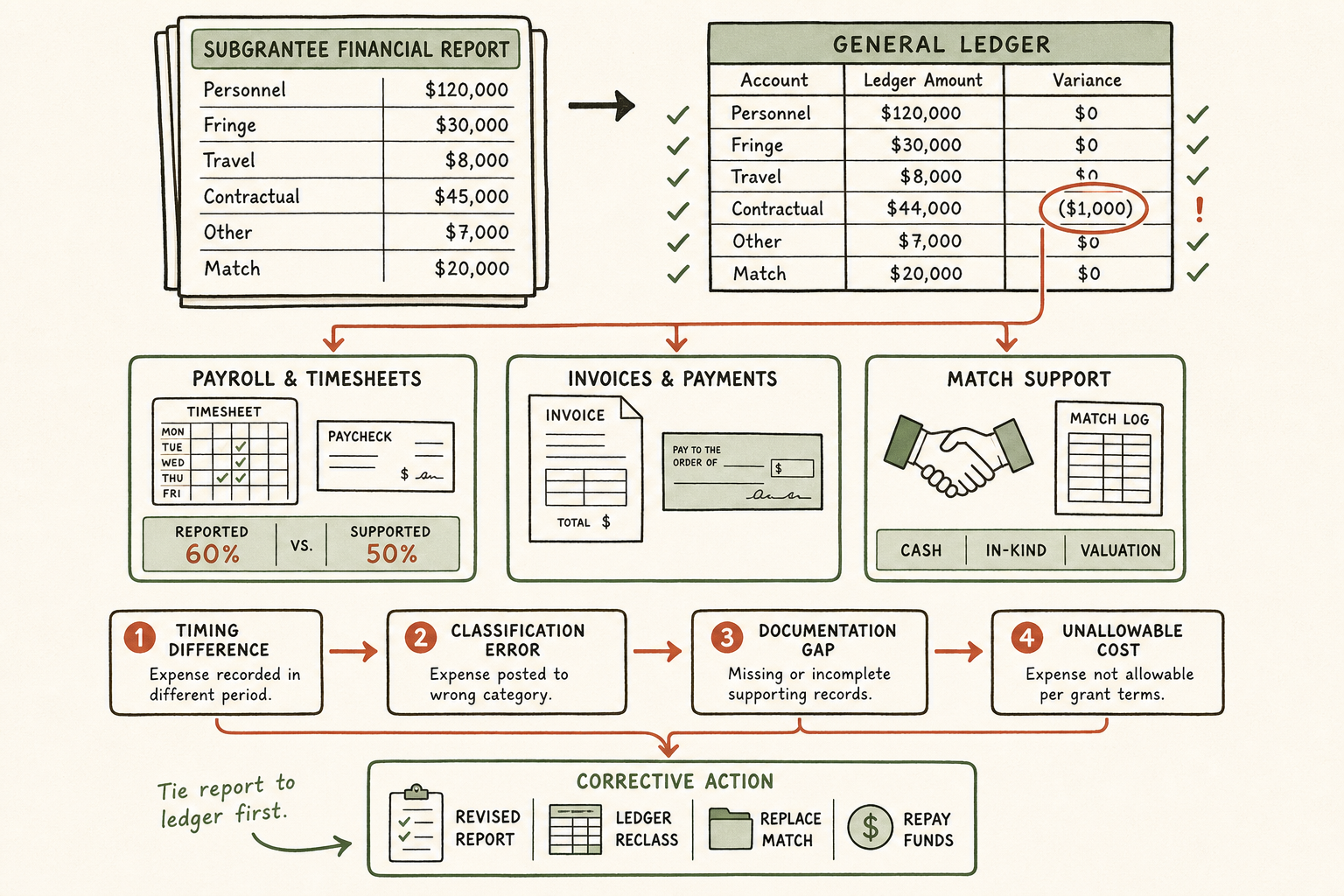
Because monitoring isn't proofreading. It's testing whether the report is supported by records created at the time, kept in an organized way, and tied back to the approved budget and award requirements.
For Federal awards, the recipient's financial management system must identify all Federal awards received and expended and provide records that support the source and application of funds, including authorizations, obligations, unobligated balances, assets, expenditures, income, and interest, among other elements in 2 CFR § 200.302. Record retention rules are in 2 CFR § 200.334.
If you're a commission or National Direct acting as a pass-through entity, you also have to monitor subrecipient activities and take action when noncompliance is identified under 2 CFR § 200.332.
This article uses subgrantee the way many programs do in daily conversation.
The legal relationship under the Uniform Guidance is subrecipient when there's a subaward.
That matters.
These steps aren't for vendors or contractors.
What you're reviewing
An expenditure report is a summary.
You are reviewing the summary against the records underneath it.
At minimum, that usually means comparing:
| Report item | What to compare it to | What you're testing |
|---|---|---|
| Federal share by cost category | General ledger detail or other accounting records for the reporting period | Whether the reported amount agrees to the recipient's accounting records |
| Match by cost category | Match ledger, subsidiary match records, or other verifiable accounting and valuation support | Whether required match is allowable, properly valued, and supported by records |
| Personnel costs | Payroll registers, activity records, approved allocations | Whether salary and wage charges are supported and properly allocated |
| Fringe | Fringe rate support, payroll records, benefit invoices or calculations | Whether fringe was calculated correctly and charged consistently |
| Contractual or consultant | Executed agreement, invoices, procurement file, payment support | Whether the cost was procured and paid appropriately |
| Other direct costs | Invoices, receipts, allocation support, proof of payment | Whether the cost is allowable, allocable, and documented |
The allowability rules live in more than one place.
Start with the Uniform Guidance cost principles in 2 CFR subpart E, especially the basic standards for allowability in 2 CFR § 200.403, allocability in 2 CFR § 200.405, and financial management and documentation standards in 2 CFR § 200.302.
Then layer in AmeriCorps requirements.
AmeriCorps program rules on costs, budget categories, and match can vary by stream and by award terms. Check the specific award terms, applicable program regulations in 45 CFR chapter XXV, and the current guidance pages for grantees and sponsors at AmeriCorps.
And before you rely on any citation in this piece, verify it against the current eCFR text.
The packet you should ask for before you start
Don't begin with screenshots.
Ask for a set of records you can tie out in order.
Request these items for the same reporting period as the expenditure report:
- The financial report submitted to you.
- The general ledger detail, or equivalent accounting detail, by cost category for the period and cumulative year to date.
- A budget-to-actual report showing approved budget, current period actual, and cumulative actual.
- Payroll registers for all staff charged in whole or in part to the award.
- Timesheets or other activity records where needed to support salary and wage charges.
- Fringe calculation support.
- Match support, including the source of match, valuation method if in-kind, and where the contribution is recorded.
- A transaction listing for non-personnel charges with vendor name, date, amount, and account code.
- A sample of invoices, proofs of payment, contracts, and procurement records for larger or riskier items.
If they can't produce this packet without scrambling, that tells you something about how accessible and organized the records are.
Not a moral failure.
A piece of information.
Worry makes people hide the messy binder, the half-built spreadsheet, the payroll reclass they meant to finish last month.
Say that out loud when you need to.
You can tell a subgrantee, "I'm not looking for perfection. I'm looking for support I can follow."
That changes the room.
Review in this order
Order matters.
If you start with receipts, you'll get lost.
1. Tie the report to the accounting records
Take each line on the subgrantee's expenditure report and agree it to the accounting records.
Often that means the general ledger.
Sometimes it means a clear crosswalk from account codes into the report lines.
Do this by cost category and by funding source.
Check two things first:
- the current reporting period total
- the cumulative total through the end of the period
If the report agrees only in total, that isn't enough for a solid review.
A common problem is category drift. Total expenditures may be right while costs are sitting in the wrong line. That matters for budget control, prior approval analysis, indirect cost treatment, and match tracking.
If the accounting records don't match the report, stop there.
Don't sample deeper until the subgrantee explains the reconciliation.
Sometimes it's timing.
Sometimes it's a manual spreadsheet override.
Sometimes the report was prepared from a shadow workbook instead of the accounting system.
Each explanation leads to a different corrective action.
2. Compare the accounting records to the approved budget
Now look for variance from plan.
You're not auditing whether actuals equal budget.
You're testing whether unusual movement has a supportable reason.
Mark any category that is:
- materially over or under budget for the period,
- unusually front-loaded or back-loaded,
- inconsistent with program operations, or
- close to a threshold that may trigger prior approval under the award terms or 2 CFR § 200.308.
That last point needs care.
Prior approval rules under 2 CFR § 200.308 are subject to agency exceptions and award-specific terms.
Check your own terms and conditions before you decide a variance is an approval problem.
A spike in travel during member orientation might be fine.
A year with almost no staff costs and a sharp rise in contractor costs deserves a closer look.
A report with perfectly smooth spending every month deserves a second question too. Sometimes that's normal. Sometimes it means allocations are being copied forward without being checked against current activity.
3. Test personnel costs before anything else
Payroll is often the largest line.
It's also where unsupported costs multiply fast.
Compensation for personal services is covered in 2 CFR § 200.430. Charges to Federal awards for salaries and wages must be based on records that accurately reflect the work performed, are supported by a system of internal control, reasonably reflect total activity, and meet the other standards in 2 CFR § 200.430(g).
For each sampled employee charged to the award:
- Compare the amount in the accounting records to the payroll register.
- Confirm the employee's pay rate matches approved personnel records.
- Review timesheets or other activity records when the employee works on multiple activities or cost objectives.
- Check the allocation method. If a staff member splits time across AmeriCorps and non-AmeriCorps work, the allocation should match documented activity, not a stale budget estimate carried forward month after month.
- Recalculate one or two pay periods by hand.
That hand check is a monitoring practice.
It's not written into the regulation.
It's useful because it can surface quiet errors that summaries hide.
If budget estimates are used for interim accounting purposes, the system has to produce reasonable approximations of the activity performed, and significant changes in the related work activity must be promptly identified and entered into the records under 2 CFR § 200.430(g)(1)(vii).
What counts as timely can vary in practice.
Your award terms, agency guidance, or written monitoring protocol may set a clearer expectation.
4. Review match as its own universe
Don't treat match like a side note.
Treat it like a second grant.
Cost sharing and matching requirements are in 2 CFR § 200.306. To count, match generally has to be verifiable from the recipient's records, not included as a contribution for another Federal award unless authorized, necessary and reasonable, allowable, and provided for in the approved budget when required by the agency.
For each reported match entry, ask:
- What is the source?
- Is it cash or in-kind?
- When was it incurred or contributed?
- Where is it recorded?
- How was it valued?
- Has it been used anywhere else?
Then tie the amount to support.
Cash match will often trace to the accounting records and underlying source documents.
In-kind match should trace to documentation of the contribution and the valuation method.
For donated volunteer services, value the time at rates consistent with those ordinarily paid for similar work by the recipient or subrecipient. If it doesn't have employees performing the required skills, use rates consistent with the relevant labor market, as provided in 2 CFR § 200.306(e). Fringe benefits may be included when reasonable, allowable, and allocable under that same section.
A match number that appears only on the report, without verifiable recipient records and adequate valuation support, isn't ready for credit.
What to do when you find a variance
A variance isn't automatically a finding.
It's a question.
Ask it in sequence.
Step 1: Define the variance precisely
Write the variance in one sentence.
Example: "Personnel on the report exceeds personnel in the accounting records by $X for the quarter," or "Reported match includes volunteer hours with no valuation support."
Precision keeps the conversation calm.
Step 2: Ask for the reconciliation, not a defense
Use neutral language.
Ask, "Can you walk me from this report line to the supporting records?" Then wait.
You are testing system design and follow-through, not confidence.
Step 3: Sort the variance into one of four buckets
| Variance type | What it usually means | Typical response |
|---|---|---|
| Timing difference | Cost was recorded in a different period than reported | Require a written reconciliation and confirm correction or carryforward treatment under your reporting instructions |
| Classification error | Cost is in the wrong category or funding source | Require correction through a revised report, accounting reclass, or documented reconciliation, depending on your procedures |
| Documentation gap | Support exists partly or not at all | Question the cost until support is produced and assess whether internal controls need correction |
| Unallowable or unsupported charge | Cost can't be charged or matched as reported | Document the issue, correct reporting as appropriate, and route it through the pass-through entity's resolution process to determine whether repayment, offset, replacement match, or another remedy is required |
This framework keeps you from overreacting.
It also keeps you from minimizing a real problem.
Use your written monitoring procedures and award terms to decide when an issue is a monitoring exception, a questioned cost, or a formal finding.
Step 4: Decide whether the issue is isolated or systemic
One missing activity record is a problem.
Ten sampled payroll charges supported by the same flawed allocation method is a control issue.
Document what made you decide.
If it looks systemic, expand the sample or require the subgrantee to perform a lookback review across the relevant period.
Step 5: Set the correction in the right place
Not every problem is fixed the same way.
Possible corrective actions include:
- revised financial report,
- accounting reclassification,
- correction on the next report with documented reconciliation,
- repayment of unsupported Federal funds if required through the resolution process,
- replacement of unsupported match if permitted and required,
- updated timesheet or activity-record procedures,
- training for staff preparing reports,
- increased monitoring frequency.
Be specific about due dates and evidence.
"Please fix this" isn't monitor language.
"Submit a revised report, the reclass entry, and updated match support by May 15" is.
The red flags worth slowing down for
Some patterns deserve a longer pause.
- Reports are prepared from spreadsheets that don't reconcile to the accounting system.
- Payroll allocations mirror the budget every month with no update for significant changes in actual activity.
- Match is tracked outside the accounting system with no formal review and weak valuation support.
- Large journal entries are posted at quarter end with vague descriptions.
- Personnel costs drop while contractual costs rise, with no documented operational explanation and no required approval or budget revision where the award terms or 2 CFR § 200.308 require one.
- The subgrantee can show invoices but not proof of payment.
- A corrected report changes several categories, but no one can explain why the first version was wrong.
None of these prove misuse.
They tell you where to look next.
A good monitor follows the number until the story and the records say the same thing.
Document your review so another person could repeat it
This part gets skipped when you're tired.
Don't skip it.
Your workpapers should show:
- the report reviewed,
- the accounting records and source records used,
- the sample selected and why,
- the variances identified,
- the subgrantee's explanation,
- your conclusion,
- the corrective action required, if any.
If another monitor picked up your file six months from now, she should be able to see what you tested and why you were satisfied or not satisfied.
That's not bureaucracy.
That's continuity.
And if the same issue comes back next quarter, your documentation will tell you whether this is slippage, misunderstanding, or a control the subgrantee never really built.
What you're really doing
You're not trying to catch someone being bad.
You're trying to see whether the financial report is a trustworthy summary of real, supported activity.
Sometimes the variance will be harmless and explainable.
Sometimes it will uncover a reporting habit that puts the whole award at risk.
Your job is to know the difference.
Start with the report.
Tie it to the accounting records.
Test payroll.
Test match.
Then keep going until the number holds.
A quick reminder
AmeriCorps grants can vary from one to the next. If you’re unsure how a rule applies to your program, check with your commission or designated point of contact at the AmeriCorps agency for any additional guidance and clarifications. They know your award terms best.
Questions people ask
- What if the expenditure report total matches the ledger, but the categories don't?
Treat that as a reconciliation issue that still needs follow-up. The regulation in 2 CFR § 200.302 requires records that support the source and application of funds; a category mismatch can affect budget control, prior approval analysis, indirect cost treatment, and match tracking even when the total is right. Ask for a category-by-category reconciliation, determine whether the error is in the report or the accounting records, and then follow your reporting instructions for the fix. Depending on your procedures, that may mean a revised report, an accounting reclassification, or a documented reconciliation.
- Do I always need to review timesheets when testing personnel costs?
Not always a document called a timesheet, but you do need to review the records that support salary and wage charges. Under 2 CFR § 200.430(g), those charges must be supported by records that accurately reflect the work performed and meet the regulation's internal-control and total-activity standards. If staff work on multiple activities or cost objectives, activity records become especially important. The exact form can vary, so check your subaward terms, agency guidance, and monitoring protocol.
- How should I handle unsupported match that was already reported?
First decide whether the problem is missing documentation, incorrect valuation, or match that isn't allowable at all. Match credited to the award must meet the standards in 2 CFR § 200.306, including being verifiable from the recipient's records. If adequate support exists, collect it and document the reconciliation. If the match was reported incorrectly, require the report to be corrected under your procedures. If it can't be supported or isn't allowable, route it through the pass-through entity's resolution process to determine whether the amount must be removed, replaced with allowable match, or otherwise resolved.
- When is a variance a finding instead of a routine reconciliation item?
A variance is a fact. A finding is a classification decision. A timing difference with clear support may be a routine reconciliation item. A repeated reporting error, unsupported cost, weak payroll-allocation method, or match documentation failure may rise to a monitoring exception, questioned cost, or formal finding. The regulation in 2 CFR § 200.332 requires pass-through entities to monitor subrecipients and address noncompliance, but your written monitoring procedures and award terms should define how your organization classifies and resolves issues.
- What if my grant comes through a state or territory service commission?
- Check your commission’s current requirements too. They may be stricter than the federal floor, and stricter is what you follow. What a commission can’t do is override controlling federal law, regulation, or your AmeriCorps award terms, and it can grant only the waivers it’s authorized to grant. Read this post alongside your commission’s guidance, your award terms, and your written policies — and when something looks like a real conflict, ask your commission or program officer rather than guessing.
About the author
Gary Kosman is the founder and CEO of America Learns. He has worked with AmeriCorps programs and state service commissions for more than two decades, helping organizations strengthen the systems they use to manage members, grants, reporting, compliance, and impact. Reach him at gary@americalearns.net or 310-689-0542 x101.
Last reviewed August 9, 2026. Regulations change. Verify every citation against the current eCFR text and your own grant terms and conditions before you rely on it.
Looking for another topic?
Browse all compliance topics — from timesheets and member files to financial and progress reporting.
Browse topicsKeep reading on subgrantee monitoring and related topics
Subgrantee Monitoring/July 30, 2026
How to Build a Subrecipient Risk Matrix That Holds Up
If you pass federal funds through to subrecipients, you've oversight duties you can't delegate away. Here's how to document risk, choose monitoring steps, and separate internal monitoring labels from Single Audit requirements.
OIG Findings/September 4, 2026
How Commissions Can Catch Timesheet and Term Errors Early
When education awards are tied to weak time records or unsupported service-term changes, the cost lands late and hard. A commission can catch most of it before exit with a tighter review sequence.
Performance Measurement/September 2, 2026
Your Data-Collection System Is Part of Your Audit Trail
Surveys, logs, and tests can become Federal award records. Federal rules do not require you to keep every draft or form configuration — they require retention of the records and supporting documentation that substantiate what you reported. ([2 CFR § 200.334](https://www.ecfr.gov/current/title-2/section-200.334))
2 CFR 200 Basics/August 18, 2026
When Staff Duties and Timesheets Don’t Match
Salary costs get vulnerable when payroll support, payroll charges, and the role described in your award materials stop lining up. The fix starts with a clean match between supported work, the amount charged, and the staffing picture your award says you funded.
Member Timesheets/August 12, 2026
What AmeriCorps Members Cannot Do on Service Time
The first question is about time and duties. If a member or staff person engages in a prohibited activity while charging time to the AmeriCorps program, accumulating service or training hours, or otherwise performing activities supported by the AmeriCorps program or AmeriCorps, your program should review the record promptly under its written procedures, award terms, and any applicable AmeriCorps or pass-through instructions. Private-citizen participation in the listed activities has its own conditions too, including a logo instruction in the regulation.