A Close Reading of 2 CFR 200.430(g), and Why It Sits Under So Many Personnel Findings
The Uniform Guidance paragraph on personnel documentation is short, dense, and underneath many salary-and-wage findings. Here's what it requires now.
Drafted with AI assistance, checked against primary sources, reviewed and approved by Gary Kosman on August 10, 2026.
The paragraph underneath the panic
You know this moment.
Payroll is posted. A file is missing. Someone says, "We have the budgeted percentages." And your stomach drops, because you already know that isn't the same thing as support.
For employee compensation charged to a federal award, the paragraph to read is 2 CFR § 200.430(g). It's short. It's dense. And it carries more risk than its length suggests.
This piece is about employee salaries and wages.
That line matters. AmeriCorps member service-hour records matter too, deeply. But they're governed through AmeriCorps-specific rules, award requirements, and program guidance, not because members automatically fall inside the employee-compensation rule in 2 CFR § 200.430(g).
And here's the part people don't say out loud enough: when an audit starts, discomfort makes people blur categories. You aren't the only one who has inherited files like that. Name it early. Fix it while the room is calm.
What the regulation requires
Start with the current eCFR text. Then read each requirement as its own test.
The charges must be based on records that accurately reflect the work performed.
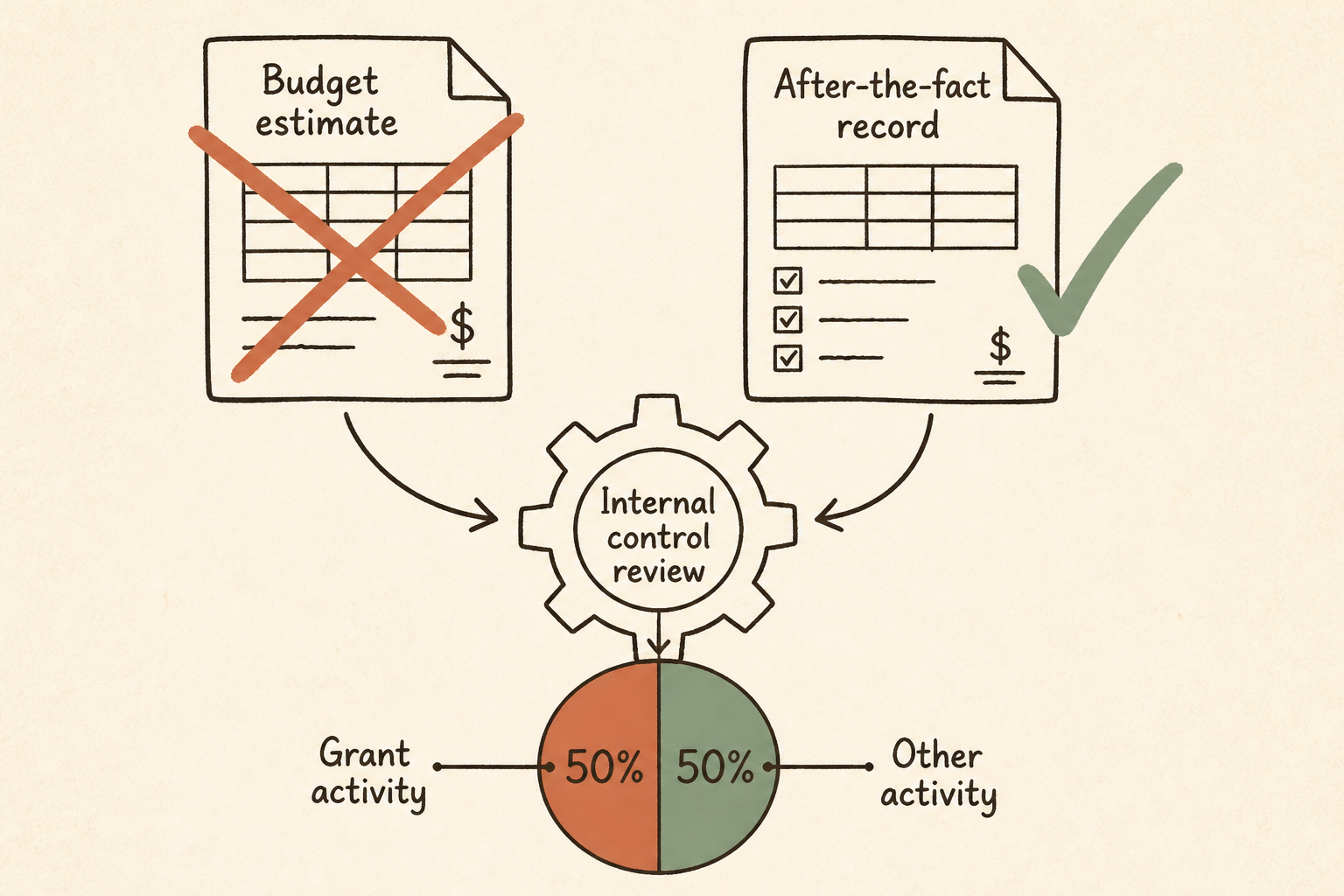
Planned effort isn't the same thing as work performed. A budget allocation can help you plan payroll. By itself, it isn't support for a charge under 2 CFR § 200.430(g).
Those records must be supported by a system of internal control that provides reasonable assurance the charges are accurate, allowable, and properly allocated.
That language is in 2 CFR § 200.430(g), and it connects directly to the broader internal-control requirement in 2 CFR § 200.303. The regulation doesn't prescribe one universal workflow. It does require a control environment that can support the charge.
The records must be incorporated into the official records of the entity.
If the support lives only in someone's notebook, inbox, or memory, the file is fragile. Official records need to live where your organization keeps official records.
The records must reasonably reflect the total activity for which the employee is compensated.
This is the 100% concept. Not 100% federal. One hundred percent of compensated activity across the whole job.
The records must encompass federally assisted and all other activities compensated by the non-Federal entity on an integrated basis.
You can't build a careful record for the federal share and leave the rest vague. The documentation has to make sense as one whole picture.
The records must comply with the established accounting policies and practices of the non-Federal entity.
Consistency matters. Paperwork invented only when the monitor is coming doesn't age well.
Budget estimates alone don't qualify as support.
This is the line to tape to your monitor. If what you've is a projected split and nothing showing what happened, you don't yet have adequate support under 2 CFR § 200.430(g).
What changed, and why older advice can trip you
A lot of grants people still carry around older phrases.
"Semiannual certification."
"Personnel activity report."
Those phrases came from older federal guidance. They aren't the current text of 2 CFR § 200.430(g).
That means two things.
First, don't cite a semiannual-certification "exception" as if it's still written into the regulation. It isn't.
Second, don't assume the absence of an old-format PAR automatically means noncompliance. The current rule is more flexible in form, but not softer in substance. Your records still have to accurately reflect work performed and be supported by real internal controls.
Common practice varies. Some organizations use signed timesheets. Some use payroll certifications. Some use supervisor attestations plus reconciliations. Those may be workable methods. They aren't the regulation itself. Check your own award terms and conditions for anything more specific than the federal baseline.
What this means for your staff files
For employees whose salaries or wages are charged in whole or in part to the AmeriCorps award, ask four questions in this order.
- What record shows the work performed?
- Where is that record kept as an official entity record?
- What control activity supports its accuracy and allocation?
- Does the full set of records reflect the employee's total compensated activity, not only the grant share?
If you can't answer one of those without improvising, that's the weak point.
A job description isn't enough.
A grant budget isn't enough.
A static percentage set at the start of the year isn't enough by itself.
The rule doesn't force one form.
It does force evidence.
And what it doesn't automatically mean for members
This part needs to stay clean.
AmeriCorps member timekeeping matters enormously. It affects service-hour documentation and program accountability. But member service-hour records shouldn't be described as though they're governed by the employee-compensation rule in 2 CFR § 200.430(g).
Treat member documentation as its own compliance lane.
Use the AmeriCorps regulations, your notice of award, your grant terms and conditions, and current agency guidance for the program you run. Those requirements can vary by program and by award year. Verify against the current eCFR text before you revise policy.
The internal-control layer
Here's the hard part.
When records are thin, people hide.
Not because they're dishonest.
Because they're embarrassed. Because they were covering three jobs. Because the prior director left. Because the file is a mess, and a quiet voice says that if you wait long enough maybe no one will ask.
Audits feed on that silence.
2 CFR § 200.303 doesn't require one specific control like a supervisor signature on every sheet. It requires internal controls that provide reasonable assurance the award is managed in compliance with law, regulation, and award terms.
So be exact.
If your organization uses review and approval, say who reviews what, when, and against which source records.
If your organization uses reconciliations, say how payroll charges are compared to supporting records and how differences are corrected.
If your organization uses exception reports or segregation of duties, document that too.
The point isn't compliance theater.
The point is to be able to show why the charge is accurate, allowable, and properly allocated.
A short table you can use
| Question | What the current rule says | What to avoid |
|---|---|---|
| What must support salary and wage charges? | Records that accurately reflect work performed under 2 CFR § 200.430(g) | Planned percentages standing alone |
| How strong must the process be? | Supported by internal controls with reasonable assurance under 2 CFR § 200.430(g) and 2 CFR § 200.303 | Assuming a signed form, by itself, proves control |
| How much activity must the records cover? | Total compensated activity, integrated across federal and non-federal work | Tracking only the grant slice |
| Can the budget be the support? | No; budget estimates alone don't qualify under 2 CFR § 200.430(g) | Treating the approved budget as proof of actual work |
| Do member timesheets follow this exact rule? | Not automatically; check AmeriCorps-specific requirements and award terms | Treating members as employees for this purpose without authority |
What this looks like on a bad week
A bad week tells the truth.
The payroll cutoff moves up because of a holiday. Your program director is out. A coordinator is entering time late. Someone notices the allocation hasn't matched reality for two pay periods.
That isn't proof that your team is careless.
It's proof that your system is being tested.
A resilient process does three things in a week like that.
It captures what work was performed.
It routes that information into official records.
It gives someone a defined way to review, reconcile, and correct the charge.
Those aren't magic words.
They're the difference between a file you can defend and a file you've to explain.
A budget tells you what you planned. A record tells you what happened.
Before you update any policy or training, verify the current text in the eCFR for 2 CFR § 200.430(g), 2 CFR § 200.303, and any applicable AmeriCorps regulations in title 45 of the eCFR. Then check your current AmeriCorps award terms and conditions for added documentation rules beyond the federal floor.
A quick reminder
AmeriCorps grants can vary from one to the next. If you’re unsure how a rule applies to your program, check with your commission or designated point of contact at the AmeriCorps agency for any additional guidance and clarifications. They know your award terms best.
Questions people ask
- Does a budget estimate satisfy the documentation requirement in 2 CFR 200.430(g)?
No. Under 2 CFR § 200.430(g), budget estimates alone don't qualify as support for salary and wage charges to a federal award. You need records that accurately reflect the work performed.
- Does 2 CFR 200.430(g) still allow a semiannual certification for employees working on only one cost objective?
Current 2 CFR § 200.430(g) doesn't prescribe a special semiannual-certification exception. Older guidance used that concept, and some organizations may still use similar documentation as part of their controls, but the current rule is the broader one: records must accurately reflect work performed and be supported by internal controls. Also check your award terms for any added format or approval requirements.
- How does 2 CFR 200.303 relate to personnel documentation under 200.430(g)?
2 CFR § 200.303 requires internal controls that provide reasonable assurance federal awards are managed in compliance with statutes, regulations, and award terms. Applied to personnel charges, that means your organization needs control activities suited to its risks—such as review, approval, reconciliation, segregation of duties, correction procedures, or other documented controls. The regulation doesn't require one single method for every recipient.
- What does 'reasonably reflect total activity' mean under 2 CFR 200.430(g)?
In 2 CFR § 200.430(g), it means the records for an employee must make sense across the whole compensated job, not only the federal share. Salary and wage documentation should reasonably reflect total compensated activity and integrate federally assisted and other compensated activities together.
- Do AmeriCorps member timesheets fall under 2 CFR 200.430(g)?
Not automatically. 2 CFR § 200.430(g) addresses documentation for employee salary and wage charges. AmeriCorps member service-hour records should be checked against the applicable AmeriCorps regulations, current award terms, and program guidance for your grant.
- What if my grant comes through a state or territory service commission?
- Check your commission’s current requirements too. They may be stricter than the federal floor, and stricter is what you follow. What a commission can’t do is override controlling federal law, regulation, or your AmeriCorps award terms, and it can grant only the waivers it’s authorized to grant. Read this post alongside your commission’s guidance, your award terms, and your written policies — and when something looks like a real conflict, ask your commission or program officer rather than guessing.
About the author
Gary Kosman is the founder and CEO of America Learns. He has worked with AmeriCorps programs and state service commissions for more than two decades, helping organizations strengthen the systems they use to manage members, grants, reporting, compliance, and impact. Reach him at gary@americalearns.net or 310-689-0542 x101.
Last reviewed August 10, 2026. Regulations change. Verify every citation against the current eCFR text and your own grant terms and conditions before you rely on it.
Looking for another topic?
Browse all compliance topics — from timesheets and member files to financial and progress reporting.
Browse topicsKeep reading on 2 cfr 200 basics and related topics
2 CFR 200 Basics/August 18, 2026
When Staff Duties and Timesheets Don’t Match
Salary costs get vulnerable when payroll support, payroll charges, and the role described in your award materials stop lining up. The fix starts with a clean match between supported work, the amount charged, and the staffing picture your award says you funded.
2 CFR 200 Basics/August 17, 2026
Uniform Guidance for AmeriCorps: 2 CFR part 200 AmeriExplained
If you run an AmeriCorps grant, 2 CFR part 200 shapes much of your daily compliance work. This guide translates the rule into program language and shows how it fits with AmeriCorps regulations and award terms.
2 CFR 200 Basics/August 14, 2026
A Calm 60-Day Plan for Start-Up Compliance
If you're starting late and carrying the grant mostly alone, you don't need a perfect launch. You need the right compliance pieces in the right order so member files, timekeeping, financial controls, and data collection can hold up.
OIG Findings/September 4, 2026
How Commissions Can Catch Timesheet and Term Errors Early
When education awards are tied to weak time records or unsupported service-term changes, the cost lands late and hard. A commission can catch most of it before exit with a tighter review sequence.
Performance Measurement/September 2, 2026
Your Data-Collection System Is Part of Your Audit Trail
Surveys, logs, and tests can become Federal award records. Federal rules do not require you to keep every draft or form configuration — they require retention of the records and supporting documentation that substantiate what you reported. ([2 CFR § 200.334](https://www.ecfr.gov/current/title-2/section-200.334))