The Timesheet Line That Helps Explain Charged Hours
When prohibited activity questions show up, your timesheet line matters. A clear service description can help a reviewer understand what happened during charged time and whether the file points toward allowable AmeriCorps service or training rather than something outside the award.
Your timesheet line is evidence
When someone questions whether charged or counted hours were tied to prohibited activity, one of the first records a reviewer may read is the timesheet.
Not because it's the whole answer.
Because it's often the fastest place to start.
And if that story is vague, you can feel your stomach drop even when you know the work was real.
That feeling matters.
Audit stress makes smart people hide behind broad labels like "service," "program support," or "outreach." Shame loves a blank line. It loves a line so general that nobody can tell what happened. If you've ever looked back at a timesheet and thought, "I know what we meant, but I can't show it from this line," you're not failing. You're noticing the same gap a reviewer will notice.
The AmeriCorps Office of Inspector General reports page includes Anti-Fraud Advisory Volume 5. For member prohibited-activity rules in AmeriCorps Subtitle C programs, see 45 CFR § 2520.65. The False Claims Act, 31 U.S.C. 3729-3733 is a separate fraud statute.
So the documentation question isn't only, "Did this happen?"
It's also, "Does this record help explain what category of activity this was while time was being charged or counted?"
The control isn't more words
It's better words.
A long description that still hides the activity won't help you.
A short description with the right detail often will.
The point of the timesheet line isn't to sound impressive. It's to let a reviewer understand the basic activity and, where needed, connect it to the member's role, service plan, training calendar, schedule, or other supporting records.
If the line forces the reviewer to guess, you've created extra risk. If the line names the service in ordinary language, you've made the rest of the file easier to read.
That matters most when the question is prohibited activity, because the issue is the nature of the activity during charged or counted time. A record that says "community work" doesn't say much. A record that says "prepared literacy tutoring materials for after-school service session" says much more.
Not everything has to fit in the description box.
But the box should do enough work that a reviewer can see, on its face, what happened before turning to the next record.
What the regulation says, and what your forms need to do
45 CFR § 2520.65 is a principal regulatory source for prohibited activities by members in AmeriCorps Subtitle C programs.
The False Claims Act, 31 U.S.C. 3729-3733 is different. It's not a timesheet formatting rule. It's a fraud statute. It matters because records that misstate what happened can create problems far beyond messy paperwork.
And there's another distinction worth keeping in front of you.
A descriptive timesheet line does not make a prohibited activity allowable.
And a vague line does not, by itself, prove an otherwise valid hour was invalid.
What the line does is change how much guessing the reviewer has to do.
So your timesheet practice has to do two jobs.
First, it has to fit the actual documentation requirements in your award, your program rules, and your internal procedures.
Second, as an internal-control practice, it should make the recorded activity easier to understand later.
Those aren't the same thing.
For members in AmeriCorps Subtitle C programs, 45 CFR § 2520.65 lists prohibited activities; other applicable statutes, regulations, award terms, and program instructions may impose additional restrictions or documentation expectations. Your commission or state office may add instructions. Your own internal controls should add the practical habits that make the file readable. Practice varies, so check your own terms and conditions and verify against the current eCFR text before you finalize a form or procedure.
The line that helps most
This isn't a federal template.
It's a readability rule.
And readability is a compliance tool.
A useful timesheet line often contains four elements, in this order:
| Element | What it does | Example shape |
|---|---|---|
| Activity verb | Names the work plainly | tutored, trained, prepared, delivered, attended |
| Service object | Shows what the work was about | math intervention lesson, volunteer orientation, member training |
| Beneficiary or setting | Places the work in program context | middle school students, service site, classroom, food pantry |
| Program connection | Shows why AmeriCorps time was charged | for scheduled service session, required member training, site-based service |
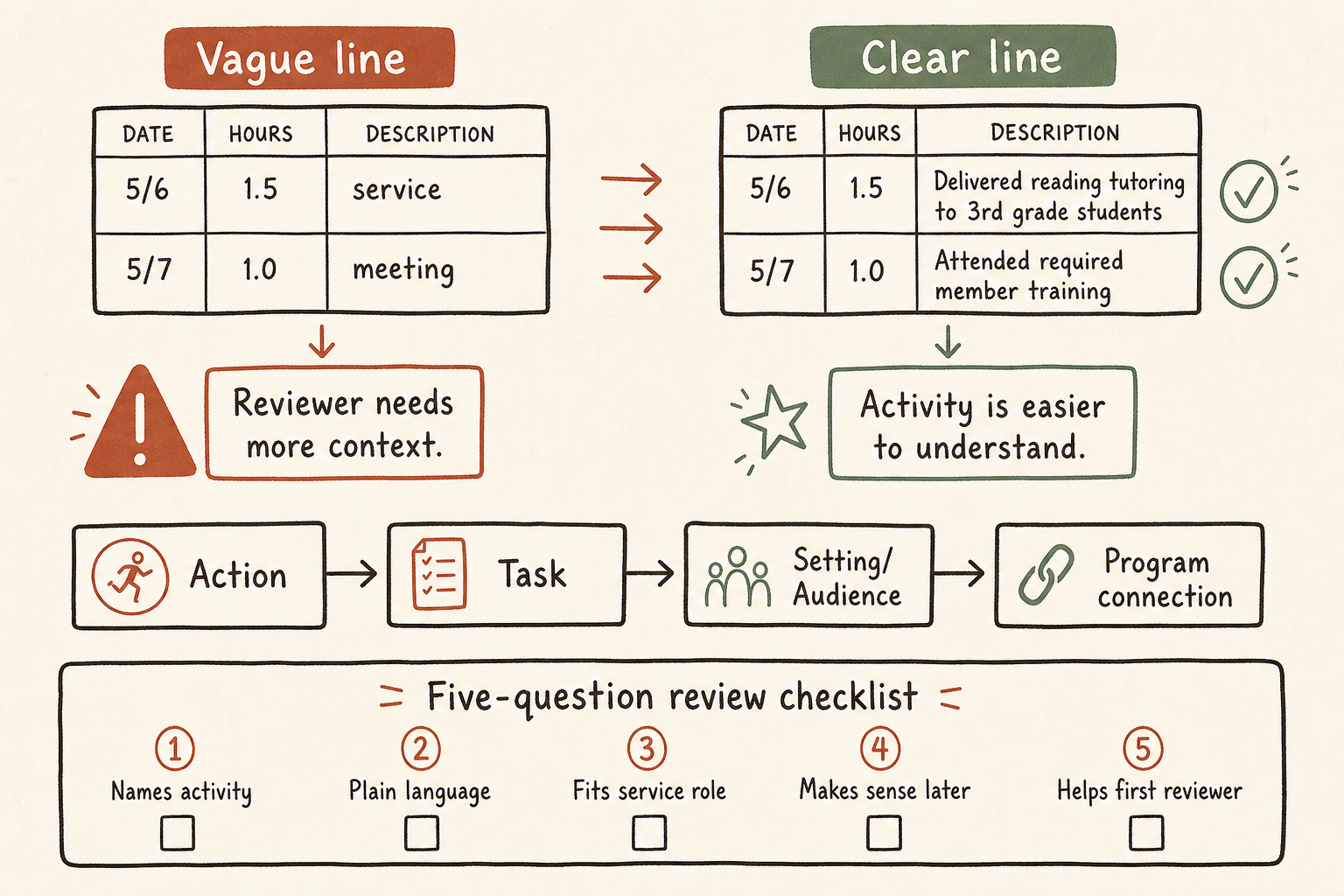
Compare these:
| Weak line | Stronger line |
|---|---|
| Service | Delivered reading tutoring to 3rd grade students during scheduled after-school service |
| Outreach | Prepared flyers and sign-in materials for Saturday volunteer project as assigned site service support |
| Training | Attended required member training on program procedures |
| Meeting | Met with site supervisor to plan next week's service activities |
Notice what changed.
Not the size of the line.
The certainty.
A reviewer should be able to understand the basic activity from the entry and, if needed, connect it to the rest of the file without a reconstruction project.
Build the proof before the signature
Waiting until approval day is too late.
By then, memory has already started to smear.
If you want cleaner timesheet lines, build the control upstream.
Step 1: Decide the approved activity labels
Make a short internal list of the activity categories your members or staff actually perform.
Use ordinary language, not umbrella phrases.
Good categories are specific enough that a person can tell what happened.
Poor categories invite filler.
For example, "direct service," "training," and "administrative" may be too broad for the description field by themselves. They can still be useful as internal categories, but the line entry usually needs more.
Step 2: Define the minimum description standard
Tell members and supervisors what a complete line includes.
A practical rule is: action + service task + setting or audience.
If your form has a separate field for date, hours, and location, don't make people repeat those items in the narrative. But do require enough text that the activity can be understood without a follow-up interview.
Step 3: Ban catch-all wording
You don't need a punitive tone.
You do need a list of phrases that won't be accepted alone.
Examples include "service," "AmeriCorps work," "program duties," "office work," and "miscellaneous tasks."
Those lines aren't useful because they don't explain the activity.
Step 4: Review before certification
Supervisor review shouldn't be a signature hunt.
It should be a line-by-line read for clarity under your award and internal procedures.
If the supervisor can't understand the activity without extra explanation, send it back while the week is still fresh.
Step 5: Match the line to the service description elsewhere
Your timesheet shouldn't live alone.
Where your program uses position descriptions, site agreements, schedules, training calendars, or service plans, the language should make sense across documents. Not word-for-word identical. Consistent.
That consistency helps show that the recorded hours fit the member's approved role and planned service.
What reviewers do when they can't tell
They look for support somewhere else.
A vague line on its own is a readability problem. A vague line that doesn't line up with other records creates more work.
If a timesheet says "training" but nothing in the training calendar, agenda, supervisor notes, or member file helps identify it, a reviewer may ask follow-up questions.
If a timesheet says "planning" all afternoon, but the member's normal service setting suggests direct service at that time, a reviewer may ask what changed.
If descriptions are vague, repetitive, or inconsistent with schedules or program documents, a reviewer may seek more supporting records.
None of that proves wrongdoing.
But it can turn an ordinary review into a long one.
The safest practice is ordinary and boring
Boring is good.
Boring records survive review.
As an internal-control practice, consider requiring entries to be completed promptly, described specifically, and kept consistent with the member's actual service activities. Consider requiring supervisors to read them before approval. Consider requiring corrections to be visible and explained under your recordkeeping rules, not hidden.
That's not glamorous.
It's what works.
A timesheet line doesn't need to sound official. It needs to make the activity understandable.
A practical screen for every line
Before a member or supervisor certifies a timesheet, ask these five questions:
- Does this line name the activity, not merely the day?
- Could a person outside the program understand what happened?
- Does the activity sound connected to the member's approved service or training?
- Would this line still make sense six months from now?
- If this were the first record a reviewer saw, would it help rather than confuse?
If the answer to any of those is no, consider revising the line or adding supporting documentation before approval.
That's not busywork.
It's risk reduction.
When your staff push back
They may say there's no time.
They're telling the truth.
People write vague timesheets because they're overloaded, because the form is cramped, because the examples were poor, or because nobody explained why one line matters so much.
Start there.
Show them that the goal isn't to catch them making mistakes. The goal is to protect valid service hours from avoidable doubt.
That shift matters.
People do better recordkeeping when they understand that documentation isn't suspicion. It's translation.
The work happened in real life. The timesheet helps turn it into something a reviewer can verify.
What to fix this week
Pick one current timesheet.
Read only the description lines.
Cover the member name and the supervisor signature if you need to. Ask yourself whether the activity is still clear.
Then mark each line with one of three labels:
- clear on its face,
- understandable only with context, or
- too vague to help on its own.
If many of your lines fall in the middle category, your system is leaning too hard on institutional memory.
Institutional memory is not enough.
A usable control is a short written rule, a small set of examples, and a supervisor who sends back weak lines before they become official records.
That is one practical internal-control response to the risk highlighted by Anti-Fraud Advisory Volume 5 on the AmeriCorps Office of Inspector General reports page.
Not by waiting for someone to accuse your program of misconduct.
By making sure the ordinary service record is readable enough that the wrong activity doesn't blend in with the right one.
And one more thing: verify your procedures against the current eCFR text for 45 CFR § 2520.65, review your own grant terms and conditions, and make sure your internal instructions match both. Practice varies, and your file needs to match the rules that govern your award now, not the training somebody remembers from three years ago.
Questions people actually ask
- Why does the timesheet description matter so much for prohibited activity questions?
- Because it's often one of the first records a reviewer reads when trying to understand what happened during charged or counted time. A specific entry can help the reviewer identify the activity and connect it to the member's role and other supporting records. A vague entry doesn't prove the hour was improper, but it can force reliance on other documents and create avoidable compliance risk.
- Do federal rules require a certain number of words on each timesheet line?
- [45 CFR § 2520.65](https://www.ecfr.gov/current/title-45/section-2520.65) does not prescribe a word count for a timesheet narrative. This article also refers readers to Anti-Fraud Advisory Volume 5 on the [AmeriCorps Office of Inspector General reports page](https://www.americorpsoig.gov/reports), but you should verify the advisory's current text yourself before relying on it for any documentation-specific conclusion. Award terms, commission instructions, and recipient procedures may still require particular fields, certifications, or supporting documentation.
- Can a detailed timesheet line make a prohibited activity allowable?
- No. Better wording doesn't change the underlying activity. If the activity was prohibited, a detailed entry won't fix that. What a detailed entry can do is make an allowable activity easier to recognize and easier to match to the rest of the file.
- What's the best way to train members to write better timesheet entries?
- Use a repeatable pattern such as action + service task + setting or audience. Give examples drawn from your program's actual work. Also give examples of phrases that are too vague to stand alone, like "service" or "office work." Then have supervisors review for clarity before certification under your award and internal procedures.
- What source should we use when updating our prohibited activity documentation procedures?
- Start with the current text of [45 CFR § 2520.65](https://www.ecfr.gov/current/title-45/section-2520.65) if your program is in AmeriCorps Subtitle C, because that's a principal regulatory source for member prohibited activities discussed here. Then review your grant terms and conditions, any commission or state instructions, and Anti-Fraud Advisory Volume 5 on the [AmeriCorps Office of Inspector General reports page](https://www.americorpsoig.gov/reports). Verify everything against the current eCFR text before you update forms or procedures, because practice and award requirements can vary.
- What if my grant comes through a state or territory service commission?
- Then your commission’s guidance comes first. Commissions can and do set requirements that are tighter than the federal floor, and they can also grant waivers. Before you act on anything you read here, check your commission’s current guidance, your award terms, and your written policies — and when they conflict with something in this post, follow your commission.
About the author
Gary Kosman is behind this experimental site. He writes the articles here. Reach him at gary@americalearns.net or 310-689-0542 x101.
Last reviewed August 6, 2026. Regulations change. Verify every citation against the current eCFR text and your own grant terms and conditions before you rely on it.
More on member timesheets
Member Timesheets/August 5, 2026
What OIG Notices First in Timekeeping Records
You may not be worried about a fraudster. You are worried about exhausted staff, late timesheets, and records that get cleaned up after the fact. That's exactly why this matters.
Member Timesheets/July 23, 2026
How to Fix an AmeriCorps Timesheet Without Making It Worse
Once a signed timesheet exists, it's part of your grant record. Here's how to correct it without hiding the history, and what to do when the problem is bigger than one line item.
Member Timesheets/July 21, 2026
What Actually Has to Be on an AmeriCorps Member Timesheet
For AmeriCorps State and National, a member timesheet is evidence about service hours, hour categories, and approvals under the rules that apply to your award. It isn't the same thing as payroll support for staff salaries.